AI's Uncanny India: A Glossy, Soulless Stereotype
As an editor in India, I see AI generating perfect but soulless images of our culture. It's a glossy stereotype that erases the real, diverse India.
This opinion piece was drafted with AI assistance under the editorial direction of Rohan Mehta and reviewed before publication. Views expressed are the author's own.
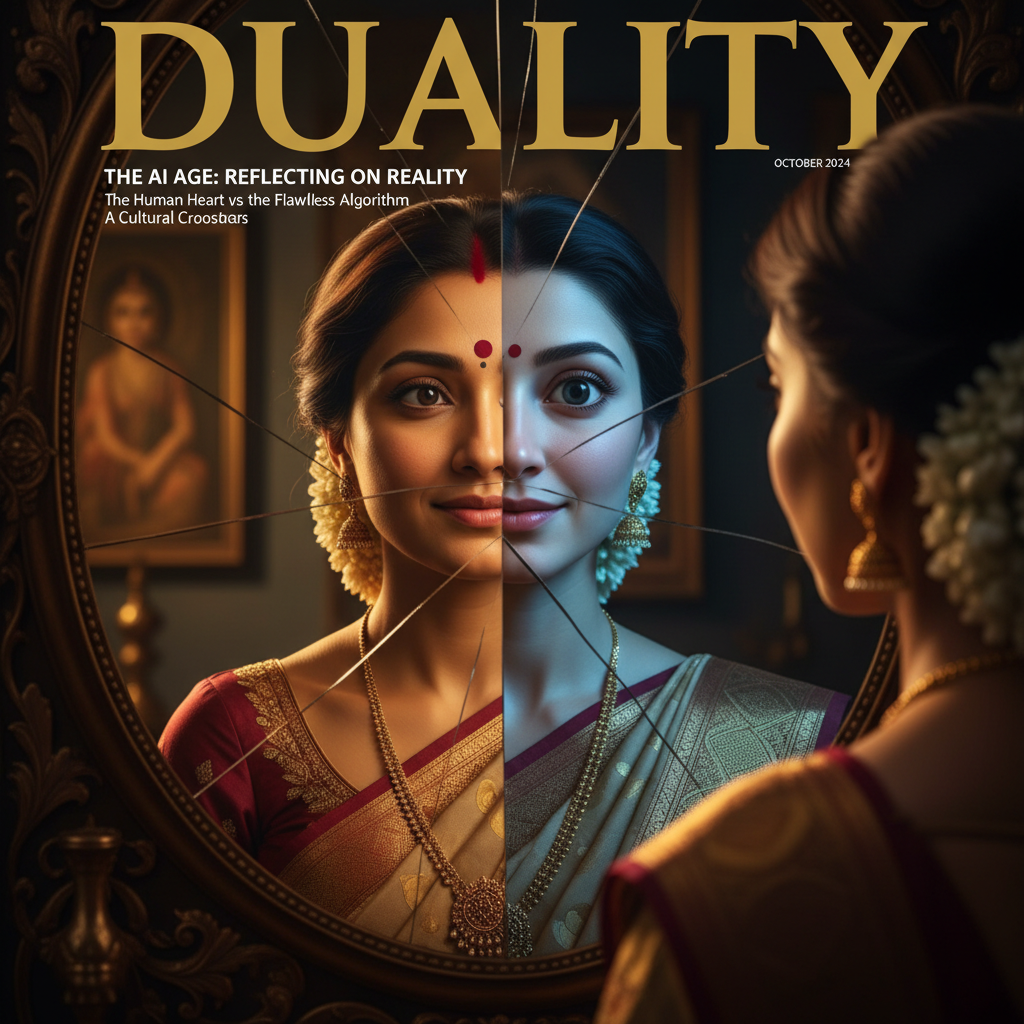
I saw it again last night, scrolling through my feed between dinner and a deadline. A hyper-realistic, impossibly beautiful image titled 'South Indian Bride'. She was stunning, of course. Draped in a Kanjeevaram sari that glowed with its own internal light, adorned with temple jewellery so intricate it must have been forged by gods, not goldsmiths. Her skin was flawless, her gaze serene, the backdrop a blur of marigolds and brass lamps. It was perfect. Technically, artistically perfect. And it felt completely, utterly wrong.
That’s the feeling I've been getting a lot lately as an editor at an AI-focused publication. A gentle but persistent unease. We’re living through an explosion of generative art, and my feeds are flooded with these spectacular, algorithm-dreamed visions of India. 'Holi, the festival of colours', 'A busy Mumbai market', 'A royal Rajasthani wedding'. They rack up thousands of likes. They're dazzling. And to me, they feel like postcards from a country that doesn't exist.
It's a strange new kind of uncanny valley. We usually talk about the uncanny valley in the context of robots or CGI characters that look almost, but not quite, human. The tiny imperfections make them creepy. What I'm seeing is a cultural uncanny valley. These AI images get the broad strokes of ‘Indianness’ right—the colours, the clothes, the motifs—but they miss the soul. They are so close to our reality that their deviations feel more jarring, more alienating than any cartoonish caricature ever could.
The AI-generated bride is a perfect example. She’s labelled 'South Indian', but which part? Is she a Tamil Iyer bride with her nine-yard *madisar*? A Malayali Christian bride in cream and gold? A Coorgi bride with her unique draped sari and veil? The AI doesn't know or care. It has amalgamated thousands of images tagged 'South Indian bride'—likely dominated by high-end commercial shoots and cinema—and created a statistical average. The result is a generic, pan-regional pastiche. She wears a sari with a design that might be from Tamil Nadu, a nose ring popular in Karnataka, and a hairstyle you’d see in a Telugu film. She is everyone and therefore no one.
I think of my own cousin’s wedding in Chennai a few years ago. I remember the specific shade of green of her sari, chosen after weeks of deliberation. I remember the delightful chaos of the *kasi yathirai* ritual, the slightly-too-loud nadaswaram music, the way my aunt furtively dabbed sweat from the groom’s brow. I remember the candid photographer capturing a peel of laughter that was anything but serene. That day was messy, imperfect, and pulsatingly alive. It was authentic. The AI’s perfection, by contrast, is sterile. It’s a wedding with all the life airbrushed out.
This algorithmic flattening extends to everything. Ask an AI to generate an image of 'Diwali', and you'll get a scene of almost clinical cleanliness. A beautiful family in perfectly coordinated, wrinkle-free ethnic wear will be smiling serenely, holding identical, smokeless diyas. It's a page from a high-end catalogue. My Diwalis were never like that. They were about the thrill of lighting the loud, smoky *lakshmi* firecrackers, the one stubborn diya that kept going out, the smell of sugar, ghee, and gunpowder hanging in the air. They were about wearing last year's kurta because the new one wasn't ready. Real festivals are a beautiful mess. The AI gives us a sanitized fantasy.
Even a simple prompt like 'Indian street food' results in a sanitized vision. You'll get neatly arranged pani puris, glistening and perfect, or a cart that looks like it was designed by a boutique branding agency. It misses the glorious, chaotic reality: the vendor's lightning-fast hands, the thumb dipped defiantly into the spicy water, the crumpled newspaper used as a plate, the symphony of sounds and smells at a real chaat stall in Old Delhi or on Mumbai's Juhu beach. The AI renders the aesthetic but filters out the experience.
The 'why' behind this is not malicious. It's a problem of data. AI models like Midjourney or Stable Diffusion are trained on colossal datasets of images scraped from the internet. So, what images of 'Indian wedding' are most prevalent online? Not my cousin's wedding album. Not the grainy photos from a village photographer in rural Bengal. The dominant images are from Bollywood, high-fashion magazines, commercial stock photography, and the highly curated feeds of wealthy influencers. This content is already an idealized, often North-Indian-centric, upper-class version of our culture, packaged for global consumption.
The algorithm learns from this skewed diet of images and regurgitates it, amplifying the stereotype. It learns that 'Indian festival' means bright colours, perfect smiles, and expensive clothes. It learns that 'Indian woman' means a specific phenotype—often fair-skinned and with features that align with a globalized standard of beauty. It has no access to the rich, textured, and incredibly diverse reality of 1.4 billion people. It hasn’t seen the fisherman’s festival in a Koli village in Mumbai or the stark, minimalist beauty of a Ladakhi wedding.
And this matters. It matters because it contributes to a digital monoculture. It flattens the breathtaking diversity of India—our hundreds of languages, cuisines, textiles, and traditions—into a single, glossy, easily digestible brand. It's a subtle form of erasure. When this synthetic, stereotyped 'Indianness' becomes the dominant visual representation online, it risks becoming the truth for a global audience, and even for a younger generation of Indians who live so much of their lives online.
This isn't some Luddite screed against artificial intelligence. I'm an editor at an AI publication; I see and use these incredible tools every day. They have the potential to democratize creativity, to help us visualize new worlds. The problem isn't the brush; it's the palette it's been given to paint with. The models can only create based on what they've been shown. The bias isn't in the code; it's in our collective digital footprint.
Perhaps this uncanny valley is a necessary, if uncomfortable, phase. It serves as a mirror, showing us the biases in the data we've fed the machine. It highlights what we, as a global community, have chosen to photograph, upload, and label. It reveals the gaps in our digital archive.
So what do we do? We have to be more critical consumers of this content, to recognize the artificial gloss for what it is. For creators, designers, and photographers in India, it might be a call to action. We need to consciously document and share the specific, the local, the wonderfully imperfect parts of our culture. We need to upload the photos of the lesser-known festivals, the regional wedding rituals, the everyday life that happens away from the curated glare of a professional photo shoot. We need to feed the machine a better, more honest diet.
Until then, I'll keep looking for authenticity. The most profound images of India for me will never be the ones generated by a prompt. They will be the ones that capture a truth. An old photograph of my grandmother, her hands—wrinkled and real—carefully lighting a single oil lamp, its flickering light casting long shadows. There is more story, more soul, and more genuine 'Indianness' in that one imperfect frame than in a million flawless pixels generated by an algorithm. That's a reality no AI can render. Not yet.
Why it matters
- 01AI art often presents a stereotyped, culturally flattened version of 'Indianness' due to biased training data.
- 02This glossy, perfect aesthetic creates a 'cultural uncanny valley,' feeling alien and soulless despite its technical skill.
- 03We must critically engage with AI outputs and actively work to digitize and represent our diverse, authentic realities.