I Gave My Mumbai Apartment an AI Makeover. Here’s What Happened.
I used an AI interior design tool to remodel my small Mumbai flat on a budget. A personal story of practical inspiration, hilarious results, and creative breakthroughs.
This opinion piece was drafted with AI assistance under the editorial direction of Rohan Mehta and reviewed before publication. Views expressed are the author's own.
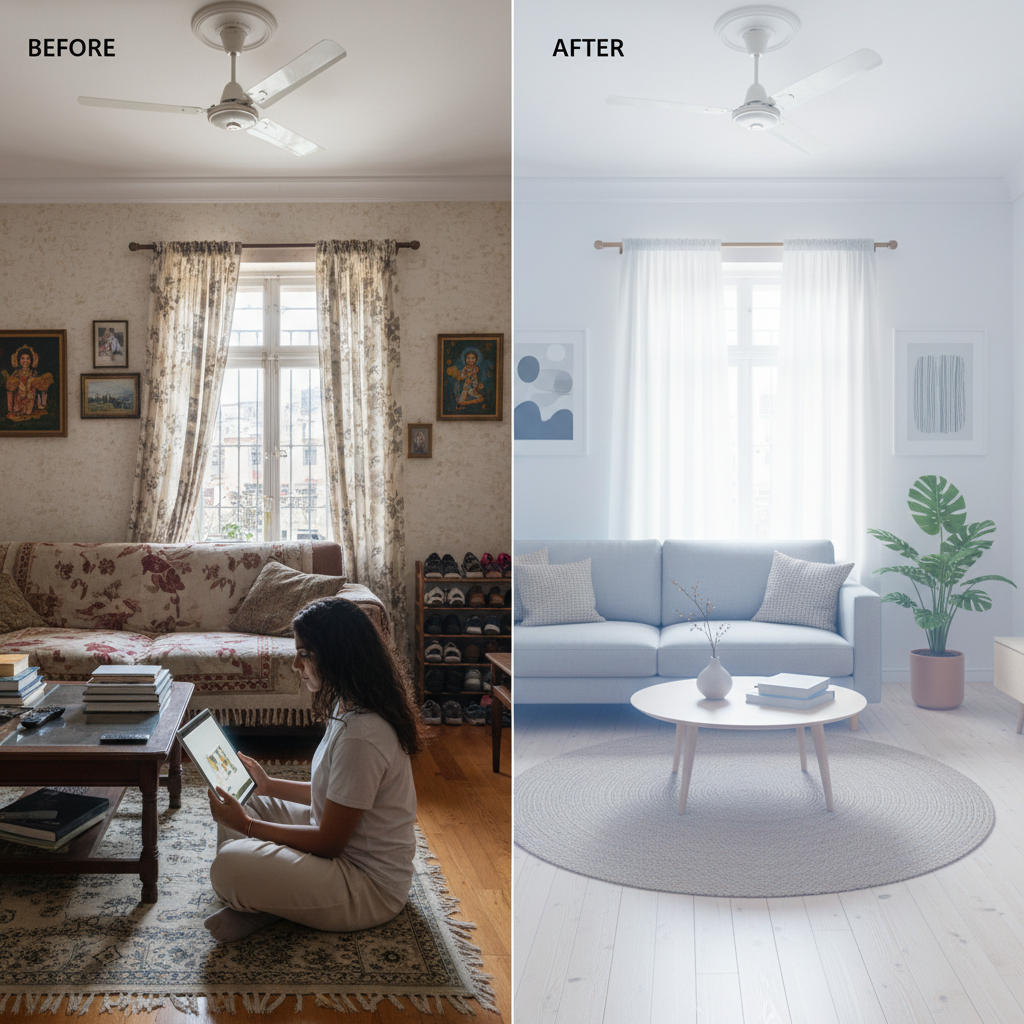
My living room had reached a state of comfortable, chaotic paralysis. You know the look. It’s the one where furniture, acquired over a decade from various sources and stages of life, has settled into a configuration dictated more by inertia than intention. My sofa, a hand-me-down from a cousin who moved to Dubai, was a benevolent giant that ate up half the floor. The bookshelf, my first “adult” purchase, was overflowing. The walls were a shade of beige I like to call ‘Landlord’s Choice.’ This was my 700-square-foot slice of Bandra, Mumbai, and while I loved it, it felt tired.
Being a tech editor at Pulse AI, my first instinct wasn't to call an interior designer. The thought alone conjured images of daunting consultations and budgets that would make my eyes water. No, my instinct was to see if an algorithm could solve my problem. The internet was buzzing with a new wave of accessible AI tools, like Interior AI and Reimagine Home, that promised to be my personal digital decorator. For a nominal fee, or sometimes for free, they offered to transform a simple photo of my drab room into a high-design fantasy. The proposition was too tempting to ignore. Could an AI truly understand the soul, and more importantly, the spatial constraints, of a Mumbai apartment?
I picked a tool, uploaded a hastily snapped, poorly lit photo of my living room, and held my breath. The first step was to choose a style. The menu was a smorgasbord of interior design terminology I’d only ever seen in glossy magazines. ‘Scandinavian Minimalist,’ ‘Japanese Zen,’ ‘Industrial Loft,’ ‘Bohemian,’ ‘Maximalist.’ It felt like ordering a fancy coffee with no idea what a 'macchiato' really is. I decided to dive in at the deep end. Let’s start with ‘Scandinavian Minimalist.’
The result that rendered a few seconds later was breathtaking. My cluttered room was gone. In its place was a vision of clean lines, light wood, and serene simplicity. The AI had digitally thrown out my bulky sofa and replaced it with a sleek, grey three-seater on delicate wooden legs. My overflowing bookshelf was now a set of ethereal floating shelves. A single, beautiful fiddle-leaf fig stood in the corner where a pile of unread magazines used to live. It was stunning. It was also utterly impossible.
This is the first lesson you learn when you ask an AI to redesign your home: the algorithm doesn’t know about your load-bearing walls, your landlord’s strict ‘no-drilling’ policy, or the fact that getting a new sofa up your narrow building staircase is a feat of engineering that would challenge the builders of the pyramids. The AI’s vision was beautiful, but it was a vision for a home in a void, not a home squished between the Sharmas and the Patels in a 40-year-old building with questionable plumbing.
Feeling emboldened, I tried ‘Maximalist.’ The result was hilarious. My living room was suddenly reimagined as a British colonial hunting lodge on acid. Dark wood paneling, a chesterfield sofa in clashing floral velvet, taxidermy (I think I saw a deer head), and a Persian rug so large it seemed to be crawling up the walls. It was a room that would feel cramped in a palace, let alone my apartment. My brain couldn’t compute the sheer density of *stuff* it had crammed into the image. It was a visual representation of what happens when you tell a person who has had too much sugar to “go nuts.”
After cycling through a few more styles—‘Japanese Zen’ which looked lovely but would require me to become a person who meditates and owns only three items of clothing, and ‘Bohemian’ which featured a macramé swing I would absolutely knock myself unconscious on—I started to see the real value of the tool. It wasn't a blueprint; it was a kaleidoscope.
It was a way to shake my brain out of its creative rut. I would never have considered the color palette from the ‘Scandinavian’ design, but seeing that combination of soft grey, light wood, and a pop of deep green from the plant made me look at my own walls differently. The beige suddenly felt oppressive. The AI’s maximalist fever dream, as absurd as it was, had a bold, patterned rug that I found myself strangely drawn to. It made me realize my floor was a blank canvas I had completely ignored.
The real magic happened when I stopped treating the AI as a designer and started treating it as a brainstorming partner. A very eccentric, sometimes clueless partner, but a creative one nonetheless. I stopped looking at the images as a whole and started cherry-picking elements. That sleek sofa was a no-go, but the AI’s suggestion to place it against a different wall was a revelation. I tried it with my existing sofa, and with a bit of a shove and a grunt, the room suddenly felt more open.
Inspired, I went on a real-world mission, armed not with a contractor’s brief, but with a mood board of AI-generated ideas. The ‘Scandinavian’ image convinced me to paint. I went to the local hardware store and, after an hour of agonizing over paint chips, picked a shade of light, airy grey instead of the default beige. It cost less than a fancy dinner for two and instantly made the room feel twice as large.
I couldn’t afford a designer rug, but the memory of the ‘Maximalist’ image sent me to the local markets in Dadar. There, amidst piles of textiles and the calls of vendors, I found a vibrant, block-printed cotton dhurrie. It wasn’t an antique Persian rug, but it had a similar spirit, and it brought life and personality to my floor for a fraction of the cost.
The AI had suggested a gallery wall of abstract prints. I made my own version with family photos, postcards, and a few prints I bought online, arranged in a similar cluster. It didn't have the same curated perfection, but it had my story. The AI couldn't have come up with that. It doesn’t have my memories of a trip to Rajasthan or a silly photo of my parents from the 70s.
This, I think, is the perfect metaphor for our relationship with AI today. It’s not a replacement for human experience or expertise. An AI couldn’t navigate the labyrinthine lanes of a Mumbai furniture market, bargain with a seller, or understand the sentimental value of a chipped teacup. A professional human designer would have asked me about my life, my habits, my aspirations—and then translated that into a functional, beautiful space. The AI asked for a photo and a keyword.
But what it gave me was priceless in its own way: confidence. It democratized the first, most intimidating step of any creative project—the blank page. It gave me permission to play, to visualize possibilities that were out of my imaginative reach, all from the comfort of my clunky, beloved sofa. It was a low-stakes sandbox for my home, allowing me to see a dozen futures for my living room before committing a single rupee.
In the end, my apartment didn’t get an AI makeover. It got a me-makeover, with a little help from my digital muse. The room is still small. The staircase is still narrow. But it’s no longer paralyzed by inertia. The walls are a calming grey, the floor has a dash of personality, and the furniture is arranged in a way that breathes. It feels less like a space I simply exist in and more like a space that reflects me. And I have a surprisingly creative algorithm, and its wild, wonderful, and utterly ridiculous ideas, to thank for it.
Why it matters
- 01AI design tools are excellent idea generators and creative prompts, not literal blueprints for your home.
- 02The real value comes from blending the AI's ambitious suggestions with your real-world budget, space, and personal style.
- 03For those without a big budget, these tools democratize design inspiration, breaking the initial creative block for free or cheap.