India's AI Divide: Beyond the Bubble of Bangalore and the Valley
As an AI editor, I see a chasm between the global hype and the reality for my family in Lucknow. This is why bridging the AI participation gap matters more for India.
This opinion piece was drafted with AI assistance under the editorial direction of Rohan Mehta and reviewed before publication. Views expressed are the author's own.
Last week, I was on a video call with my family in Lucknow. My aunt, beaming with pride, showed me a new photograph of herself. She looked radiant, at least ten years younger. 'Dekho, Rohan,' she said, 'this phone has that new AI thing. It makes old photos look new!' To her, and to most of my family, 'AI' is a magical beautification filter, a clever camera trick, or the voice that answers when you ask your phone for the weather. It’s a fun, trivial novelty. I smiled and told her she looked great, but a familiar sense of dissonance washed over me.
Just an hour before that call, I was neck-deep in editing a piece for Pulse AI about the catastrophic risks of unaligned artificial superintelligence. The author was debating the finer points of recursive self-improvement in large language models and the probability of an intelligence explosion wiping out humanity. My daily lexicon is filled with terms like 'inference latency,' 'parameter counts,' 'foundation models,' and 'existential risk.' I live and breathe a conversation that orbits around the creation of god-like digital minds.
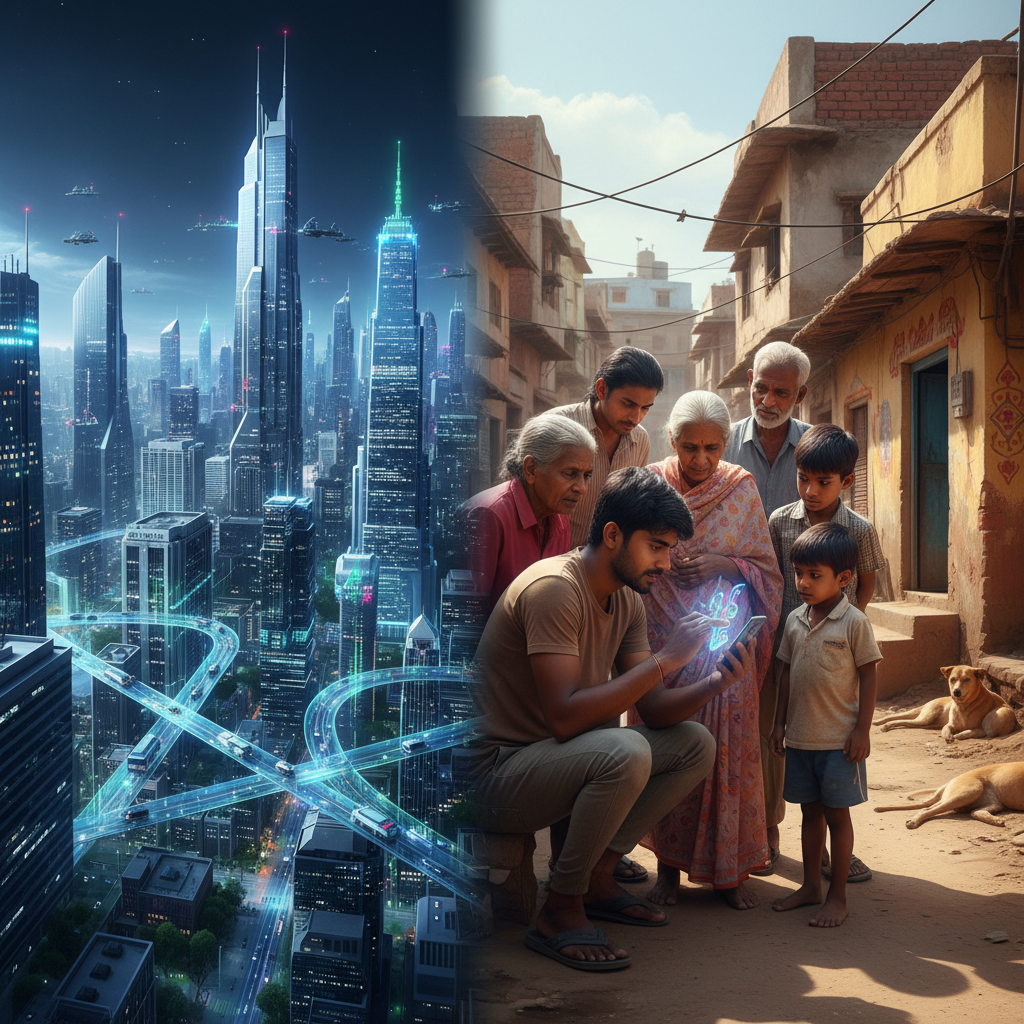
This is the great AI divide. It isn't a geographical line between East and West, or even a simple digital divide between those with and without internet access. It is a profound chasm in perspective and participation that exists between the hyper-ventilating tech bubbles of Bangalore, Hyderabad, and Silicon Valley, and the rest of the world—the world of my aunt in Lucknow, of the shopkeeper in Jaipur, the farmer in Punjab.
In my professional circle, we are obsessed with the frontier. We track the race between OpenAI, Google, and Anthropic. We write endlessly about India’s ambition to build its own sovereign AI models to compete on the global stage. We celebrate unicorn valuations and debate whether a national AI mission should prioritise massive compute clusters or algorithmic breakthroughs. The narrative is one of scale, of power, of prestige. We are building digital titans.
But when I step out of this echo chamber, I find that the titans are invisible. The revolution, for most people, is not happening. AI, in its hyped-up form, is largely irrelevant to their daily lives. The AI that does touch them is subtle, often unnoticed. It's the fraud detection that flags a suspicious UPI transaction, the algorithm that curates a feed on Instagram, or the navigation system that reroutes them around a traffic jam. These are useful, certainly, but they are services consumed, not tools wielded. The user is a passive recipient, not an active participant.
This leads to what I believe is the most critical challenge for India today: the 'participation gap.' We are so focused on the grand, top-down project of building a world-class AI model that we are failing to address the much more urgent, bottom-up need for democratising AI at the grassroots level. The glory of creating the next ChatGPT is seductive, but does it empower the 60 million micro, small, and medium enterprises that form the backbone of our economy? Does it help a weaver in Benaras get better prices for her sarees or a street food vendor in Delhi manage his inventory?
I argue that it does not. A single, monolithic AI, no matter how powerful, is a solution looking for a problem. The real magic, the real revolution for a country as diverse and complex as India, lies in the opposite direction. It lies in enabling millions of Indians to solve their own specific, local, and immediate problems using simple, accessible AI tools. Think of it less as building one giant dam and more as giving millions of people the tools to dig their own wells.
What would this look like in practice? Imagine a small-scale spice merchant in Kerala using a simple AI-powered app on his phone. He could upload a photo of his cardamom, and the AI could instantly grade its quality, suggest a fair market price based on real-time data, and even translate his product description into multiple languages to reach buyers in Europe or the Middle East. This isn’t science fiction; the technology for this is readily available. The gap is in access, interface, and application.
Imagine a primary school teacher in a village in Bihar. She's overwhelmed, handling a classroom of fifty students with varying learning levels. What if she had an AI tool that could help her create personalised lesson plans and worksheets? An app that could listen to a child read and provide gentle, real-time feedback on their pronunciation. This wouldn't replace her; it would augment her, freeing her up to give individual attention where it's needed most.
This is the kind of AI revolution India should be aiming for. It's less glamorous than announcing a hundred-billion-parameter model, but its cumulative impact would be infinitely greater. It reflects the spirit of UPI, which didn't create a new super-bank but a decentralised platform that empowered everyone, from a street chai-wallah to a large corporation, to participate in the digital economy. It was a victory for interoperability and accessibility, not centralisation.
Our current path risks creating a new form of digital feudalism. A small, English-speaking, technically proficient elite in a few metropolitan cities will build and control the AI platforms, while the vast majority of the country remains passive consumers, their data harvested and their choices subtly manipulated by algorithms they don't understand or control. The wealth and power generated by AI will concentrate at the top, widening the already stark inequalities in our society.
India's unique strength is not its ability to amass capital or build massive data centers to rival China or the US. Our strength is our people: our incredible diversity, our entrepreneurial spirit, and our famous capacity for 'jugaad'—frugal innovation. Our national AI strategy must be built on this foundation. It should focus on creating open-source tools, promoting education in local languages, and fostering an ecosystem of small, nimble companies that build AI solutions for specific Indian contexts.
As an editor at a global publication, I feel this tension daily. I am part of the bubble, reporting on a future that feels abstract and distant from the present reality of the people I come from. My work feels important, yet incomplete. It's not enough to simply document the frontier of AI research. The real responsibility, for journalists, policymakers, and technologists alike, is to act as a bridge across the participation gap.
The next time I speak to my aunt, I hope our conversation about AI is different. I don’t want to just try and fail to explain what a large language model is. I hope to show her a simple tool that helps her manage her household budget, or one that connects her with other gardening enthusiasts in Lucknow to trade tips on growing organic vegetables. I want 'AI' to stop being a cosmetic filter on her phone and become a real tool in her hands.
That, to me, would be real progress. It would be a sign that the AI revolution isn't just happening in the boardrooms of Bangalore and Silicon Valley, but in the homes and small businesses of Lucknow and a million other places like it. That is a future worth building, and a story I would be truly proud to write.
Why it matters
- 01The true AI divide is not between nations, but between a small tech elite and the vast majority of the population.
- 02For India, democratizing access to simple AI tools for everyday problems is more critical than building one single, large-scale model.
- 03Bridging AI's 'participation gap' is the only way to unlock widespread economic and social progress for the entire country.