My Family's WhatsApp Group Is AI-Translated—And It's Magical and Messy
An AI translation tool transformed my family's WhatsApp chat, bridging generations. But while it fosters connection, it also reveals what's lost in the algorithm.
This opinion piece was drafted with AI assistance under the editorial direction of Rohan Mehta and reviewed before publication. Views expressed are the author's own.
For years, my family’s WhatsApp group was a museum of missed connections. It was a digital space where three generations, scattered across India and the globe, attempted to communicate through a thick fog of language. On one side, you had my cousins and me, tapping away in brisk, idiomatic English. On the other, my parents, aunts, and uncles, typing painstakingly in Hindi, Marathi, or Gujarati. And then there was my grandmother, my Aji, whose contributions were mostly a stream of 'Good Morning' images featuring smiling babies or blooming roses, punctuated by the occasional, inscrutable forwarded video.
Our conversations were stilted. We’d share a photo from a work trip or a Sunday brunch. Back would come a string of thumbs-up emojis and a one-word reply in English, like “Nice” or “Super.” I knew they had more to say. I knew my mother, my Aai, wanted to ask if I’d eaten, if I was sleeping enough, if the weather in Bengaluru was making my old cough act up. But typing all that out in English was a chore for her. And for me, trying to decipher a long message in Marathi script on my phone was an equal challenge. I’d have to copy it, paste it into a separate app, get a clunky translation, and then formulate a reply. The entire process was so disjointed that, more often than not, we just didn’t bother. The emotional core of our family life was happening elsewhere, on phone calls, during visits — never in this supposedly convenient chat group.
Then, one Tuesday, everything changed. My tech-savvy cousin in New Jersey sent a message to the group: “Hey everyone, I just enabled the new real-time translation feature. Just tap and hold any message you don’t understand.” A few skeptical emojis followed. Then, my uncle in Surat, a man of few English words but many Gujarati opinions, wrote a long paragraph about the local mango harvest. I tapped. In a fraction of a second, his Gujarati script dissolved and was replaced by a perfectly readable, if slightly formal, English sentence about the nuances of the Kesar versus the Alphonso.
It felt like magic. A switch had been flipped. Suddenly, the fog began to lift.
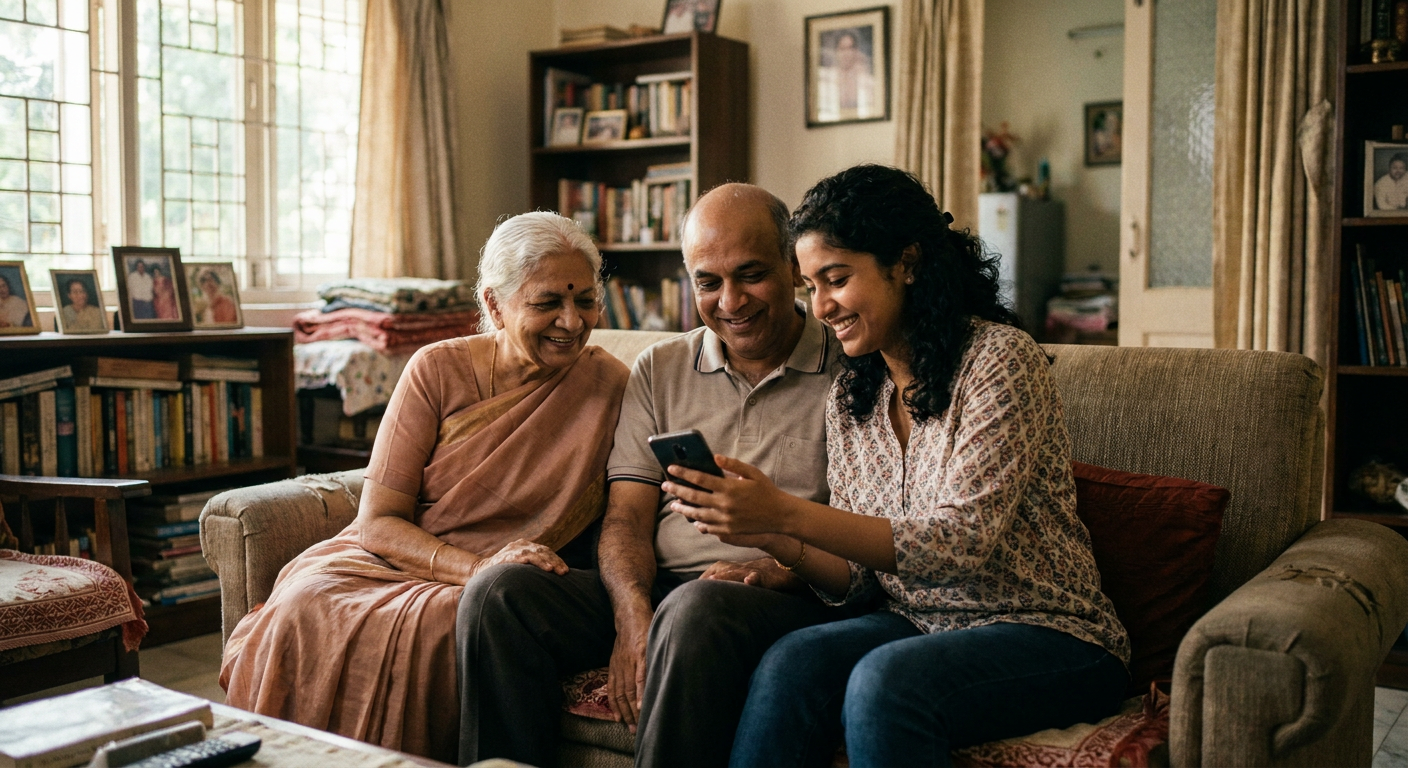
The days that followed were a revelation. My Aji, who I thought only communicated in floral greetings, began to share her day. I learned that she’d started a new knitting pattern, that the neighbors’ cat had finally had its kittens, that the bhindi she bought from the market was not as fresh as she’d hoped. These were small, everyday things, the very fabric of life that we had been missing. It was like discovering a whole new dimension to a person I’d known my entire life. Her messages, translated from Marathi, were a window into her quiet, contemplative world in Pune.
My Aai was unleashed. No longer confined to “Good,” she now sent detailed reviews of the new serial she was watching. She shared recipes, not just the names of ingredients, but the little tips and tricks that never make it into cookbooks. “Toast the besan a little longer than you think,” she wrote in Hindi, and the AI delivered it to my screen flawlessly. “It should smell like rainy-day earth.” How beautiful is that? I could finally share details about my work projects, and my father, a retired engineer, could read them in Hindi and ask clarifying questions. The group transformed from a static photo album into a living, breathing conversation. It felt like we were all sitting in the same room again.
But then the weirdness began to creep in. The algorithm, for all its power, is a literalist. It has no sense of humor, no grasp of the playful, often illogical nature of human speech. One afternoon, my uncle was teasing me about a new haircut. In Hindi, he wrote that he was “pulling my leg.” The translation that appeared on my phone was, “I am currently engaged in the act of dragging your lower limb.” The group descended into a storm of laughing emojis, followed by a series of confusing messages as he tried to explain the idiom, with the AI dutifully, and terribly, translating his every attempt.
Food, a cornerstone of Indian family life, became a recurring source of hilarious failure. My aunt’s mention of “ghee” was sometimes translated as “clarified butter,” which is technically correct but emotionally sterile. Nobody has ever lovingly drizzled “clarified butter” over a hot chapati. A beloved snack, “chakli,” was rendered as “spiral savory dough-stick.” It sounds less like a nostalgic treat and more like something you’d find in a hardware store. The AI could translate the words, but it couldn't translate the culture, the memory, the entire universe of meaning packed into a single, simple term.
And that’s where the wonderful starts to curdle into something more unsettling. Beyond the funny mistranslations lies a more subtle, profound loss. The AI flattens language. It strips away the poetry, the cadence, the very soul of how we speak. When my mother asks in Marathi, “Jevlas ka, बाळा?” the word “बाळा” (baala) is not just “baby” or “child.” It’s a universe of affection, history, and tenderness. The AI translates the whole phrase to a flat, functional “Did you have your meal?” I get the information, but I lose the love. The warmth is gone.
I’m an editor at an AI publication. I spend my days thinking and writing about the implications of this technology. I am, by nature and profession, an optimist. I see the incredible potential of tools like these to connect humanity. And yet, I see what’s happening in my own family, and I have to wonder. Are we really getting closer, or are we just consuming a sanitized, algorithmically-approved version of each other? The AI provides a bridge, but it’s a smooth, sterile, featureless bridge. The old way—the messy process of asking my mom to translate, of her explaining a phrase, of me trying to sound out a word in a language I barely speak—was inefficient, but it was also a form of intimacy. That struggle was its own kind of connection.
By outsourcing this labor to an algorithm, we gain efficiency but risk losing texture. We believe we are understanding more because we are reading more words, but are we feeling less? The unique musicality of Gujarati, the earthy wisdom of a Hindi proverb, the untranslatable affection in a Marathi term of endearment—all of it gets churned through the great global processor and comes out the other side as standard, functional English. Something is gained, but something is undeniably lost.
So, what do we do? We’re not going to turn the feature off. The joy of finally understanding my Aji’s daily updates is too precious to give up. The ability to share a complex thought with my father without a language barrier is a gift. The tool has, on balance, been a force for good. It has reopened doors that were slowly closing between the generations.
But it has also served as a powerful reminder of what lies beyond the translation. It has made me acutely aware of the nuances I’m missing, the cultural richness encoded in the languages of my own family. And in a strange twist, this piece of artificial intelligence is pushing me toward a more authentic connection. I find myself calling my Aji more often, not just to text, but to hear her voice. I ask my mother to explain the original Hindi phrase behind a clunky translation. The AI gave me a map, but it’s making me want to travel the territory for myself. It helps me understand what my family is saying, but it also inspires me to learn how they are truly saying it, in all its messy, beautiful, untranslatable glory.
Why it matters
- 01AI translation can foster newfound intimacy in families by breaking down generational language barriers.
- 02While functional, algorithmic translation often misses cultural nuance, humor, and the emotional subtext of language.
- 03The imperfections of AI tools can ironically encourage us to seek more authentic, direct forms of communication.