My Soulless AI Co-author Is Making Me a More Human Writer
I thought using AI for writing was a creative shortcut. Instead, its generic prose has become the catalyst for me to find a more distinct and emotional human voice.
This opinion piece was drafted with AI assistance under the editorial direction of Rohan Mehta and reviewed before publication. Views expressed are the author's own.
I have a confession to make, one that feels particularly awkward given my role as an editor at an AI-focused publication. For the longest time, the idea of using an AI to write felt like a betrayal. Not just to my craft, but to myself. Writing, for me, has always been a deeply personal act of translation—taking the chaotic jumble of thoughts, memories, and emotions in my head and wrestling them into sentences that might, if I’m lucky, resonate with another human being.
The thought of outsourcing any part of that process to a machine felt like hiring a stranger to write a love letter on my behalf. Sure, the grammar would be perfect, the structure sound. But the soul? The specific, messy, beautiful humanity of it all? That would be gone. It felt like cheating.
My first few experiments only confirmed my fears. I was working on a piece about the changing nature of urban spaces in India, a topic close to my heart. I grew up in Mumbai, a city that redraws itself every single day. I prompted the AI, asking it to write an introduction about the 'palpable energy of Indian cities'. What I got back was… fine. It was a well-composed paragraph about bustling markets, diverse populations, and the juxtaposition of old and new. It was also completely, utterly dead. It read like a sanitized travel brochure, stripped of the specific smells, the particular quality of the light, the sheer, maddening noise of it all. It had no soul.
This, I thought, was the danger. This bland, probabilistic sludge was the future of content. It was writing that aspired to nothing more than adequacy. It was a shortcut, a crutch. And for a few weeks, I used it that way. I’d use it to generate outlines or rough paragraphs when I was feeling stuck. Each time, I felt a pang of guilt, a sense that I was slowly eroding the very skills that defined me as a writer. I was letting a machine do the foundational thinking, and my own creative muscles felt like they were beginning to atrophy.
I was becoming an editor of mediocrity, polishing the machine’s generic sentences instead of creating my own. The AI’s work was a comfortable, lukewarm bath, and it was tempting to just sink into it, to accept ‘good enough’ and move on. The efficiency was seductive. But the result was a voice that wasn't mine. It was an echo of a thousand other articles, a statistical average of everything that had ever been written on the topic. It was nobody.
The turning point came, as these things often do, with a deadline. I was hopelessly blocked on a personal essay about my relationship with my father and the game of cricket. It’s a well-worn theme in the subcontinent, the thread connecting generations. I asked the AI to draft a section about the feeling of watching a match with him as a child. The result was a clinical description of the sport, sprinkled with clichés about 'father-son bonding' and 'shared passion'. It mentioned the 'roar of the crowd' and the 'hush of anticipation'.
Reading it, I didn't feel disappointment. I felt a surge of pure, unadulterated rage. This sterile paragraph wasn't my memory. My memory was the scratchy wool of the old sofa, the specific taste of the lukewarm Limca he’d let me sip from his glass, the way my father would lean forward, elbows on his knees, for every single ball, his body a tense line of hope. It was the smell of samosas frying in the kitchen during the innings break. It was his specific, booming laugh when a wicket fell. The AI saw a sporting event; I remembered a universe contained within our living room.
In that moment of furious rejection, everything shifted. I realized I had been using the tool all wrong. The AI’s soulless prose wasn’t a crutch to lean on; it was a wall to push against. Its blandness wasn't a flaw to be corrected, but a feature to be exploited. It was a perfect, pristine negative space that showed me exactly where the humanity was missing. It gave me a bland, grey canvas and, by contrast, made me desperate to splash it with the most vivid, personal colours I could find.
I deleted the AI’s entire draft and started again, not from a blank page, but from a place of fiery opposition to what the machine had produced. The AI’s generic description of a 'crowd's roar' forced me to remember the specific sound of our neighbours shouting from their balcony. Its cliché about 'bonding' forced me to articulate the silent understanding that passed between my father and me, a language spoken only through grunts of approval and sighs of frustration.
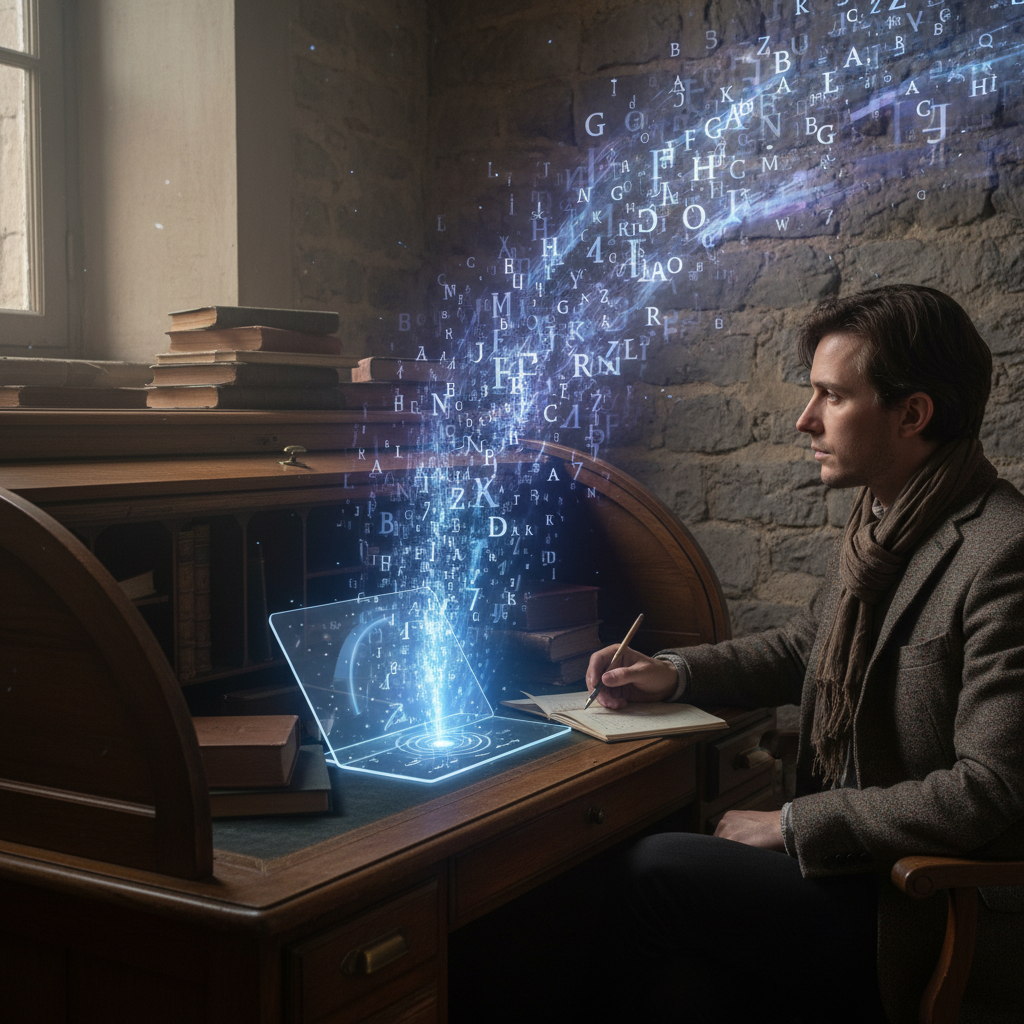
This has become my new process. My AI is not my co-author; it is my sparring partner. It is my soulless muse. I now use it to deliberately create the thing I want to rebel against. I ask it to draft a section, and then I treat its output as a challenge. Where it is general, I must be specific. Where it is dispassionate, I must be emotional. Where it is objective, I must provide a point of view, a lived experience.
When writing about technology’s impact on global supply chains, I’ll let it draft the technical explanation. This frees me from the drudgery of summarizing reports and allows me to spend my energy on the human story—interviewing the small business owner in Tiruppur whose life was changed by a new logistics platform, or the factory worker in Bangladesh whose job is suddenly precarious. The AI handles the 'what'; I get to focus on the 'so what'. It assembles the skeleton, and my job is to give it a heart, lungs, and a nervous system.
I’ve come to believe the collective anxiety about AI in creative fields is slightly misplaced. The fear isn't that AI will one day write a masterpiece that will make us all redundant. I don't see that happening. A large language model is, by its nature, a consensus machine. It is designed to find the most probable, the most average, path. Great art is almost never about the probable path. It’s about the surprising turn, the specific aberration, the voice that is anything but average.
The real danger is not that AI will become a better writer than us, but that we will become lazier writers because of it. The danger is that we will accept its blandness, that we will settle for the soulless and efficient over the difficult and human. But the opportunity is the inverse of that danger. The opportunity is to use AI as a whetstone. By showing us a perfect picture of the generic, it can sharpen our own desire for the specific, the personal, the strange. It reminds us what we, as humans, bring to the table: memory, point of view, scars, joy, a unique history that shapes every word we choose.
My AI co-author is still soulless. It has no memories of a rainy Mumbai afternoon, no understanding of the quiet bond forged over a cricket match. It cannot feel. And for that, I am profoundly grateful. Its emptiness has become the negative space around which I sculpt my own humanity. It’s making me a slower, more deliberate, and more thoughtful writer. By showing me the soulless path, it’s forcing me, sentence by sentence, to find my own.
Why it matters
- 01AI's generic output can serve as a negative template, clarifying what your own writing should avoid.
- 02Instead of a crutch, AI can be a sparring partner that challenges you to inject more personality and emotion.
- 03The true value of AI in creative work lies in its ability to free us up to focus on uniquely human elements.