What Are AI Embeddings? The Digital Map of Meaning That Powers Your World
Ever wonder how Spotify knows you'll love an obscure artist? The magic is AI embeddings, an invisible map of meaning that powers the world's top tech.
This opinion piece was drafted with AI assistance under the editorial direction of Rohan Mehta and reviewed before publication. Views expressed are the author's own.
I have a confession to make. The other night, I fell down a YouTube rabbit hole that started with a video of a street food vendor in Mumbai making Vada Pav and somehow, two hours later, I was watching a documentary about the art of traditional Japanese knife sharpening. My wife asked me how on earth I got there. The honest answer? I have no idea. The algorithm led me there. But the more interesting question is, how did the algorithm know that the part of my brain that’s fascinated by the rhythmic efficiency of a street vendor in my home city would also be captivated by a master craftsman patiently honing a blade halfway across the world?
The answer isn't just keywords or viewing history. It’s a concept that is, without a doubt, one of the most important and quietly revolutionary ideas in modern artificial intelligence. It’s called an ‘embedding’. It's the secret sauce behind almost every slick, personalized digital experience you have, from Netflix and Google to Spotify and Amazon. And it works a lot like a very, very special kind of librarian.
Imagine you walk into a library. In a traditional library, books are organized alphabetically by the author's last name. It's a logical, efficient system. If you know you want to read a book by Salman Rushdie, you go to the 'R' section. But this system tells you nothing about the book itself. *Midnight's Children* might be sitting next to a dry academic text simply because the authors' names are similar. The organization is purely superficial.
Now, imagine a different kind of library. In this one, there are no alphabetical labels. Instead, the librarian has read every single book, and has arranged them in a vast, open room based on their essence. In one corner, you have books filled with gritty, hardboiled detective stories. Not far from them, but distinct, are the classic whodunnits of Agatha Christie. Across the room, you find epic fantasy novels, with books like *The Lord of the Rings* sitting close to *The Wheel of Time*. But it's more complex than just genre. A book like Haruki Murakami's *Kafka on the Shore*, with its blend of magical realism, coming-of-age themes, and philosophical musings, might be uniquely positioned between the fantasy section, the literary fiction aisle, and a nook dedicated to introspective journeys.
This librarian hasn't just sorted by genre; she has created a map of meaning. Books that feel similar are close to each other. Books that are wildly different are far apart. If you tell this librarian you just finished and loved *Project Hail Mary* by Andy Weir, she wouldn't just hand you his other book, *The Martian*. She might walk you over to a spot on the map and say, “Based on that, you might like this. It’s also about a lone, resourceful protagonist solving complex scientific problems under pressure, but it's set in a different context.” This, in a nutshell, is what an embedding does.
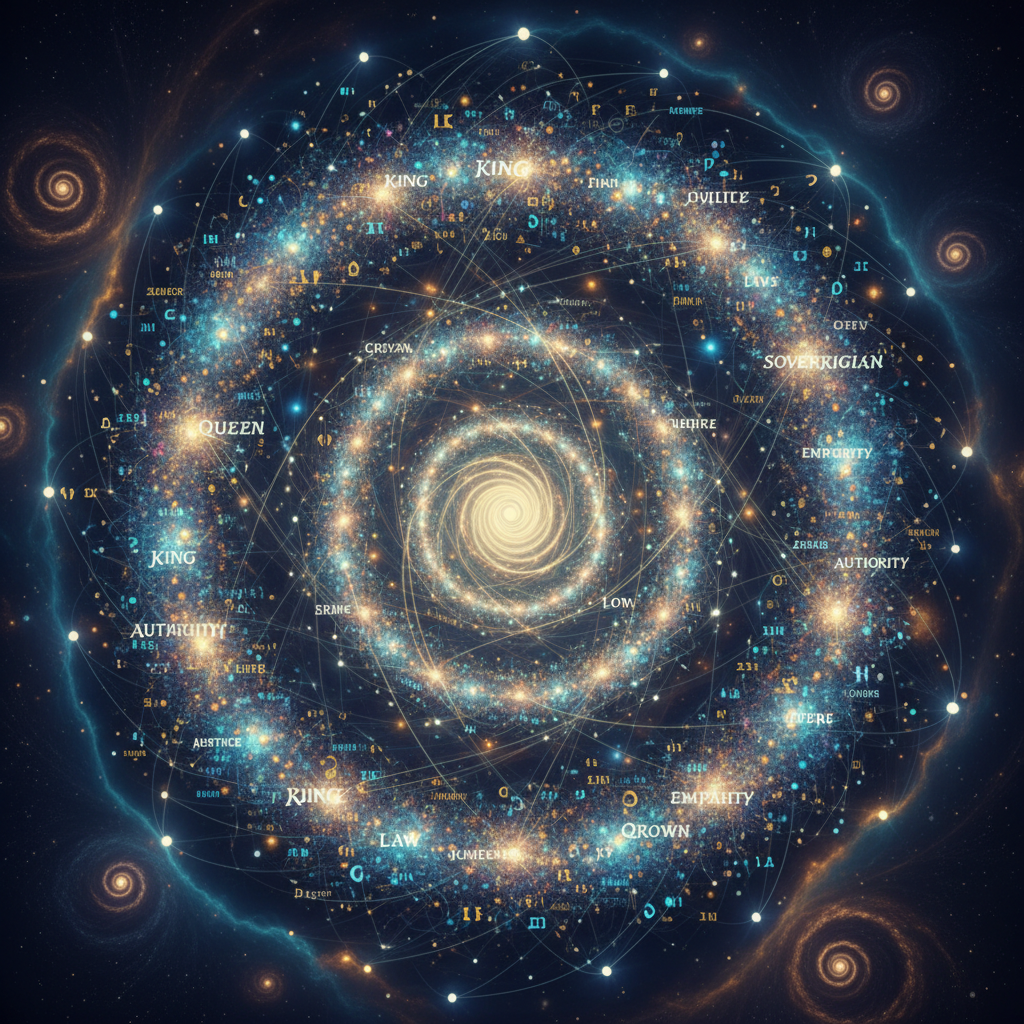
In the world of AI, this 'room' is a massive, multi-dimensional mathematical space. And the 'position' of each book, or song, or movie, or word, is a list of numbers called a 'vector'. Think of it as a set of coordinates, like a GPS location, but instead of navigating physical space, it navigates a space of meaning. A movie’s embedding isn’t just a single point; it's a long list of numbers like [0.86, -0.45, 0.21, ...], where each number represents a coordinate along a specific dimension of meaning. One dimension might represent 'romance,' another 'humor,' another 'dystopian future,' and another 'fast-paced action'. The crucial part is that the AI learns these dimensions on its own. We don’t tell it what they are. It just figures out the most useful ways to organize the content based on the data it's trained on.
This is why Netflix's recommendation engine feels so uncanny. When it suggested I watch the German sci-fi thriller *Dark* after I had binge-watched the Spanish heist show *Money Heist*, it wasn't because they were both popular European shows. It was because their embeddings are likely close to each other in this meaning space. They probably share high values on abstract dimensions like 'complex non-linear narrative,' 'ensemble cast with shifting loyalties,' and 'high-stakes tension.' The AI detected a similarity in their conceptual DNA, a similarity I wouldn't have been able to articulate myself but immediately recognized when I started watching.
It’s the same with my music. I grew up listening to a lot of classic British rock, but I also have a deep love for Carnatic music from South India. For years, my playlists were a chaotic mix. Then streaming services got good at this. One day, Spotify recommended an indie band from Bengaluru that fused fuzzy guitar riffs with traditional Indian melodic structures. On paper, it makes no sense. But an AI, trained on the audio of millions of songs, didn't care about genre labels. It listened to the music and plotted its coordinates. It found that the song's embedding—its unique position on the map of sound—was located precisely between the coordinates for The Verve and the coordinates for a Ravi Shankar raga. It found the mathematical midpoint between two of my tastes.
This concept is the bedrock of so much more than just recommendations. It's fundamental to how search engines have become so good at understanding what we really mean. When I type “places to get good chai in Delhi that aren’t too crowded,” Google doesn’t just look for pages with those exact words. It converts my query into an embedding. It understands, through its training, that ‘chai’ is related to ‘tea,’ ‘masala chai,’ and specific cafes. It understands that ‘not too crowded’ is conceptually related to phrases like ‘quiet ambience,’ ‘hidden gem,’ and 'off-peak hours.' It then searches for web pages, reviews, and map locations whose own embeddings are closest to my query’s embedding in this vast space of meaning. It’s a matching game played with concepts, not keywords.
So how does the librarian get so smart? How are these embeddings created? The AI model is trained on an astronomical amount of data—the entire internet, all of Wikipedia, massive libraries of books, or catalogues of music. In doing so, it learns from context. It learns that the word 'king' often appears in sentences with words like 'queen,' 'palace,' and 'kingdom.' It also learns a fascinating form of conceptual math. The most famous example is that if you take the embedding for 'king,' subtract the embedding for 'man,' and add the embedding for 'woman,' the resulting vector is incredibly close to the embedding for 'queen.' The AI has learned the relationship of gender. It's built a model of our world, with all its relationships, encoded in numbers.
This is the engine inside the generative AI tools that have taken the world by storm. When you give a prompt to an image generator like Midjourney, it's not looking up a picture of each word. It converts your entire phrase—“a photorealistic portrait of an elderly astronaut looking back at Earth from the moon, wistful”—into a single embedding. It then generates an image that is its best attempt at matching that conceptual coordinate. The model knows what ‘wistful’ looks like because it has seen it described in text and associated with certain visual characteristics in millions of images across the internet. It operates entirely within this shared map of meaning, bridging text and visuals.
But this magical librarian is not infallible. Its worldview is shaped entirely by the books it has read. And if those books—the data we feed it—are full of human biases, then the library's layout will be biased too. If the training data historically associates the word 'doctor' with men and 'nurse' with women, the AI’s embeddings will place 'doctor' closer to 'he' and 'nurse' closer to 'she.' This can lead to skewed search results, biased hiring algorithms, and all sorts of other harmful outcomes. The map reflects the territory, including its ugliest parts.
There’s also the risk of the 'filter bubble.' If the librarian only ever shows me things that are very close to what I already like, my world becomes smaller. My recommendations become a comfortable echo chamber. The algorithm, in its quest for efficiency, might never show me that challenging book from the other side of the room—the one that might have disagreed with me, frustrated me, and ultimately, made me think. The YouTube algorithm that took me from Vada Pav to Japanese knives was a wonderful moment of serendipity. But for every one of those journeys, there are a dozen times it just shows me more of the same.
Embeddings are the invisible architecture of our modern digital lives. They are a profound attempt to quantify meaning itself, to take the messy, beautiful, and complex tapestry of human culture and translate it into a language a computer can understand. They are the reason our devices feel like they ‘get’ us. But as we continue to build our world on top of these maps of meaning, we have a responsibility to be critical of how they are drawn, whose perspectives are centered, and what parts of the world they might be leaving out.
Why it matters
- 01AI embeddings translate complex items like songs, words, or movies into numerical coordinates on a 'map of meaning'.
- 02This 'meaning map' allows services like Netflix and Spotify to recommend items that are contextually similar, not just superficially alike.
- 03While powerful, embeddings can create filter bubbles and amplify the societal biases present in their training data.