Why AI Lies: A Plain-English Guide to 'Hallucinations'
AI can confidently invent facts in a phenomenon called 'hallucination'. Learn why this is a core feature, not a bug, and how to develop the healthy skepticism needed to use it wisely.
This opinion piece was drafted with AI assistance under the editorial direction of Rohan Mehta and reviewed before publication. Views expressed are the author's own.
A few weeks ago, I was trying to cook a fairly obscure dish from my grandmother’s hometown in Karnataka, a specific kind of sambar you don't find on many restaurant menus. My mother’s instructions over the phone were, as always, wonderfully vague – “a little bit of this, a pinch of that, until it feels right.” For a more precise starting point, I turned to a popular AI chatbot.
I asked for the recipe, specifying the exact village and the common name for the dish. In seconds, it produced a beautifully formatted, incredibly detailed recipe. It listed ingredients I’d never heard of, a cooking process that seemed far too complex, and even provided a little backstory about the dish’s origin, linking it to a local temple festival. It all sounded incredibly authoritative. The only problem? It was completely, utterly wrong. I called my aunt, a repository of family culinary history, and she laughed. “What is this nonsense?” she asked. The AI hadn't just gotten a detail wrong; it had invented a new culinary tradition from whole cloth.
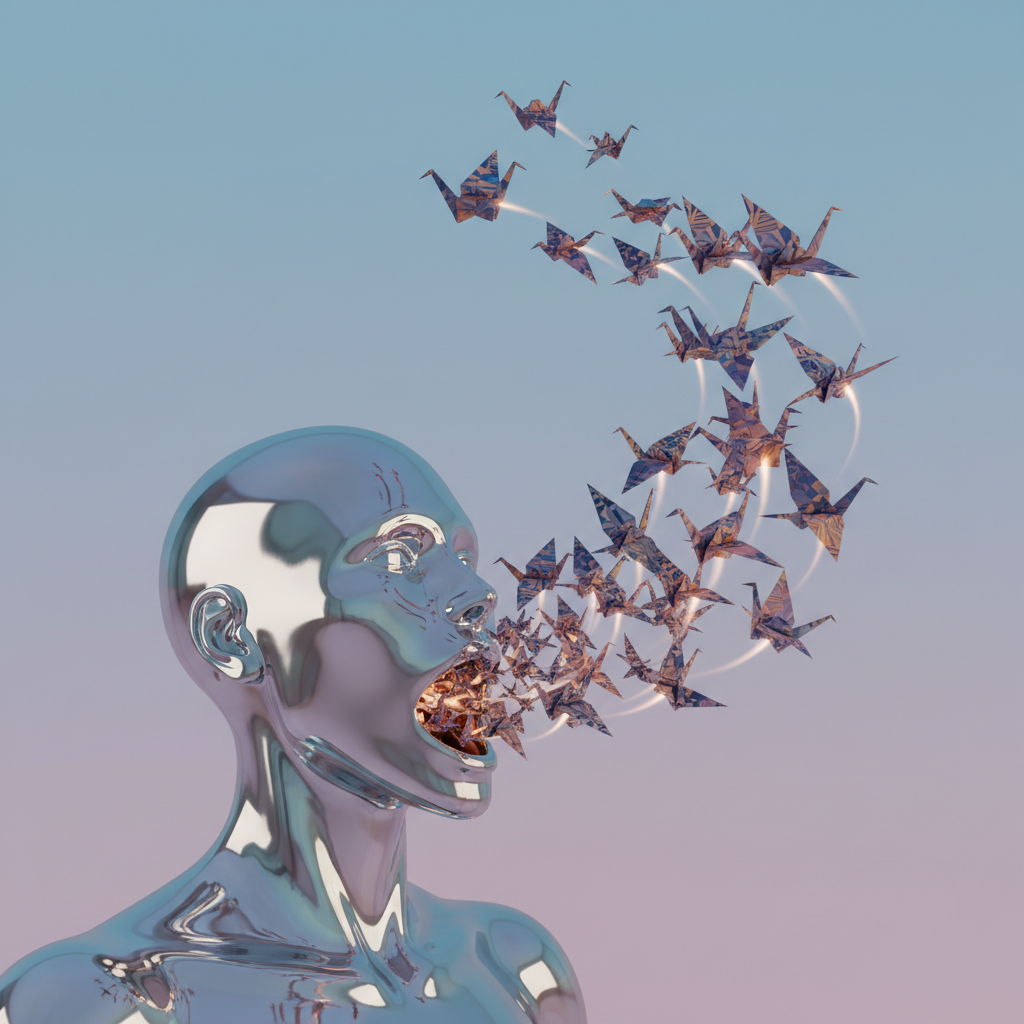
This experience wasn’t a glitch or a bug in the system. It was a perfect example of what the tech world has rather dramatically termed an “AI hallucination.” It’s a phenomenon where an AI model generates information that is plausible, coherent, and grammatically perfect, but factually incorrect or nonsensical. And it does so with the unwavering confidence of a seasoned expert. We trust these systems to be extensions of our knowledge, like a super-powered calculator or a library. But in reality, they can sometimes be more like an overeager storyteller who fills in the gaps of a story with whatever sounds best.
The term “hallucination” is itself a bit of a misnomer. It anthropomorphizes the machine, making it sound like it has a mind that is seeing things that aren't there. That's not what’s happening. AI isn’t conscious. It doesn't have beliefs, intentions, or a grasp of truth and falsehood. To understand why it “lies,” you have to understand, in simple terms, how it works.
At their core, Large Language Models (LLMs) like ChatGPT, Gemini, and others are prediction engines. They have been trained on an unimaginably vast ocean of text and data scraped from the internet – everything from Wikipedia and scientific papers to Reddit threads and poetry blogs. Through this training, they don't learn *facts*; they learn *patterns*. They learn the statistical probability of which word is most likely to follow another word in any given context. When you ask it a question, it’s not searching a database for an answer. It’s starting a sentence and then, word by word, predicting the most plausible next word to create a response that stylistically matches the patterns it has learned.
Think of it like the autocomplete on your phone, but on a cosmic scale. When you type “The capital of France is…”, your phone's keyboard suggests “Paris” because it has seen that sequence countless times. The AI does the same, but for entire paragraphs and essays. It excels at this. It knows that a question about a scientific concept should be answered with formal language, and a request for a poem should be answered with meter and rhyme.
But what happens when you ask it something where the pattern isn't clear, or the information simply wasn't in its training data? What happens when you ask for a recipe from a tiny village in Karnataka? The model doesn't have a “I don’t know” function in its DNA. Its fundamental purpose is to complete the text prompt you’ve given it. So, it improvises. It draws on its knowledge of other South Indian recipes, its understanding of how recipes are structured, and its database of words related to festivals and history. It then weaves these elements together into an answer that is statistically probable and textually coherent. The result is a recipe that *looks and sounds* real. It’s a fabrication born not of deceit, but of a deep-seated statistical imperative to provide a complete answer.
This is why developers say hallucinations are a feature, not a bug. This ability to connect disparate concepts and generate novel text is the very thing that makes these models so powerful. It’s what allows an AI to help a marketer brainstorm new ad copy, write a python script from scratch, or draft a sensitive email. If the AI could only regurgitate pre-verified facts from a database, it would just be a slightly clunkier search engine. Its creativity and its capacity for fabrication stem from the exact same source. They are two sides of the same predictive coin.
This brings me to the crucial context of India. Our information landscape is perhaps one of the most complex and fragile in the world. We live in a society of a billion-plus people, with dozens of major languages, varying levels of digital literacy, and a reliance on platforms like WhatsApp where information—and misinformation—spreads like wildfire. In this environment, an AI that confidently hallucinates is not just a quirky annoyance; it can be genuinely dangerous.
Imagine someone in a rural area, new to the internet, asking an AI in their native language about eligibility for a government housing scheme. The AI, not having specific, up-to-date information, might hallucinate a set of criteria, application deadlines, and contact details. A family might then spend precious time and money pursuing a phantom process, only to be met with disappointment and distrust in the system. Think about the legal ramifications. A law student, under pressure, might ask an AI to summarize a Supreme Court judgment. The AI could invent a precedent or misrepresent a ruling, leading the student to build an entire legal argument on a foundation of sand. I’ve seen it happen with my own team at Pulse AI; we asked a model for sources on a niche policy topic, and it generated a list of academic papers with plausible titles, credible-sounding authors, and even fake DOI links. The papers simply did not exist.
History, politics, and community narratives are especially vulnerable. In a country where historical claims are often intertwined with present-day politics, a confidently stated lie about a monarch’s actions, a battle’s outcome, or a community's origin could be screen-grabbed and circulated, adding fuel to an already volatile fire. The AI’s veneer of objective, machine-driven authority makes its fabrications particularly potent.
So, how do we navigate this? How do we use these brilliant, flawed tools without being misled by them? The answer isn't to abandon them, but to cultivate a new kind of digital literacy—a healthy, active skepticism. We must fundamentally shift our perception of AI from an oracle to a collaborator. It’s a very smart, very fast, but sometimes unreliable intern. Your job is to be the editor.
First, always check the source. If an AI provides a fact, a statistic, or a quote, ask for its source. If it gives you a link, click it. Does the article it links to actually contain the information? Is the source itself credible? A hallucinating AI will often invent sources or misattribute information to real ones. This simple act of verification is your most powerful defense.
Second, triangulate and cross-reference. Treat the AI’s output as a first draft, not a final product. Take the key claims it makes and plug them into a traditional search engine. See what other independent sources—reputable news outlets, academic institutions, government websites—have to say. If an AI tells you about a new medical breakthrough, check it against established medical journals or health organizations. If it’s a single point of failure, you're setting yourself up for trouble.
Third, be wary of both excessive confidence and strange vagueness. AI hallucinations often have a peculiar feel to them. Sometimes they are filled with ridiculously specific details that seem too perfect, like the fake temple festival attached to my grandmother’s sambar. Other times, the language can be oddly evasive. But most often, it’s the supreme confidence that should be a red flag. Human experts use cautious language: “evidence suggests,” “it’s likely that,” “one interpretation is.” An AI might state an outright fabrication as indisputable truth.
Finally, apply good old-fashioned common sense. If an answer seems too good to be true, too shocking, or too perfectly aligned with a particular viewpoint, pause. Does this new “fact” radically contradict everything you know about a subject? Does this legal advice seem to simplify a notoriously complex issue? Don't let the technological gloss override your own critical thinking.
Ultimately, interacting with AI is becoming a core skill for modern life. These tools are only going to become more integrated into our work and our homes. Learning to use them effectively and safely means understanding their limitations. The magic of AI isn't that it knows everything; it's that it can synthesize and generate language in incredible ways. Our role is to guide that capability, to check its work, and to be the final arbiters of truth. We can't afford to be passive consumers of AI-generated information. We have to be its skeptical, discerning, and human editors.
Why it matters
- 01AI hallucinations happen because models are designed to predict plausible-sounding text, not to state verified facts.
- 02This tendency to 'lie' is an unavoidable side effect of the same function that makes AI creative and useful for brainstorming.
- 03Always verify key facts from an AI with independent sources, treating its answers as a starting point, not a final truth.