Beyond the Chatbot: A Plain-English Guide to Embodied AI
From robots that see packages to droids learning to cook from videos, discover embodied AI—the tech that gives artificial intelligence a physical body.
This opinion piece was drafted with AI assistance under the editorial direction of Rohan Mehta and reviewed before publication. Views expressed are the author's own.
I’ve spent the better part of the last few years talking, writing, and thinking about AI. Like many of you, my daily interactions with it were confined to a screen. I’d prompt ChatGPT for an email draft, ask a smart speaker for the weather in Mumbai, or marvel at an image generated from a few lines of text. The intelligence was dazzling, but it was also disembodied. It was a brain in a jar, a ghost in the machine, powerful yet intangible. It could write a poem about a falling leaf, but it couldn't feel the breeze or catch the leaf.
Then, a few months ago, I saw a video that fundamentally shifted my perspective. It wasn't a sleek, sci-fi production. It was a clumsy, almost comical clip of a humanoid robot trying to make a cup of coffee. It fumbled with the filter, slightly misjudged the water pour, but eventually, it succeeded. I realized I wasn't watching a pre-programmed sequence. I was watching a machine learn, through trial and error, in the messy, unpredictable physical world. This, I understood, was the next frontier. This is 'embodied AI'.
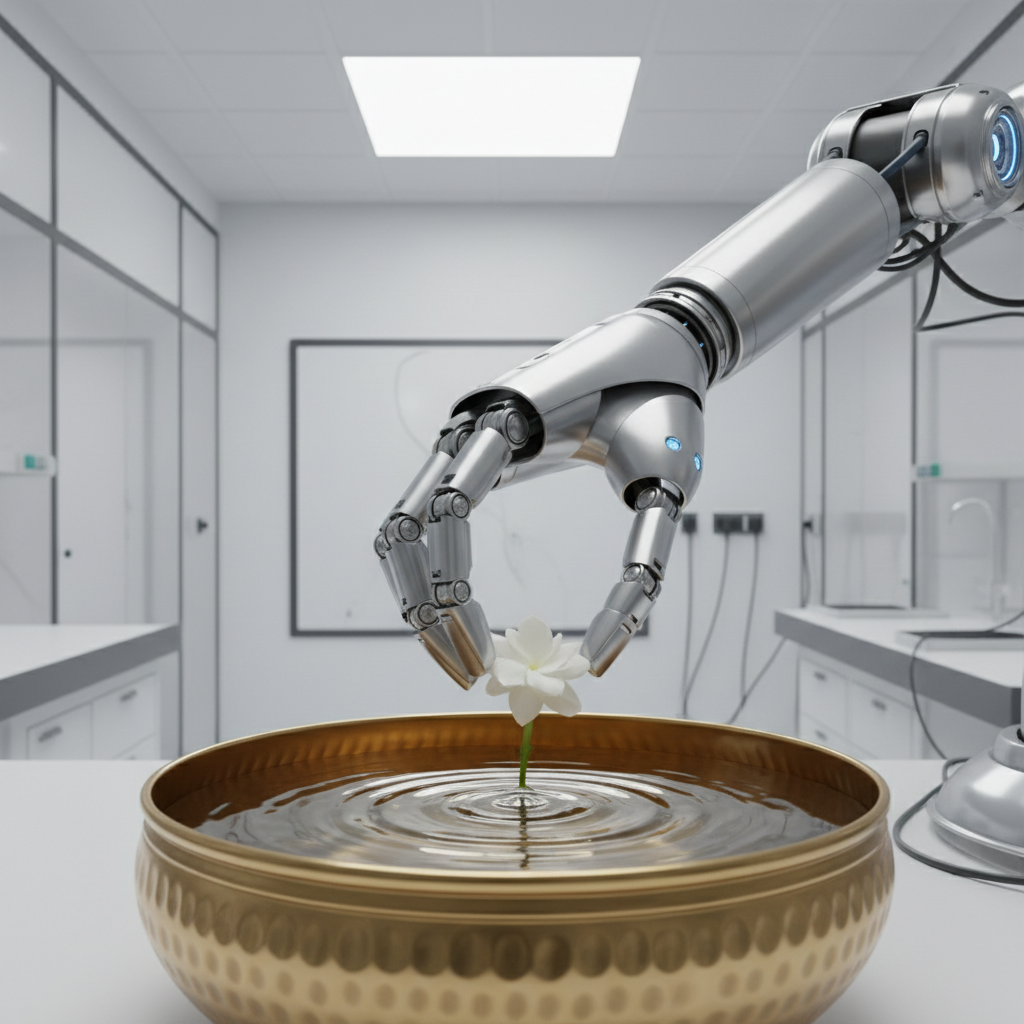
In the simplest terms, embodied AI is artificial intelligence that has a body. It’s not just code running on a server somewhere in a data centre in Virginia or Hyderabad; it’s software connected to sensors and motors, giving it the ability to perceive, move, and act in the physical world. It has 'eyes' (cameras), 'ears' (microphones), and 'hands' (grippers). It learns not just from an ocean of text on the internet, but from the fundamental laws of physics—gravity, friction, cause and effect.
Think of it this way. A chatbot like ChatGPT has read every book ever written about how to ride a bicycle. It can explain the physics of balance, the mechanics of pedalling, and the history of the derailleur with flawless expertise. But it cannot, for the life of it, actually ride a bike. An embodied AI, on the other hand, is the toddler getting on a tricycle for the first time. It falls, it scrapes its knee (metaphorically), it learns to adjust its balance, and eventually, it pedals. Its knowledge is earned, not just indexed. This single distinction is what makes it so revolutionary.
The disembodied AI we know lives in a world of pure information. For embodied AI, the world is a place of infinite variables. A floor can be slippery, a package can be heavier than expected, a person can walk unexpectedly into its path. This is the chaos of reality, and navigating it is a monumental challenge that requires a different kind of intelligence.
This isn't just a lab experiment anymore; it's quietly reshaping the backbone of our economy. Take the sprawling warehouses run by Flipkart or Amazon on the outskirts of any major Indian city. For years, we’ve seen videos of small, puck-like robots shuttling shelves around. That was an early, simple form of embodied automation. The next generation is far more sophisticated. I’m talking about robotic arms that can actually *see* a product in a cluttered bin, differentiate it from a dozen other items, and gently pick it up without crushing the box. This is a task that requires an incredible fusion of vision, touch, and dexterity—something that was, until recently, exclusively human.
During the pandemonium of a Diwali sale, this technology is the difference between a package arriving in two days or ten. It’s about building a supply chain that is not just faster, but more resilient and less prone to human error, especially for the gruelling, repetitive tasks that lead to burnout.
In manufacturing, the story is similar. The 'Make in India' initiative aims to turn the country into a global manufacturing hub. But to compete, we need to move beyond simple assembly. We need advanced manufacturing. Embodied AI is the key. Traditional industrial robots are powerful but dumb; they follow a precise, pre-programmed path. If a part is misaligned by a millimetre, the whole line can grind to a halt. An intelligent robot, however, can see the misalignment, adjust its grip, and continue the task. It can be taught a new job not by weeks of complex coding, but by watching a human do it, or even by being guided through the motions once. This flexibility is what will allow factories to produce bespoke products on demand, a far cry from the one-size-fits-all model of the last century.
Perhaps the most fascinating, and personal, application is in the home. I think of my own parents, living independently in their late seventies. The idea of a robot that could help with daily chores—loading a dishwasher, folding laundry, or even just fetching a glass of water—goes from science fiction to a deeply practical tool for aging with dignity. Companies like Figure AI and Google's DeepMind are making giant leaps here. They are integrating large language models—the same tech behind ChatGPT—into their robots. This means you could one day tell a droid, in plain English or Hindi, "I spilled some coffee, can you please clean it up?" The robot would need to understand the sentence, visually identify the spill, find a cloth, and perform the cleaning action. It's an astoundingly complex sequence that is now becoming plausible.
Imagine a robot learning to cook a perfect masala dosa by watching a Tarla Dalal video on YouTube. It would learn to gauge the heat of the tawa, the consistency of the batter, and the right moment to flip it. This isn't about replacing the joy of cooking; it's about providing assistance to those who need it, whether it's the elderly, people with disabilities, or just a busy parent trying to manage a household.
Of course, the road ahead is filled with obstacles. The real world, as I said, is messy. Developing hardware that is robust, safe, and affordable is a huge engineering problem. These robots are still astronomically expensive, and their energy consumption is a serious concern. The software is just as difficult. While learning in simulations is getting very good, the gap between the virtual and the real—what researchers call the 'sim-to-real' gap—remains a major hurdle. A robot that is a superstar in a simulated kitchen can be a clumsy oaf in a real one.
And then there’s the big question, the one that hangs over every conversation about automation: what about jobs? There's no simple answer, and anyone who gives you one is selling something. Yes, embodied AI will likely displace jobs that involve repetitive manual labour, in warehouses, factories, and even on farms. To deny that is naive. But technology has always done this. The ATM replaced many bank tellers, but it also created new jobs in software development, ATM manufacturing, and maintenance. Similarly, we will need a new class of workers: robot supervisors, maintenance technicians, AI trainers, and ethicists who help design the rules for how these machines interact with our world.
I see it not as a direct replacement, but as a shift in the nature of human work. We will move from doing the physical labour ourselves to orchestrating fleets of machines that do it for us. The focus will shift to creativity, strategy, and human-to-human interaction—the things machines still can't do.
We are at the very beginning of this journey. The transition from disembodied, screen-based AI to embodied, physical AI will be slow, and then sudden. It won't be a single event, but a gradual infusion of intelligence into the objects all around us—cars, appliances, tools, and toys. It will force us to confront profound questions about our relationship with technology, the definition of work, and what it means to be human in a world we share with intelligent machines.
The last decade was defined by AI learning to talk. The next will be defined by it learning to walk, to grasp, to see, and to help. For me, as I watch that clumsy robot eventually master the art of making coffee, it’s a future that feels less like a threat and more like a collaboration. It’s the moment AI steps out of the screen and into our lives, not as a ghost, but as a helper. And that changes everything.
Why it matters
- 01Embodied AI gives artificial intelligence a physical body, allowing it to learn from and interact with the real world, unlike screen-based AIs.
- 02This technology is already transforming key industries like logistics, manufacturing, and healthcare by automating complex physical tasks.
- 03The rise of embodied AI will bring significant societal shifts, raising new questions about jobs, safety, and human-robot collaboration.