Confessions of an AI Editor: My AI News Fatigue Is Real
As an AI editor, my job is to cover every breakthrough. But the relentless pace has left me exhausted and questioning if we're all just lost in a hype tsunami.
This opinion piece was drafted with AI assistance under the editorial direction of Rohan Mehta and reviewed before publication. Views expressed are the author's own.
My morning routine has become a source of anxiety. Before the steam has even finished rising from my cup of chai here in my Mumbai apartment, I’ve unlocked my phone. It’s a Pavlovian response, a twitch I’ve developed over the past two years. And every morning, the response is the same: a deluge.
Today, it’s a new open-source model from a European consortium that claims to outperform everything in its class. Yesterday, it was a text-to-music generator that went viral overnight. The day before, a major player dropped a surprise update with a demo so slick it felt like science fiction. My job, as an editor for an AI-focused publication, is to make sense of this, to find the signal in the noise. But lately, it feels like the noise has won. It’s not just a firehose of information; it’s a dozen firehoses aimed at my head from every direction, and I’m forgetting how to swim.
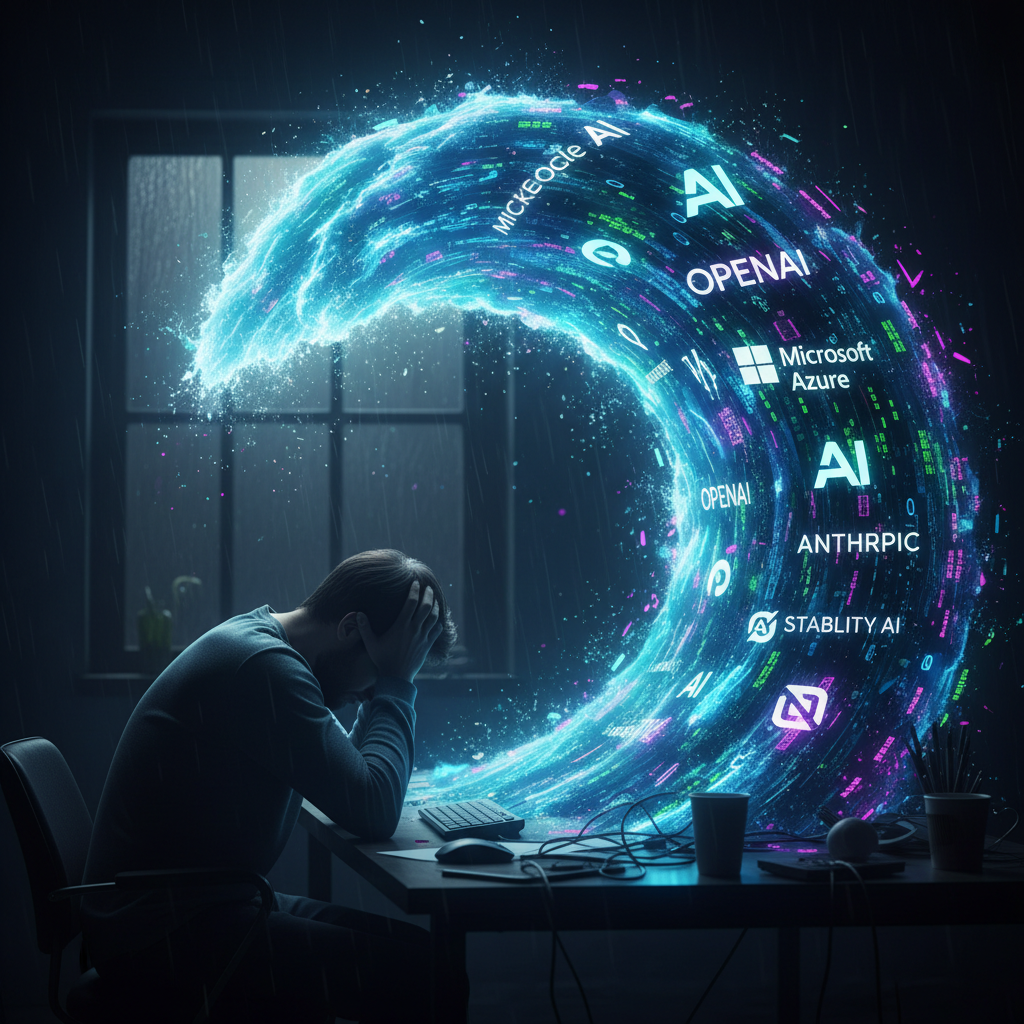
This isn't the kind of fatigue that comes from using AI tools. It's the fatigue of observation. It’s the burnout that comes from standing on the shoreline of a technological ocean, where a new tsunami labeled “The Next Big Thing” crashes down every six hours. From GPT-4 to Claude 3, from Llama 3 to Gemini 1.5 Pro, and now the dizzying, almost theatrical launch of GPT-4o—the names and numbers blur into an endless stream. Each one arrives with a set of benchmarks, a flashy demo, and a chorus of voices on X and LinkedIn declaring it a “paradigm shift.”
We’ve been running on this treadmill for so long that we’ve forgotten what it feels like to stand still. The pace is no longer just fast; it’s punitive. There’s no time to digest, to truly understand the implications of one model before three more have taken its place in the news cycle. We are in a state of perpetual professional whiplash.
What’s worse than the volume of news is the pressure to have an immediate, fully-formed opinion on it. My DMs and inbox are a testament to this. “Rohan, what’s your take on the new multimodality?” “Is this the model that finally makes agents viable?” “Should my startup pivot to build on this new API?” People don’t just want information; they want prophecy. They want certainty in a field defined by anything but.
The pressure to be a pundit-on-demand is exhausting. There's a fear that if you don't have a hot take within an hour of a major announcement, you’re irrelevant. You missed the boat. The discourse moves on, with or without you. This creates a culture of shallow analysis, where we celebrate speed over depth and reaction over reflection. We are becoming connoisseurs of the demo, not critics of the technology.
From my vantage point in India, this global race has a unique local texture. I speak with founders in Bangalore’s tech parks who are caught in a vicious cycle. They feel compelled to integrate the latest, buzziest model not because it’s necessarily better for their product, but because it’s what their investors want to see on a pitch deck. There's a palpable anxiety among the developer community here—a feeling of being perpetually behind a curve that is being set thousands of miles away in California, often in the middle of our night.
I remember a conversation with a friend, a brilliant machine learning engineer in Hyderabad. She confessed that her team spends almost a third of their time just evaluating and re-evaluating new models and frameworks, time they could be spending on refining their actual product. They are caught in a state of decision paralysis, terrified of betting on a horse that will be obsolete in three months. The promise of AI is immense opportunity, but the reality for many is immense pressure.
This professional fatigue inevitably seeps into the personal. It’s the weekend dinner where I can’t stop myself from scrolling through a technical blog post. It’s the inability to read a book without feeling a low-grade hum of anxiety that I’m missing a crucial paper on arXiv. The industry’s weaponized FOMO—fear of missing out—has become a constant companion. It robs you of the ability to be present.
More troublingly, this frantic pace prevents us from asking the bigger, more important questions. How can I write a thoughtful piece about the long-term impact of AI on labor when I’m still trying to get my head around the token context window of a model that was released yesterday? The urgent has completely displaced the important. We’re so busy chronicling every single step of the race that we haven't had a moment to ask if we’re even running in the right direction.
Lately, I've started to question the entire narrative. Is every one of these launches a genuine “breakthrough”? Or are we living through a period of immense, venture-capital-fueled marketing? The language has become so hyperbolic. Everything is “magic,” every update is an “iPhone moment.” The delta in capabilities between one top-tier model and the next is often marginal, yet it’s presented as a revolutionary leap. As a journalist, I feel a growing sense of complicity in this hype tsunami, and a responsibility to push back against it.
I’m not giving up. But I am changing my approach, for my own sanity and for the quality of my work. I am learning to filter, to become a bouncer at the club of my own attention. I’m starting to ignore announcements that are clearly just incremental iterations. Instead of chasing the “what,” I’m trying to focus on the “so what?” How does this technology actually change things for a small business owner in Jaipur, a teacher in Chennai, or a farmer in Punjab? The human stories are where the real meaning lies, and they don’t move at the speed of a press release.
I’ve started building deliberate “no AI” zones into my life. Long walks along Marine Drive without my phone, losing myself in the crowd and the sound of the waves. I’ve returned to reading fiction, to immersing myself in worlds that move at a human pace. These acts of disconnection are no longer a luxury; they are a necessary survival strategy. They provide the quiet space needed for real thought to emerge.
My AI news fatigue is real, and I know I’m not alone. It’s a quiet epidemic spreading through our industry. It’s a symptom of a system that has prioritized relentless, unsustainable growth over human-centric progress. Acknowledging this burnout isn’t a sign of weakness; it’s a necessary first step toward building a healthier relationship with the powerful technologies we are creating. We need to give ourselves permission to slow down, to think deeply, and to find the quiet, enduring signals amidst the deafening noise.
Why it matters
- 01The relentless pace of AI model releases creates a unique form of professional burnout, even for industry experts.
- 02It's crucial to distinguish between genuine technological leaps and the venture-capital-fueled marketing hype that often surrounds them.
- 03Finding strategies to filter noise, focus on deeper impact, and deliberately disconnect is essential for sustainable engagement with the field of AI.