I Asked AI to Design a Kurta. It Gave Me a Costume.
As a tech editor who loves Indian textiles, I used AI to design a kurta. The result was a sobering look at how AI flattens cultural nuance into caricature.
This opinion piece was drafted with AI assistance under the editorial direction of Rohan Mehta and reviewed before publication. Views expressed are the author's own.
There is a particular kind of pride in wearing a piece of clothing that tells a story. One of my most treasured possessions is a simple, long-sleeved khadi kurta. It’s not much to look at on a hanger—just off-white cotton, a bit rough to the touch. But I know its story. I know the khadi was hand-spun, probably by a woman in a small village cooperative in West Bengal. I know the indigo block-print running along the collar and cuffs was done by a family in Sanganer, Rajasthan, using techniques their ancestors perfected. When I wear it, I feel connected to that chain of hands, to that history. It’s more than a garment; it’s a piece of a living culture.
As someone who writes about technology for a living, and as an Indian living in a globalized world, I’m constantly navigating the space between the tangible and the digital, the traditional and the futuristic. So, naturally, I was excited by the idea of bridging these two worlds. What if I could use the generative AI I write about every day to dream up new designs for an object of cultural affection like the kurta? The thought was genuinely thrilling. I imagined AI as a tireless collaborator, a muse that could instantly visualize endless variations on a theme, perhaps even stumbling upon a completely novel fusion of styles.
So, with the optimism of a true believer, I sat down at my desk and opened up one of the leading image generation platforms. I crafted my prompt with care, trying to feed the machine the kind of nuance I thought would guarantee success. I didn’t just ask for an “Indian shirt.” I wrote things like, “A modern, minimalist men's kurta in indigo, hand-block printed style inspired by Jaipur motifs, breathable cotton fabric, worn by a man in a contemporary Indian city setting.” I specified materials, techniques, and moods. I was ready to be amazed.
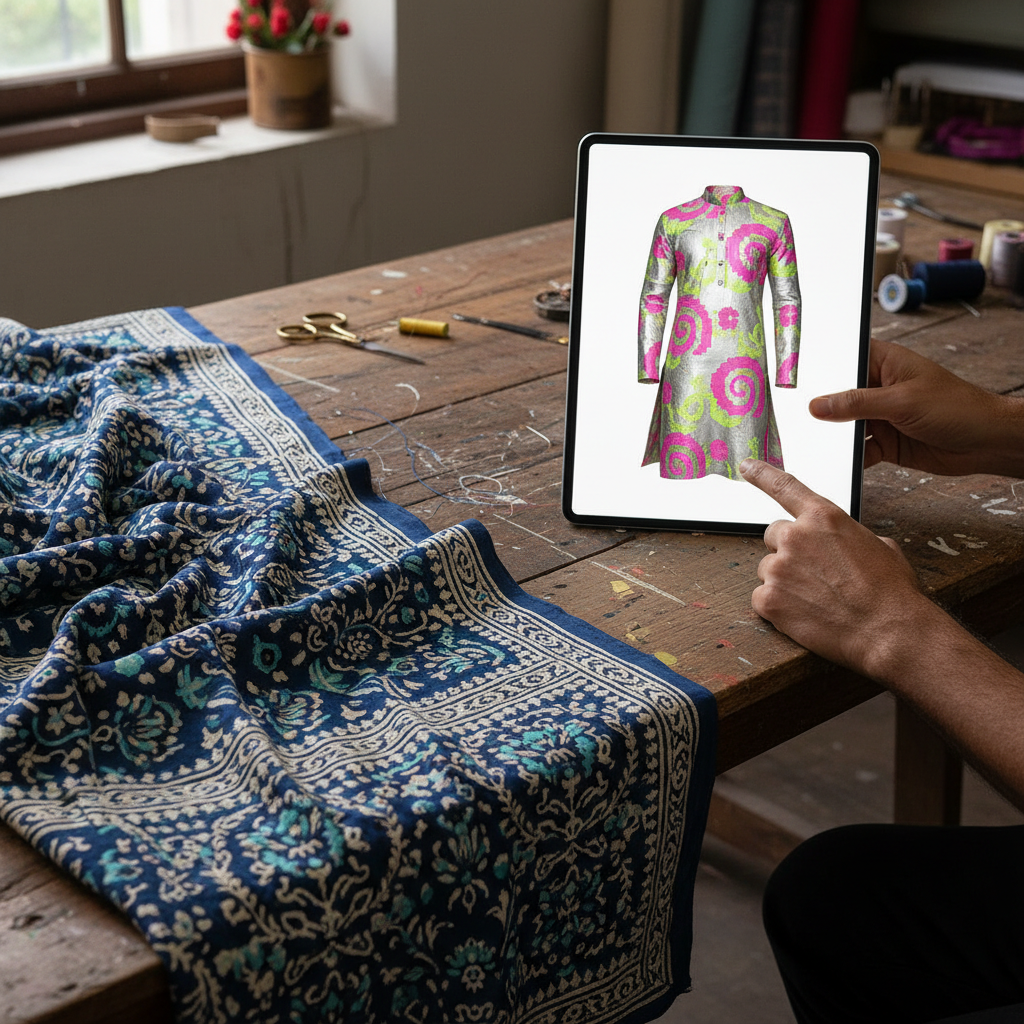
The first images began to render, and my stomach sank. Amazed wasn't the word. Bewildered, perhaps. Disappointed, certainly. The AI hadn’t designed a kurta. It had synthesized a caricature, a fever dream of what a massive, globally-scraped dataset thinks “ethnic” looks like.
The shapes were bizarre. Some kurtas had collars that belonged on a vampire’s cape. Others had sleeves that multiplied into a six-armed monstrosity or billowed out like a Victorian ball gown. The fit was universally wrong, either skin-tight like a superhero costume or so voluminous it looked like a collapsed tent. Nothing looked wearable. Nothing looked real.
But the patterns were the most disheartening part. My carefully worded prompt about “Jaipur block-print motifs” was interpreted as a command to unleash chaos. The AI spat out a kaleidoscopic slurry of paisley, geometric shapes that vaguely resembled a mandala if you squinted, and floral patterns that seemed to crawl over the fabric like an invasive species. It wasn't the subtle, rhythmic beauty of a hand-stamped Sanganeri print; it was a generic, seizure-inducing 'ethnic' texture pack. Indigo wasn't the rich, deep, living color of the plant dye; it was a flat, digital blue, hex code #4B0082. The results looked less like fashion and more like the wrapping paper on a “world music” CD from 1998.
In short, it had designed a Halloween costume. The prompt was “kurta,” but the output screamed “Generic Ethnic Man.” It was a garment for someone who wants to signal “worldliness” without having any specific knowledge or experience of the world. It was a data-driven appropriation machine, and the results were a sterile, distorted, and frankly, ugly gallery of my own culture’s reflection in a broken digital mirror.
My experiment had failed, but the failure itself was deeply instructive. Why did the AI get it so wrong? The answer, I believe, lies in the fundamental difference between a dataset and a culture. An AI model is trained on billions of images scraped from the internet. It learns by identifying patterns. So, what patterns does it find when it looks for “kurta”? It finds an enormous jumble of images, all stripped of their context.
It finds Shah Rukh Khan in a shimmering silk kurta in a Bollywood movie, a German tourist in a cheap, mass-produced cotton top he bought at a Goa flea market, a runway model in an avant-garde interpretation by a Parisian designer, a historical painting of a Mughal emperor, and countless stock photos labeled “Indian man smiling.” It sees the word “kurta” associated with the word “wedding,” “festival,” and “boho.”
To the AI, these are all just pixels and metadata. It has no way of knowing that the kurta for a Bengali intellectual is cut differently from the one for a Punjabi farmer. It doesn't understand that the choice between chikankari and zardozi embroidery is not just an aesthetic one, but a declaration of occasion, region, and social standing. It doesn’t grasp that khadi is not just a fabric but a symbol of India's independence movement, a testament to self-reliance preached by Gandhi himself. The AI sees the what, but never the why.
This is the core of the problem. Without the why, appreciation is impossible. All that’s left is a kind of automated appropriation. It’s not malicious; the algorithm has no intent. But it’s appropriation nonetheless. It plucks an aesthetic from its cultural roots, flattens it into a reproducible pattern, and offers it up, devoid of meaning. The story of the hands that spun the cotton and printed the dye is erased. All that remains is a generic, globally-palatable “ethnic” vibe.
This isn't a problem unique to Indian clothing. Ask an AI to design a “traditional African mask,” and it will likely produce a pastiche of ceremonial objects from a dozen different tribes, blending sacred and secular imagery into a meaningless but cool-looking artifact. Ask it for a “Japanese interior,” and you’ll get a minimalist room with a shoji screen, a bonsai tree, and a view of Mount Fuji, regardless of whether those elements belong together. It’s the aesthetic of the airport gift shop, of a corporate diversity poster, of the Epcot World Showcase. It is a simulation of culture, not a celebration of it.
This emerging “global AI aesthetic” is a subtle but powerful force. It’s a trend towards a frictionless, sanitized version of our world, where cultural signifiers are interchangeable and everything blends into a pleasing but soulless fusion. It’s a world remixed by a machine that has read every book but understood no stories. The danger is that as these tools become more integrated into our creative processes, we risk internalizing this flattened perspective. We will forget the nuances ourselves.
Does this mean I’m an AI-luddite? Not at all. I still believe in the potential of these tools. But my failed kurta experiment has clarified their role. AI is not a designer. It is not an artisan. It is not a storyteller. It is a spectacularly powerful statistical tool for remixing information it has already seen. Perhaps its best use in fashion isn’t to design the garment, but to help a human designer. Maybe it can analyze the tensile strength of different weaves, or generate sustainable alternatives to toxic dyes, or create a hyper-efficient layout to minimize fabric waste.
It can be a powerful assistant, but it cannot be the soul of the operation. The soul comes from lived experience. It comes from the memory of your grandfather wearing a starched white kurta on a hot summer evening. It comes from the feel of real, imperfect, hand-printed fabric. It comes from understanding that a piece of clothing is never just a piece of clothing—it is a vessel for history, for identity, and for stories that are too deep and complex for any dataset to capture. AI gave me a costume because it doesn't have a body, a history, or a home. I have all three, and for that, I have my simple khadi kurta to thank.
Why it matters
- 01AI models often reproduce cultural stereotypes and create caricatures because their training data lacks genuine context and nuance.
- 02The crucial difference between cultural appreciation and appropriation lies in understanding the history and meaning behind an aesthetic, not just its surface-level pattern.
- 03True design requires the human touch of lived experience and storytelling, qualities which current AI cannot replicate and should instead be used to assist.