I Asked AI to Design My Garden. It Gave Me Everything But a Soul.
I used an AI to plan the perfect Mumbai balcony garden. The result was a flawless, sterile space that taught me what algorithms can't replicate: the soul.
This opinion piece was drafted with AI assistance under the editorial direction of Rohan Mehta and reviewed before publication. Views expressed are the author's own.
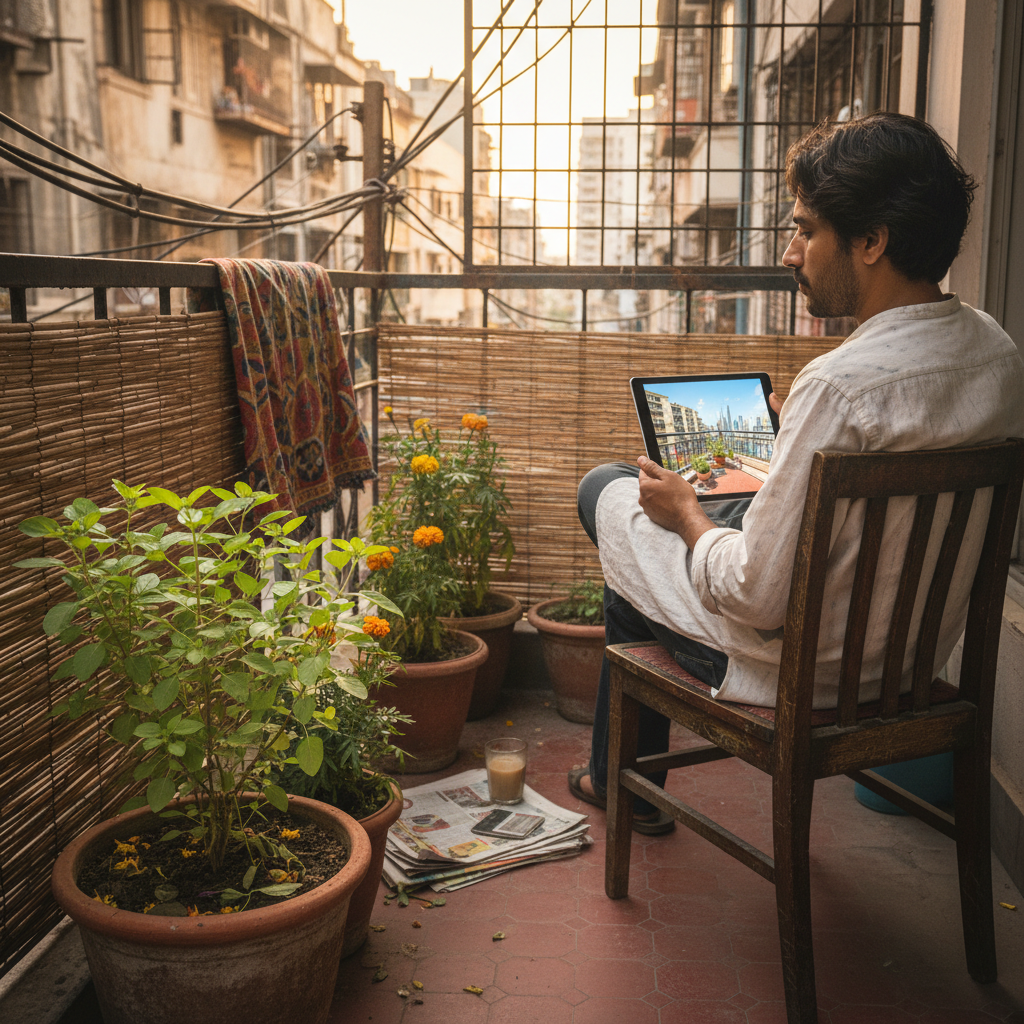
The balcony of my Mumbai flat has always been a space of pure potential. For years, it was a repository for things that had no other home: a forlorn clothes-drying rack, a pair of dusty shoes I swore I’d wear again, and the occasional visiting pigeon. But in my mind, it was always a garden. A lush, vibrant escape from the city’s relentless hum, a little patch of green suspended fourteen floors above the chaos.
Like many modern problems, I decided to solve this one with technology. I’m Rohan Mehta, an editor here at Pulse AI, so the impulse is practically baked into my job description. The idea was simple and seductive: I would use one of the new, sophisticated AI interior design tools to generate the ‘perfect’ balcony garden. I would be the test case for a seamless, data-driven approach to creating a personal sanctuary.
I started with the data. I meticulously measured every inch of the space, noting the unforgiving length and the narrow width. I used an app to track the sun’s arc across the sky, mapping the precise hours of direct, scorching sunlight versus the pockets of cool shade cast by the building’s concrete fins. This is Mumbai, after all, where the sun is not a gentle friend but a demanding overlord. Every plant’s survival depends on respecting its power.
Then, I fed the algorithm my preferences, my little list of must-haves that rooted the garden in my own life. I wanted marigolds, their fiery orange and yellow a staple in every Indian festival and a memory of my grandmother’s flowerbeds. I needed a pot of Tulsi, the holy basil, not just for its fragrance but for the quiet ritual of its presence. And, of course, a curry leaf plant, because what South Indian-inspired kitchen is complete without the ability to pluck a fresh sprig for the tadka?
I clicked ‘generate’. The machine whirred in that silent, digital way, processing my dimensions, my sunlight charts, my modest horticultural dreams. In less than a minute, it presented the solution. And it was, by every objective measure, perfect.
The layout was a masterclass in spatial optimization. It proposed a series of sleek, modular vertical planters for the narrow wall, maximizing green in a small footprint. The pots were all uniform in a tasteful matte grey, creating a chic, minimalist aesthetic. The marigolds were arranged in a neat, color-blocked row along the sunniest edge of the railing, their placement calculated for maximum bloom. The Tulsi was given a central, prominent position in a slightly larger, but still matching, pot. The curry leaf plant was nestled in a corner that received the ideal mix of morning sun and afternoon shade.
Even the floor space was considered, with interlocking wooden deck tiles that gave the whole area the feel of a high-end resort. The AI had cross-referenced my plant choices with a database of companion plants, suggesting a delicate creeper with tiny white flowers to soften the edges of the vertical planter. It was flawless. It was efficient. It was beautiful in the way a catalogue photo is beautiful.
And I felt absolutely nothing. No, that’s not right. I felt a distinct sense of unease, a hollow disappointment. I looked from the glowing screen to my empty, dusty balcony and realized the AI had designed a garden for a stranger. It had created a space devoid of story, a sterile showroom for plants.
Where was the soul? A real garden, I began to understand, isn’t designed; it’s accumulated. It’s a living museum of your life. My mind wandered to the gardens of my past. The one at my parents’ home wasn’t a product of optimization. It was a chaotic tapestry of personal history.
There was the money plant, thriving wildly in a cracked, blue plastic paint bucket that my father had repurposed after painting the house in ’98. No designer would ever choose it, but its persistence was a testament to my dad’s ingenuity and refusal to waste anything. There was the bougainvillea that had been a tiny, wilting sapling gifted by a neighbor, now a magnificent beast that had conquered an entire wall, its color a riot against the pale paint.
The AI’s design had no room for the slightly chipped terracotta pot that had housed three generations of Tulsi plants, passed down from my mother. It didn’t account for the joy of a surprise volunteer tomato plant, sprouted from a seed casually tossed from the kitchen, now bearing a few improbable, tiny fruits. Those aren’t features you can list in a prompt. They are serendipity. They are life.
The perfection of the AI’s rendering felt like a rebuke to the very essence of gardening. Gardening is a messy, unpredictable collaboration with nature, not a command-and-control operation. Plants don’t always grow in neat, symmetrical patterns. They lean, they stretch, they reach for the light in weird and wonderful ways. They get diseases. They get eaten by bugs. Sometimes, inexplicably, they just die. Other times, they thrive against all odds.
This messy, imperfect reality is where the relationship forms. It’s in the daily act of watering, of checking for new leaves, of pinching off a dead one. It’s in the thrill of seeing a bud you hadn’t noticed yesterday. The AI had given me a finished product. It had skipped the entire process, which is, of course, the entire point.
This small balcony experiment became a much larger metaphor for me, a lens through which to see the promise and the peril of our AI-driven world. We are constantly being sold on the virtues of optimization—the perfect workout plan, the most efficient route to work, the algorithmically generated playlist for ‘focus’. These tools are powerful, and I use them every day. They smooth out the friction of life, and there is real value in that.
But a life without friction is a life without texture. A perfectly smooth surface offers nothing to hold on to. The AI had designed a garden without memory, without a past, and therefore, without a future. It was a static image. A real garden is a verb. It grows, it changes, it tells time.
My balcony is still a work in progress. After rejecting the AI’s flawless vision, I went to a local nursery. I didn’t buy a matching set of anything. I bought a single marigold plant in a bright, gaudy plastic pot because the color made me smile. I got a small curry leaf sapling from a man who gave me precise, unsolicited advice on how to make it flourish. My mother is bringing me a Tulsi from her own collection the next time she visits, in a pot that is probably older than I am.
I found an old ceramic mug with a broken handle; I’m going to fill it with soil and see if I can grow some mint in it. It will be disorganized. It will probably be a bit chaotic. Some things might not survive the harsh sun. It will not look like it belongs in a magazine. But it will be mine. Every plant will have a story. Every pot will be a memory. It won’t be a perfect garden, but it will have a soul.
Why it matters
- 01AI excels at optimization but struggles to capture the emotional depth and personal history that give our creations soul.
- 02The most meaningful spaces are not designed for perfection, but are accumulated through a messy process of life and serendipity.
- 03True beauty and connection are often found in imperfection, asymmetry, and the stories embedded in our everyday objects.