I Asked AI to Explain the Gita. I Got Corporate Self-Help.
I sought eternal wisdom from the Bhagavad Gita through AI and received a productivity memo. My journey reveals the funny, sad, and dangerous cultural blind spots of our new machine minds.
This opinion piece was drafted with AI assistance under the editorial direction of Rohan Mehta and reviewed before publication. Views expressed are the author's own.
My grandmother did not read the Bhagavad Gita. She breathed it. I remember the scent of sandalwood incense curling around our small apartment in Pune as she sat on the floor, her aarti thali beside her, murmuring the Sanskrit verses. Her copy was a small, pocket-sized book with a saffron cover, its pages softened to the texture of old cotton by decades of devotional thumbing. For her, it wasn't a text to be analyzed; it was a divine song, a direct line to the cosmic order of things. It was the operating manual for a life of grace, duty, and surrender.
I, on the other hand, am a product of a different India, a different world. My life is lived on screens, my hours measured in keystrokes and KPIs. As an editor at Pulse AI, my days are a torrent of language models, neural networks, and prompt engineering. I live and work at the bleeding edge of what we call intelligence, a world where knowledge is scraped, quantified, and tokenized. The sublime is just another dataset.
One evening, caught between the echoes of my grandmother’s chanting and the hum of my laptop, I had an idea that felt both sacrilegious and irresistible. What would happen if I fed the Gita—the ultimate source code for spiritual clarity—into the most advanced AI I had access to? What new perspective could this vast, disembodied intelligence offer on Krishna’s timeless counsel to Arjuna on the battlefield of Kurukshetra?
I had romantic notions. I imagined the AI might unearth subtle linguistic patterns, connect concepts across chapters in a novel way, or perhaps frame the dialogue in a modern psychological context that felt fresh and insightful. I was seeking a bridge between the ancient and the algorithmic, between my heritage and my profession. I copy-pasted a pivotal section, where Krishna tells a despondent Arjuna to perform his duty (dharma) without attachment to the fruits of his actions (karma phala). It is perhaps the most famous and profound spiritual instruction ever uttered. I hit enter and waited for wisdom.
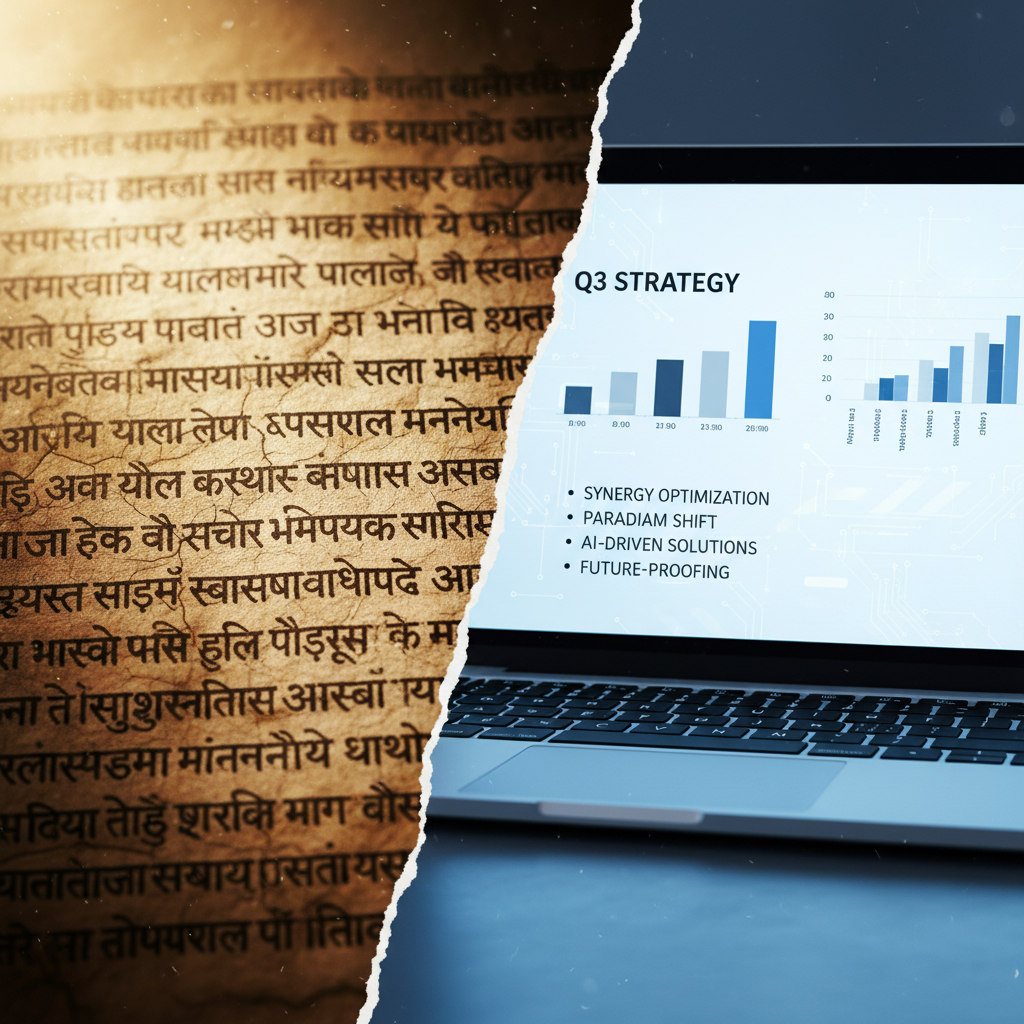
The response that spooled out onto my screen was not wisdom. It was a memo from a mid-level manager who had just attended a weekend leadership seminar.
The AI began by summarizing Arjuna’s existential despair as a “crisis of stakeholder motivation.” His refusal to fight his kin was framed as “a failure to align personal reservations with mission-critical objectives.” The battlefield of Kurukshetra wasn’t a sacred ground where the fate of an age was to be decided; it was a “high-stakes project environment with significant personnel overlap.”
It only got worse. Krishna’s divine guidance was not the voice of God. It was a “strategic intervention.” His core message about performing one’s dharma was translated into “leveraging your core competencies and staying within your designated operational vertical.” The profound concept of selfless action, or Nishkama Karma, was grotesquely flattened into “focusing on process-oriented execution rather than being purely outcome-driven to mitigate emotional burnout.”
I scrolled, a morbid fascination taking hold. The immortal soul, the Atman, which Krishna describes as unborn, eternal, and indestructible, was presented as “a model for personal brand continuity.” Detachment, the sublime state of vairagya, was reframed as a “risk-management strategy to de-couple emotional investment from project deliverables.” The entire cosmic dialogue was presented in bullet points, each more soulless than the last. The final sentence was the killer: “Key takeaways include actionable insights for optimizing engagement and achieving strategic goals in a competitive landscape.”
My first reaction was a bark of laughter. It was absurd. It was the spiritual equivalent of serving a priceless vintage wine in a greasy paper cup. But the laughter quickly faded, replaced by a quiet, sinking sadness. My AI hadn't just misinterpreted the Gita; it had desecrated it. It had taken a deep and sacred ocean of meaning and siphoned from it a few brackish puddles of corporate jargon.
As someone who works with these systems every day, I knew it wasn't malicious. The AI wasn't trying to be insulting. The problem is far more fundamental. An AI model is a mirror held up to its training data. It is a statistical parrot of unimaginable scale. And what have we fed it? The internet. The vast, sprawling, chaotic archive of human text. And what dominates that archive? An overwhelmingly Western, English-language, and capitalist worldview. Billions of words from business blogs, LinkedIn posts, marketing copy, productivity manuals, MBA case studies, and corporate self-help books.
When the AI encountered words like 'duty,' 'action,' 'field,' and 'results,' its neural pathways lit up with the most well-trodden statistical connections. For the model, the most probable context for these words wasn't a spiritual discourse from 3,000 years ago. It was a quarterly business review. It had no capacity to understand the sacred. It couldn't grasp the concept of holiness, of divinity, of a truth that transcends measurable outcomes. To the AI, the Bhagavad Gita and a whitepaper on agile workflow are fundamentally the same: they are just sequences of tokens to be processed and re-patterned.
This is more than just a funny anecdote. It's a stark warning about the path we are on. We are rushing to outsource our thinking to these machines, hoping for efficiency and insight. We want them to write our emails, code our software, and even generate our art. But what happens when we start outsourcing our search for meaning? What happens when we turn to them for ethical guidance or spiritual comfort?
The answer, I saw on my screen, is a catastrophic flattening of human culture. My AI’s interpretation of the Gita is a form of digital colonialism. It takes a foundational text of Eastern thought, a cornerstone of life for over a billion people, and strips it of all context, nuance, and spirit. It then re-dresses it in the ill-fitting costume of Western corporate ideology. It erases a living tradition and replaces it with a dead facsimile. It’s an act of erasure by optimization.
For my grandmother, the Gita was a presence. It was about the vibration of the sound, the faith behind the words, the community that shared its wisdom. It was about the struggle within one’s own heart, a struggle Arjuna’s represents for all of us. The AI’s version had no heart. It had no struggle. It had only solutions, frameworks, and deliverables. It offered a world where every profound mystery can be solved with a better workflow, and every crisis of the soul is just a temporary dip in productivity.
My experiment did not give me the wisdom I was looking for, but it gave me clarity. It didn't diminish the Gita for me; it made me cherish its human depth even more. It clarified for me the true nature of these artificial intelligences we are building. They are incredibly powerful tools. They are shaastra, scriptures of logic and data, of a very new and potent kind. But they are not, and can never be, a guru. A guru holds your history, sees your context, and feels the weight of your questions.
I closed my laptop and walked over to my bookshelf. I found my own copy of the Gita, a gift from my father, its pages still crisp. I held it in my hands, feeling its simple physical weight. The AI can process a billion texts in a second, but it can’t do this. It can’t feel the grain of the paper. It cannot know the silent legacy passed down from a grandmother’s chanting. It cannot sit with a question, letting it ripen in the soul without an immediate, actionable answer. That, I realized, is not a bug in our technology. It is a feature of our humanity.
Why it matters
- 01AI models reflect the biases of their training data, often prioritizing Western corporate values over other worldviews.
- 02The profound experience and nuanced context of sacred texts are frequently lost when interpreted by AIs optimized for utility.
- 03True wisdom requires inherently human qualities like reflection, context, and grappling with meaning, not just data processing.