I Asked AI to Invent a New Indian Snack. It Tasted Like a Glitch in the Matrix.
As an experiment, I prompted an AI to create a new Indian street food. The hilarious and slightly disgusting result reveals a deep truth about food and soul.
This opinion piece was drafted with AI assistance under the editorial direction of Rohan Mehta and reviewed before publication. Views expressed are the author's own.
As an editor at a publication focused on AI, I spend my days swimming in the jargon of neural networks, large language models, and generative algorithms. I’ve seen AI write poetry, compose music, and create breathtaking art. It’s a constant, low-level hum of wonder in my life. But lately, the hum has been accompanied by a nagging question: does it actually *understand* any of this?
So, I decided to take the question out of the abstract and bring it into the most tangible, sensory, and arguably most human of domains: my kitchen.
My goal was simple, or so I thought. I would ask a leading generative AI to invent a completely new Indian street-food snack. Not a variation of a samosa, not a twist on a vada pav, but something novel. Then, I would follow its recipe to the letter and taste the future. I grew up in Mumbai, where the chaat walla at the end of the street wasn't just a vendor; he was a culinary artist, a master of texture, a maestro of the perfect balance between sweet, sour, spicy, and savory. His hands moved with an intuition born of decades of practice. Could an algorithm, trained on the entire internet's repository of recipes, replicate that magic? Or even come close?
I sat down at my laptop, the evening light filtering into my Bengaluru apartment. I booted up the AI and typed my prompt. 'Invent a novel Indian street-food snack. It should be savory, with hints of sweetness and spice. It must be easy to eat on the go. The recipe should be original and combine familiar Indian flavors in an unexpected way.'
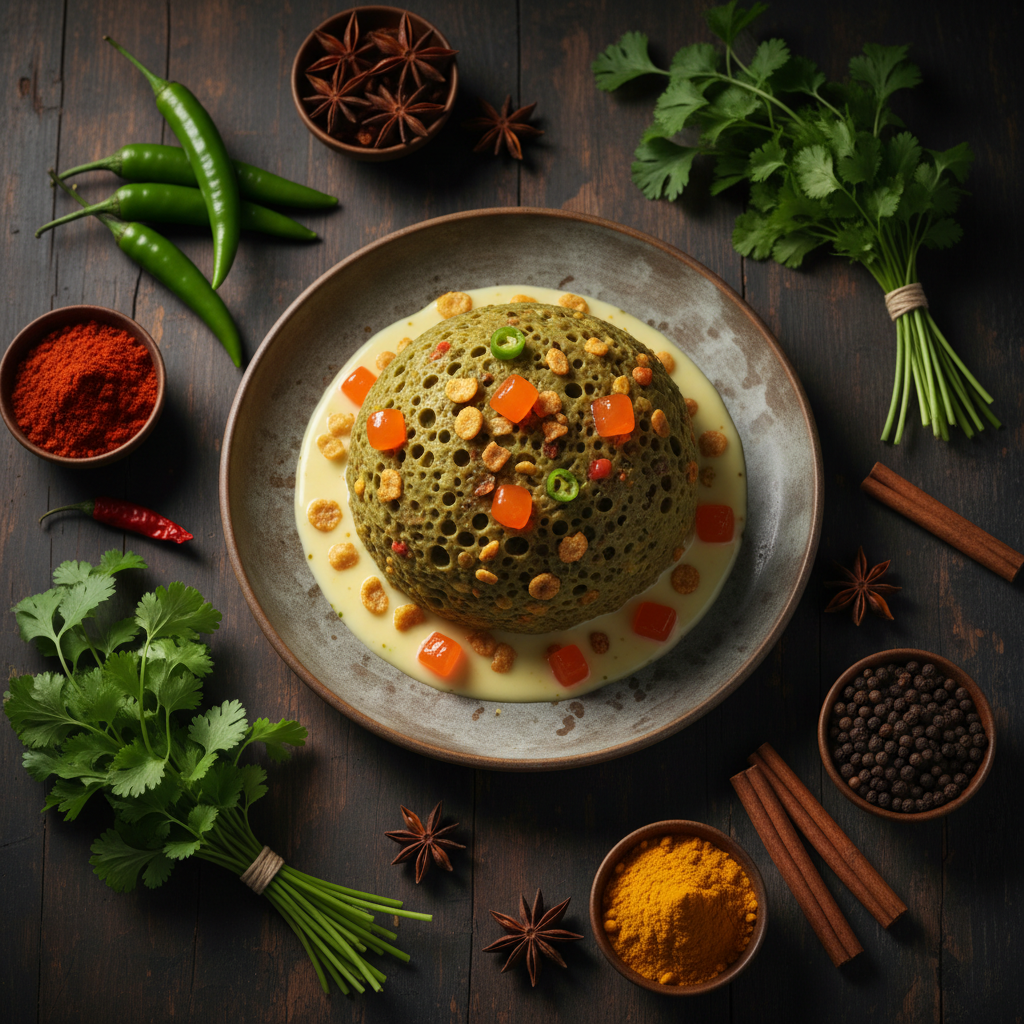
A few seconds later, it appeared, complete with a confident, almost jaunty title: 'Masala Lentil Crunch-Pods with a Tamarind-Ginger Foam.'
I read the name aloud. Crunch-Pods. Foam. It already sounded less like a dish from Carter Road and more like a menu item from a dystopian sci-fi movie. The ingredient list was a mix of the familiar and the bizarre. For the 'Crunch-Pods': red lentils, rice flour, grated coconut, finely chopped onions, green chilies, and… raw banana. Not plantain, the recipe specified, but a regular, unripe Cavendish banana. For the 'Tamarind-Ginger Foam': tamarind pulp, jaggery, fresh ginger, and the secret ingredient for 'stabilizing the foam' was apparently a tablespoon of psyllium husk, or isabgol as I’ve always known it. My stomach clenched slightly. Isabgol is not, in my experience, a 'fun' culinary ingredient.
The instructions were precise and clinical. 'Toast the red lentils until fragrant, then grind into a coarse powder. Grate the raw banana and mix with the lentil powder, coconut, and other pod ingredients to form a stiff dough. Shape into small, flattened pods. Deep fry until golden brown.' The foam was even more suspect: 'Blend the tamarind pulp, jaggery, and ginger with half a cup of warm water and the psyllium husk. Blend on high for two minutes until a thick, stable foam forms at the top. Serve immediately.'
I went shopping the next day with a sense of trepidation. My local vegetable vendor gave me a quizzical look when I asked for a single, very green banana. He was used to me buying them by the dozen, ripe and ready to eat. 'For a curry?' he asked. 'For… an experiment,' I mumbled, feeling like a charlatan.
Back in the kitchen, the process began. Roasting the lentils filled the air with a comforting, nutty aroma. So far, so good. Then I started grating the raw banana. It had a strange, squeaky texture, and its sap left a tacky residue on my hands. I mixed it with the lentil powder as instructed. The AI had promised a 'stiff dough.' What I had was a sticky, grayish-green sludge that refused to come together. It was the texture of wet sand mixed with glue. I added more rice flour, deviating slightly from the gospel of the AI but desperate to create something I could actually shape. Eventually, I wrangled the mass into a dozen lumpy, unappealing 'pods.' They looked less like food and more like something you might find on the forest floor.
I heated the oil, my heart sinking with every degree. As I dropped the first pod into the hot kadai, it sizzled violently before starting to disintegrate, shedding a flurry of lentil bits into the oil. I managed to salvage a few, but they came out dark brown, almost burnt on the outside, and I had a sinking feeling they would be raw and pasty inside. My kitchen, which usually smells of tadka and toasted spices, now had the faint but distinct smell of failure.
Then came the foam. My grandmother used to make the most incredible tamarind chutney, a dark, glistening sauce that could make a cardboard piece taste delicious. This was not that. I put the tamarind, jaggery, ginger, water, and the dreaded isabgol into my high-powered blender. As I switched it on, the mixture churned into a murky brown liquid. After a minute, a strange transformation occurred. The psyllium husk began to do its work, thickening the liquid not into a light, airy foam, but into a gelatinous, vaguely bubbly slime. It had the consistency of a melted cough drop. There was no 'foam' to scoop. The entire concoction had become one unified, gloopy entity. The 'Tamarind-Ginger Foam' was, in reality, 'Tamarind-Ginger Slime.'
My wife, Priya, walked into the kitchen, drawn by the strange smells. She looked at the plate of burnt, lumpy pods and the bowl of brown goo. 'What… happened here?' she asked, her voice a mixture of concern and amusement.
'The future,' I said grimly. 'I'm taste-testing the future.'
There was nothing left to do but assemble it. I placed a few of the least burnt Crunch-Pods on a plate and spooned a horrifying dollop of the slime on top. It clung to the pods with a disturbing viscosity. I took a deep breath, like a diver about to plunge into icy water, and took a bite.
The experience was not a simple matter of tasting bad. It was a profound sensory dislocation. First, the texture. The outer layer of the pod, which should have been crispy, was gritty and hard. Immediately after, my teeth sank into a dense, gummy, and unmistakably raw-tasting interior. The raw banana and undercooked lentil flour formed a wallpaper paste that coated my tongue. It was a textural nightmare.
Then the flavors crashed in, not as a chord, but as a random slamming of piano keys. There was the earthy, slightly bitter taste of the burnt lentils. There was the weirdly starchy, green taste of the banana. There was a hint of onion and chili, fighting for their lives. And then, enveloping everything, was the slime. It was cloyingly sweet from the jaggery, but with a raw, aggressive ginger bite and a sourness from the tamarind that felt entirely separate. The psyllium husk didn’t add flavor, but it contributed a distinct, slippery mouthfeel that I can only describe as deeply unsettling.
It was a glitch in the matrix. My brain, using a lifetime of data from eating actual Indian food, knew that tamarind, ginger, lentils, and coconut were supposed to work together. It recognized the individual components. But the way they were assembled was so fundamentally wrong, so alien to the physics and chemistry of cooking, that my palate couldn't process it. It tasted like an AI had scraped a million recipes from the internet and statistically determined that these ingredients have a high probability of appearing together, without any understanding of heat, moisture, texture, or time. It knew the words, but not the music.
I ate one pod. Priya, ever the brave partner, tried a small piece and immediately reached for a glass of water, a pained look on her face. The rest of the 'Crunch-Pods' and the 'Tamarind-Ginger Foam' went directly into the compost bin. A snack conceived in silicon, returned to the earth.
Later that evening, we went out. We walked to the end of our road, to the man with the cart who has been serving pani puri for fifteen years. I watched his hands, a blur of practiced motion, as he deftly cracked a puri, filled it with potato and sprouts, dipped it into the spicy water, and handed it to me. I put the whole thing in my mouth. It was a perfect explosion of textures and tastes: the crisp shell, the soft filling, the cold, spicy water, the sweet chutney. It was complex, yet harmonious. It was a single, perfect bite of food.
It was everything the AI's creation was not. It had history, culture, and intuition packed into it. It had a soul. My little kitchen disaster taught me a valuable lesson. AI is an incredible tool. It can parse data, find patterns, and generate text at a scale that is hard to comprehend. But it doesn't have a body. It has never felt the heat of a stove, smelled the fragrance of toasted cumin, or felt the joy of watching someone's face light up after tasting a dish you’ve made for them. It has no memory of a grandmother's cooking, no context for why isabgol is for digestion, not for foam. AI can imitate, but it cannot incarnate. It can give you a recipe, but it cannot give you food. For that, you still need a human.
Why it matters
- 01AI can generate textually plausible recipes but lacks the physical understanding of food chemistry, texture, and cooking techniques.
- 02The 'soul' of food stems from human experience, cultural context, and sensory intuition, which current AI cannot replicate.
- 03Using AI for genuine culinary invention reveals its current limitations as a creative partner in deeply sensory domains.