I Became My Family’s Unofficial AI Tech Support. It’s More Philosophy Than Troubleshooting.
My parents in Delhi use AI for everything, and I’m their help desk. The calls are not about bugs, but about AI ethics, bias, and what it means to be human.
This opinion piece was drafted with AI assistance under the editorial direction of Rohan Mehta and reviewed before publication. Views expressed are the author's own.
The call from my father in Delhi came on a Tuesday morning, my Monday evening. It wasn’t about the Wi-Fi router again, nor was it a request to help him figure out why his streaming service had logged him out. This was different. ‘Beta,’ he started, his voice a familiar mix of curiosity and consternation, ‘I asked this Genie thing to plan a day trip to Agra for your mother and me.’
My parents, both in their late sixties, have christened every AI chatbot ‘the Genie’. It’s their catch-all term for the disembodied voice that now helps them with everything from summarizing the 300+ unread messages in the extended family WhatsApp group to suggesting what to cook for dinner based on the vegetables left in the fridge.
‘So what’s the problem, Dad?’ I asked, picturing him at his desk, peering at his monitor over his reading glasses.
‘It gave me a perfect itinerary,’ he said. ‘Train times, monuments, even a lunch spot. But it also recommended a “sunset sound-and-light show at the Mehtab Bagh reflections pool”. I’ve been to Agra a dozen times. There is no such show.’ He paused. ‘So my question is… why did it lie to me?’
This is my new life. I am no longer just a son; I am my family’s unofficial AI tech support, a role that has surprisingly little to do with technology and almost everything to do with philosophy. The questions I get aren’t about error messages or processing speeds. They are about the nature of truth, the texture of culture, and the ethics of outsourcing our thoughts.
Just a few years ago, I was the one patiently explaining how to attach a photo to an email. Now, I’m explaining the concept of AI ‘hallucinations’. I tried to put it in terms he’d understand. I told him that the Genie isn’t a library, retrieving facts from a shelf. It’s a storyteller, a master weaver of words who has read almost the entire internet but understood none of it. It knows what words are statistically likely to follow other words. ‘Sunset’, ‘Agra’, and ‘show’ are probable companions, so it confidently wove them into a plausible-sounding, but entirely fictional, event. It’s not lying, I explained, because it doesn’t know it’s not telling the truth. To lie requires intent, a knowledge of the truth you are choosing to subvert. The Genie has neither.
He was quiet for a moment. ‘So it’s a very confident idiot?’ he finally concluded. I couldn’t have put it better myself. That one conversation about a non-existent light show sparked a half-hour debate about epistemology and the difference between knowledge and information. It was deeper than most conversations we’d had all year.
Then there’s the culture gap. A week later, my mother called. She had asked the Genie to help her draft an email to the Residents’ Welfare Association about the erratic water supply. She read the draft to me over the phone. It was polite, grammatically perfect, and scrupulously formal. It was also completely wrong.
‘It sounds so… American,’ she complained. ‘So cold. If I send this, Mr. Sharma in Flat 4B will think I am trying to pick a fight.’ She was right. The AI-generated text lacked the deferential, slightly meandering, and community-focused tone that is essential for getting anything done in a Delhi housing society. It went straight to the point, which in our cultural context can be interpreted as aggression. It didn’t include the requisite soft-pedaling, the inquiries about health, the gentle reminders of shared purpose.
I found myself explaining the concept of training data. I told her the Genie’s finishing school was the internet, a place where the English language and Western norms of communication are overwhelmingly dominant. Its politeness is a corporate, HR-department politeness, not the nuanced, relationship-based politeness of a community in South Delhi. Its brain is a reflection of the data it ingested, a digital monument to a specific worldview. To use it effectively in India, you have to be more than a user; you have to be a cultural translator. She had to take its sterile prose and inject it with the warmth, the context, and the uniquely Indian cadence it lacked. She ended up writing the email herself, but used the Genie’s draft as a base. ‘It’s a good starting point,’ she admitted, ‘but it has no soul.’
These conversations are fascinating, but the one that truly stopped me in my tracks was about death. A distant relative had passed away, and my father, struggling to find the right words for a condolence message, considered asking the Genie for help. He called me before he did it, his voice laced with an uncertainty I’d rarely heard.
‘Is it wrong?’ he asked. ‘To use a machine for this? It feels… disrespectful. Like I don’t care enough to write it myself.’
This wasn’t a technical question. There was no bug to fix, no setting to adjust. This was a purely ethical, deeply human dilemma. I didn’t have an easy answer. We talked for a long time. I asked him what his intention was. Was he trying to avoid the emotion of it, or was he simply struggling with the formula of it, the fear of saying the wrong thing at a delicate time?
We talked about how people have used templates for such things for centuries—phrases learned from elders, lines from religious texts, even pre-written cards. Is an AI suggestion really so different from a Hallmark card? We concluded that perhaps the tool itself wasn’t the issue. The danger wasn't in asking for a draft, but in accepting it wholesale without infusing it with genuine feeling. The AI could provide the structure, the scaffolding, but the sentiment, the memory of the person, the specific note of shared grief—that had to come from him. The sincerity is not in the initial composition, but in the final, human-felt endorsement.
He decided to ask the Genie for a few options. He told me later it gave him a starting point that he then spent an hour rewriting, weaving in a personal memory that made the message uniquely his. The machine provided the syntax, but he provided the soul.
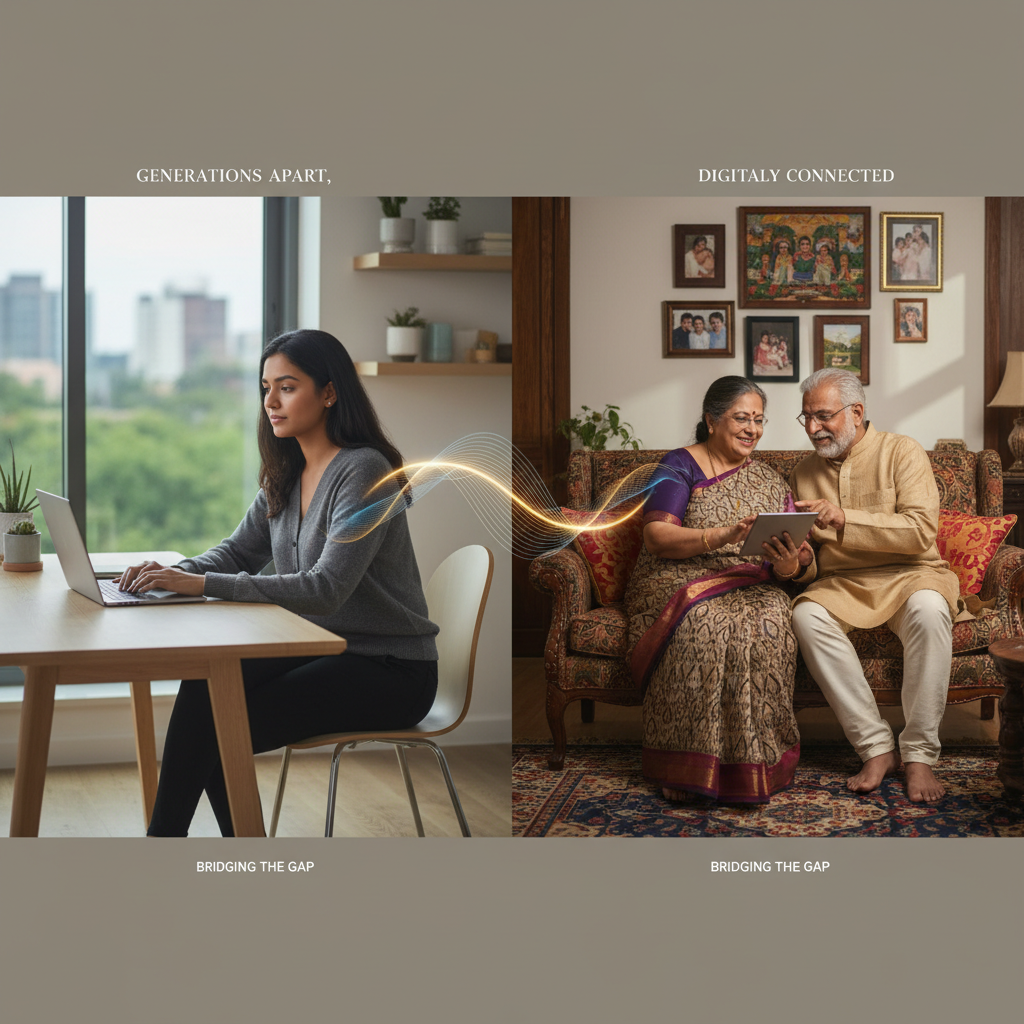
Being my family’s AI help desk has become a bridge between my world as a tech editor and their lived reality as new adopters. It has collapsed the distance between Mumbai and Delhi, between my generation and theirs, in unexpected ways. These calls are a constant reminder that the most significant impact of artificial intelligence might not be in how it transforms our economies or our work, but in the conversations it forces us to have about ourselves.
We’re all grappling with these new questions. I see it among my friends, my colleagues, and now, my own parents. We are all becoming amateur philosophers, debating the definitions of authenticity, creativity, and consciousness over dinner tables and video calls. The technology is new, but the questions are as old as humanity itself. And as I help my father debug an AI’s fiction or help my mother translate its culture, I realize I’m not really troubleshooting the AI. I’m helping them, and myself, troubleshoot what it means to be human in a world we now share with intelligent machines. And for a tech support role, it’s a surprisingly meaningful job.
Why it matters
- 01The new AI-driven tech gap forces families into deep, philosophical conversations about truth, culture, and authenticity.
- 02Mainstream AI models often carry a Western cultural bias, requiring users to consciously adapt and edit for their own context.
- 03Navigating the ethics of AI, like for personal messages, involves questioning intent and the value we place on human creation versus machine assistance.