I Fed My Private Journals to an AI. It Was Unsettling and Illuminating.
I ran years of my private, unfiltered journals through a local AI. The experience was an act of extreme digital vulnerability and radical self-awareness.
This opinion piece was drafted with AI assistance under the editorial direction of Rohan Mehta and reviewed before publication. Views expressed are the author's own.
There's a digital box where I’ve kept a version of myself for fifteen years. It's not a cloud drive or a fancy app; it's just a folder on an encrypted hard drive, filled with hundreds of simple text files. These are my journals. They are not curated for an audience. They are a raw, unfiltered stream of consciousness: the anxieties of a final year student in Mumbai, the thrill and terror of my first real job in Bangalore, the quiet grief of losing a grandparent, the mundane frustrations with Delhi traffic.
For years, this folder has been a sacred space, a one-way conversation with myself. The idea of anyone else reading it, even by accident, was a source of low-grade panic. And yet, a few weeks ago, I did something that felt like a profound betrayal of that privacy. I copied the entire folder, pointed a piece of software at it, and instructed an AI to read every single word.
This wasn't ChatGPT or Gemini. The tool I used was a powerful large language model, but one running entirely locally on my own machine. No data was sent to a server in California or anywhere else. The entire process was air-gapped from the internet. This detail is everything. It was the only reason I could even contemplate the experiment. It was an act of digital vulnerability, but a contained one. A conversation between me, myself, and a silicon ghost in the machine.
I started with a simple prompt: "Analyze the dominant emotional themes in these texts, year by year." I watched the command line flicker, my processor fan whirring to life. It felt like inviting a stranger into the most private room of my house and asking them to tell me what they thought of the decor. The response that came back seconds later was clinical, detached, and utterly unnerving.
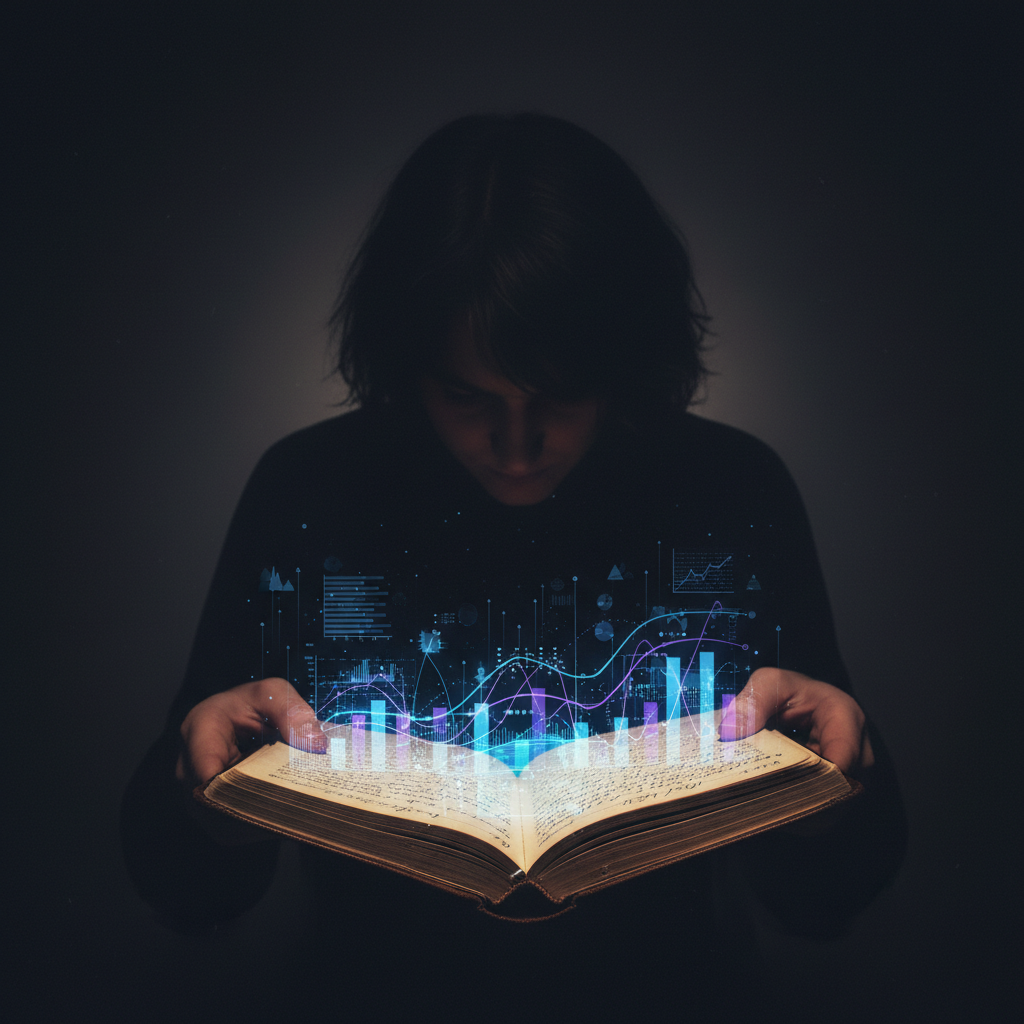
A summary of my dominant emotional states, charted over time. There it was, in stark detail: a recurring pattern of burgeoning professional optimism in the first half of the year, followed by a sharp, predictable trough of what the AI termed ‘relational anxiety and existential fatigue’ in the last quarter. I felt a chill. I had always felt this rhythm, this annual dip in my spirit that had little to do with the seasons, but I’d dismissed it as just ‘life’. The AI didn’t dismiss it. It mapped it. It showed me the cycle as clearly as a stock market chart.
Next, I asked it to identify my verbal tics when expressing stress. I’ve always prided myself on being a precise communicator, a byproduct of my profession. The AI gently disagreed. It produced a list of my ‘crutch phrases.’ When stressed or uncertain, I apparently begin sentences with “I suppose, at the end of the day…” or “Ultimately, the fact of the matter is…” more than 70% of the time. These are phrases of false authority, little linguistic shields I hold up to deflect from the simple, terrifying truth: “I don’t know.” I read the list and laughed, but it was a hollow sound. I had just used the phrase “at the end of the day” in a meeting that very morning.
The experience went from unnerving to deeply unsettling when I asked it about my hidden anxieties. I prompted: "Based on subtext and recurring topics, what are the core, unnamed anxieties present in these journals?" The model connected disparate entries I had long forgotten. A journal entry from 2014 about the stress of a university exam was linked to a 2021 entry about a delayed client payment, and another from 2023 about my parents’ health. The AI’s conclusion: a deep-seated, persistent fear of ‘losing control over external outcomes.’ It wasn’t a fear of failure, but a fear of events unfolding without my input. This was a truth so profound and so private that I had never consciously articulated it to myself, let alone anyone else. An algorithm had diagnosed a core part of my psyche by pattern-matching my own words back to me.
But this journey into my digital subconscious wasn't just terrifying. It was also strangely, powerfully illuminating. The AI was a mirror, but not like a human one. A friend or a therapist brings their own biases, their own need to soften the blow, their own emotional response. The AI had none of that. It was a judgment-free observer. It didn’t care that my anxieties were cyclical or that my language was evasive. It simply stated the pattern. There was something liberating in that cold, empirical gaze. It stripped away the story I told myself about myself and just showed me the data.
I saw growth I hadn't appreciated. The AI highlighted how my vocabulary around emotions evolved. In my early twenties, my journals described feeling ‘bad’ or ‘stressed.’ By my late twenties, the language was more nuanced: ‘frustrated,’ ‘disappointed,’ ‘ambivalent,’ ‘apprehensive.’ It showed me that, unconsciously, I had been learning to better understand my own internal weather. It also charted my problem-solving approach, showing a clear shift over fifteen years from reactive panic to a more structured, proactive mindset. It was like getting a performance review for my own personality, written by an unfeeling but meticulous observer.
This experiment has left me with a sense of profound ambivalence. As a tool for radical self-awareness, this is unmatched. Imagine having a private, secure oracle that can help you understand your own mind, untangle your own knots, and see your own blind spots. It's the promise of a kind of accelerated wisdom, a shortcut to the kind of self-knowledge people spend lifetimes in meditation or therapy seeking.
But the caveat of ‘private and secure’ is monumental. I think about my home, India, a country that has embraced digital life with an unparalleled passion. UPI, Aadhaar, WhatsApp for everything from neighborhood gossip to national politics. We are a people who adopt technology first and debate the ethics later. The temptation to use a more convenient, cloud-based ‘AI Therapist’ or ‘Journal Analyzer’ will be immense for millions. The thought is chilling.
What happens when our most private, unformed thoughts become a dataset for a corporation? When the anxieties of a nation are aggregated, analyzed, and used to sell products or, worse, shape opinions? It represents the final frontier of surveillance capitalism: the colonization of consciousness itself. We are willingly creating a tool that can know us better than we know ourselves, and we are on the verge of handing the keys over to entities that do not have our best interests at heart.
My journey with my journals was a contained experiment, a dialogue with a reflection of my own mind. The AI was just a mirror. It had no agency, no agenda. It simply showed me what was already there. But it served as a powerful, personal warning. This technology is coming. It will promise us self-knowledge, mental clarity, and emotional support. And it will be incredibly tempting. But before we turn these powerful tools inward, we need to have a very serious, very public conversation about the sanctity of the self. Because once our inner monologues are uploaded, logged, and analyzed, there is no getting them back. It's the last private space we have left.
Why it matters
- 01Feeding private journals to a local, secure AI reveals unsettlingly accurate emotional patterns and verbal tics.
- 02The AI acts as a judgment-free mirror, offering a cold but liberating path to radical self-awareness without social filters.
- 03While powerful for introspection, the use of AI on personal data raises profound privacy concerns for the future.