I Used an AI to Budget My Indian Wedding. It Was Shockingly Sensible.
When faced with planning a 'Big Fat Indian Wedding,' I turned to AI for help. It handled the complex logistics brilliantly, but missed the cultural heart.
This opinion piece was drafted with AI assistance under the editorial direction of Rohan Mehta and reviewed before publication. Views expressed are the author's own.
There’s a moment of silence that falls over every newly engaged Indian couple. It happens right after the congratulatory phone calls have ended and the last of the celebratory mithai has been put away. It’s the silence before the storm. The storm, of course, is the ‘Big Fat Indian Wedding.’ My fiancée, Priya, and I found ourselves in that exact silence a few months ago, staring at a blank spreadsheet on my laptop. The cursor blinked rhythmically, mocking our blissful ignorance.
How do you even begin to budget for an event that is less a single day and more a multi-day festival? An event where the guest list possesses the fluid dynamics of a quantum particle, and where line items include things like ‘gold jewellery by weight’ and ‘shagun envelopes for 200 relatives.’ As an editor at an AI publication, my professional life is spent contemplating how machines are reshaping our world. In a moment of either genius or desperation, I decided to bring my work home. I turned to my digital counterpart and asked it to plan the budget for my very own, very big, very Indian wedding.
The task was monumental. Indian weddings are not just financial transactions; they are a complex tapestry of tradition, family obligation, social status, and genuine celebration. My prompt to the custom GPT I’d been tinkering with was absurdly detailed. I fed it our total estimated budget, the city (Delhi), the number of core events (Mehendi, Sangeet, Haldi, Wedding, and Reception), and an estimated guest count that came with a massive asterisk. I specified that guest numbers would vary by event — fewer for the intimate Haldi, a deluge for the Reception. I added categories unique to our culture: ceremonial costs, gifts for close family, outfits for five separate functions, and the all-important gold purchase.
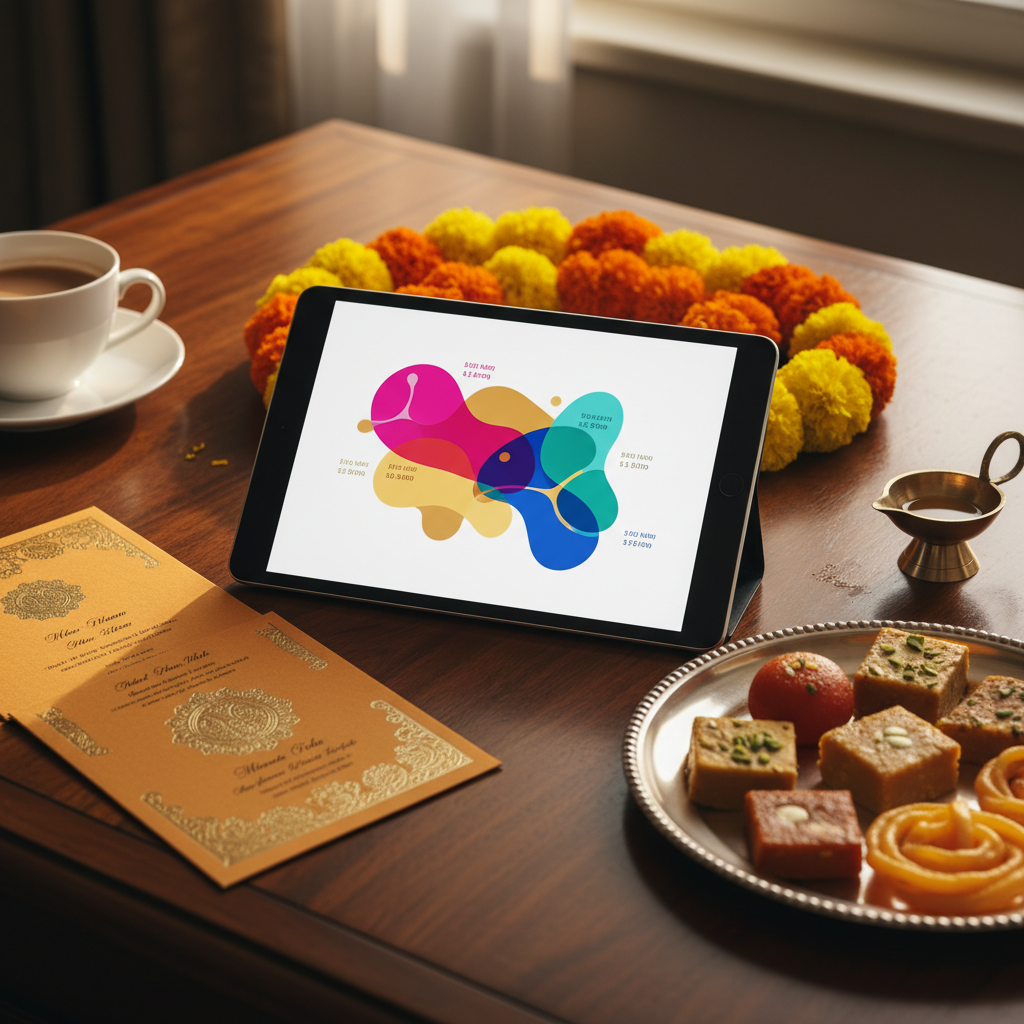
The first draft budget it produced was, as my title suggests, shockingly sensible. It was a masterpiece of cold, hard logic. The AI took our lump sum and allocated it into percentages with terrifying accuracy. It assigned roughly 40% to venue and catering, 15% to décor, 10% to photography, 10% to outfits and stylists, and so on. It wasn't just guessing; it was clearly pulling from vast datasets of vendor pricing in the Delhi-NCR region. It created a beautiful, logical framework where none had existed before.
Its real strength was in scenario planning. Our biggest point of anxiety was the guest list. My father has a tendency to invite his entire professional network out of sheer goodwill. I could ask the AI, “What happens to the budget if we add 75 guests to the reception?” Instantly, it would adjust the catering cost-per-plate, increase the budget for return gifts, and even suggest that we might need to rent a larger venue, showing the cascade of financial consequences. This was revolutionary. It depersonalized the often-tense conversations with our parents. Instead of me being the bad guy, I could just point to the screen and say, “Look, the algorithm says it will put us 20% over budget.” The AI became an impartial third-party negotiator.
It was brilliant at logistics. It recommended booking the same venue for the Sangeet and Wedding to get a bulk discount. It cross-referenced decorator price lists with reviews it found online. It created a payment schedule, reminding me when vendor deposits were due. For the logistical skeleton of the wedding — the pure project management aspect — the AI was an unparalleled assistant. It was methodical, tireless, and utterly devoid of the emotional baggage that makes wedding planning so fraught. It was turning the chaos into a neatly organized set of variables.
But a wedding, especially an Indian one, is more than a set of variables. And this is where my digital planner began to show its limitations. The cracks in its logic appeared when faced with the deeply human, often irrational, elements of our culture. The first major blind spot was the gold.
For the AI, gold was just another line item, a commodity. It suggested tracking market prices and buying during a dip. It treated it like an investment in a mutual fund. It had no concept of what it actually means. It didn't understand that the necklace Priya would wear wasn't just a purchase; it was a piece of our family's history in the making. It couldn't grasp the idea of visiting our family jeweler, a man my grandfather first bought from, to sit for hours sipping chai and co-designing the pieces. The AI saw a transaction; it missed the tradition. It couldn’t differentiate between the gold we were buying as an asset and the pieces that were gifts, part of a generational transfer of wealth and love.
Then came the vendors. The AI, optimizing for cost and public reviews, presented a list of top-rated, competitively priced photographers and caterers. This makes perfect sense on paper. But it failed to account for the unwritten ledger of relationships. It didn’t know that my mother has a favorite decorator, ‘Gupta-ji,’ who has orchestrated every major family event for the past thirty years. His aesthetic might not be the most modern, and his quote might be 10% higher than an online competitor, but the trust and peace of mind he provides are invaluable. The AI can’t quantify trust built over decades. It can’t understand that Gupta-ji will throw in extra floral arrangements just because he’s known me since I was a child.
Nowhere was this gap between logic and life more apparent than in the category it labeled ‘Gifts for Relatives.’ The AI dutifully allocated a per-person budget. Simple. Except it’s not. My programming couldn’t possibly comprehend the intricate, unspoken hierarchy that dictates these things. It doesn’t know that Priya’s eldest maternal aunt, who is flying in from Toronto, must receive a more elaborate silk saree than a local cousin. It can’t grasp the nuanced calculus that determines the exact, non-round number to be placed in a shagun envelope for a specific relative. This is a social matrix of love, respect, and subtle power dynamics that only a seasoned Indian mother truly understands. For the AI, it was all data; for my mom, it was a demonstration of our family’s grace and respect.
And finally, the AI had no concept of the ‘chaos budget.’ A human wedding planner, or indeed any experienced Indian parent, knows that a significant chunk of money needs to be set aside for things that will inevitably go wrong or be added at the last minute. The band for the baraat demanding extra for playing ten minutes longer; a sudden need for an industrial-sized cooler because of an unexpected heatwave; my uncle deciding, on the day of the Sangeet, that a live jalebi counter is absolutely essential. The AI saw these as deviations from the plan. A human sees them as part of the plan.
Ultimately, I realized the AI wasn't the pilot of this chaotic journey. It was the copilot. It was the navigator. It provided the map, crunched the numbers, and kept us on a broadly correct path. It was the perfect tool for building the scaffolding of our budget. With its logical framework in hand, Priya and I could then sit with our parents and fill in the details with human wisdom, cultural context, and emotional intelligence. The AI provided the ‘what,’ and our families provided the ‘why.’
Using AI to budget my wedding didn't strip the process of its humanity; it protected it. By outsourcing the mind-numbing number-crunching and scenario modeling, it freed up our mental and emotional bandwidth to focus on what truly matters: the personal touches, the family connections, and the traditions that will make this wedding ours. The future of planning isn't about choosing between a human and an AI. It's about a partnership. The machine handles the spreadsheets, so we can focus on the soul.
Why it matters
- 01AI is an exceptional tool for managing the logistical complexity and scenario planning of a large wedding budget.
- 02The true value of an AI planner is in providing a logical, data-driven foundation for emotional and cultural family discussions.
- 03AI still falls short in understanding the unquantifiable value of tradition, personal relationships, and cultural nuances in financial decisions.