I Was an AI Ghost Worker for a Day. Here's What I Saw.
My job was to teach AI how to see the world, one click at a time. An immersive look into the invisible human labor that powers today's biggest tech.
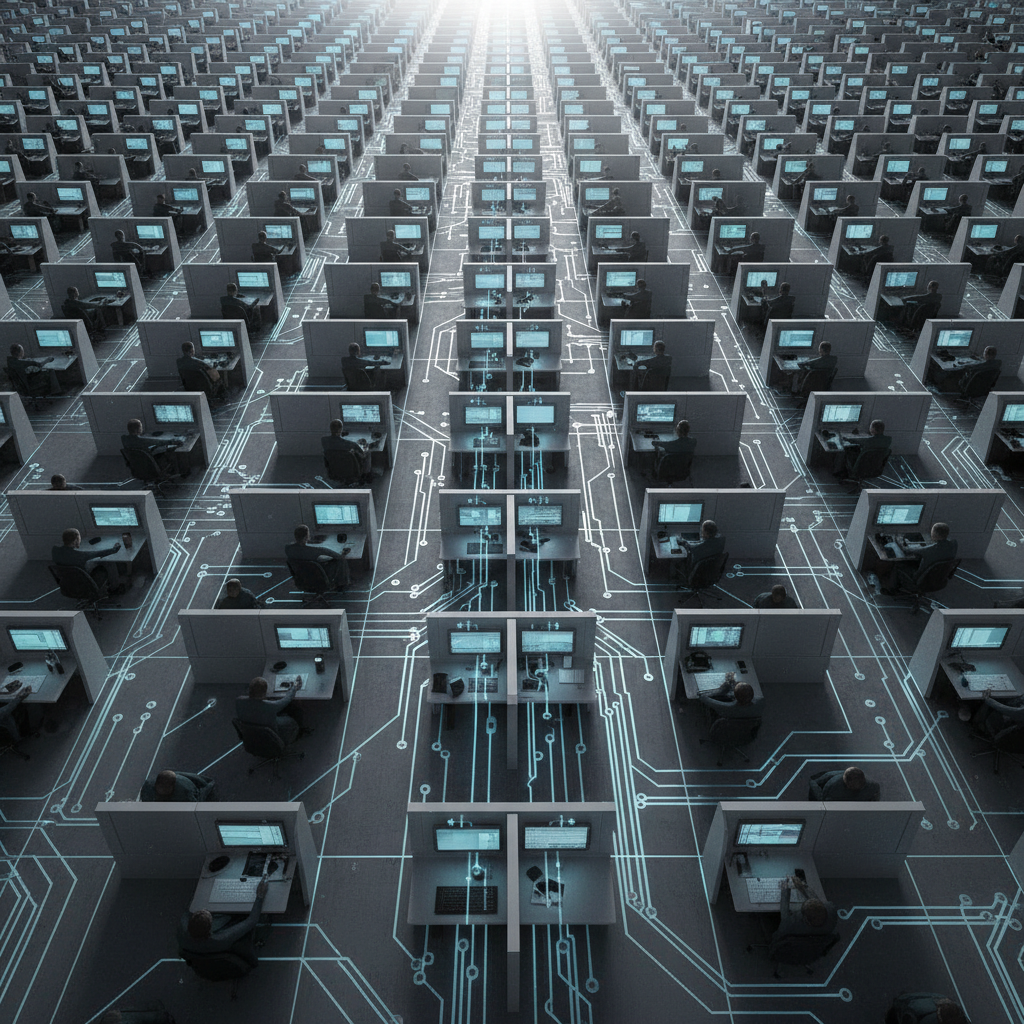
This opinion piece was drafted with AI assistance under the editorial direction of Rohan Mehta and reviewed before publication. Views expressed are the author's own.
As an editor at a publication focused on AI, my inbox is a constant flood of breathless press releases. ‘Revolutionary.’ ‘Game-changing.’ ‘A new paradigm.’ We talk about large language models as if they are nascent gods, conjuring poetry and code from the digital ether. We marvel at computer vision systems that can diagnose diseases or pilot a car through the chaotic streets of Mumbai. The prevailing narrative is one of magic, of non-human intelligence spontaneously emerging from silicon.
But a nagging question has always lingered for me, a question that cuts through the hype. If AI is learning, who is the teacher? I decided the only way to truly understand was to become one. For one full day, I logged off my editor account and became a ghost in the machine: a micro-task data annotator.
Signing up was surprisingly easy. There are dozens of platforms, global marketplaces for digital piecework. I picked one with a generic, vaguely futuristic name and within twenty minutes, I was looking at a dashboard filled with HITS, or ‘Human Intelligence Tasks.’ The irony was not lost on me. My human intelligence was being offered up for pennies.
My first assignment was a classic. The task was simple: draw bounding boxes around all the vehicles in a series of images from a dashboard camera. The pay was a paltry $0.02 per image. Easy, I thought. I’ve lived in Bengaluru my whole life; I know what a vehicle is.
The first image popped up: a fairly standard street scene in what looked like a North American suburb. I started clicking and dragging. Car, car, SUV, truck. Done. The next image appeared. This one was trickier. A motorcycle was partially obscured by a bus. Did I have to label the whole bus, or just the part I could see? The instructions, a dense wall of text, said to label all visible parts. Another box. Then a car in the distance, so blurry it was just a few pixels. Was it a car, or a mailbox? I hesitated, my cursor hovering. My two cents, and the accuracy of some future self-driving algorithm, hung in the balance. I made a guess and moved on.
For the next two hours, this was my world. I drew boxes around cars, pedestrians, traffic lights, and street signs. The work was mind-numbingly repetitive. Click, drag, release. Click, drag, release. The images, stripped of context, became surreal. A lone bicycle on an empty highway at dawn. A dense crush of cars in a rainy, neon-lit cityscape that could have been Tokyo or anywhere. I wasn’t a person looking at a street; I was a human script, executing a function. My brain, with its ability to find nuance and beauty, was being used as a simple pattern-recognition tool.
I felt a strange sense of disembodiment. My hands were doing the work, but my mind was drifting. I thought about the driver of the car whose camera was capturing these images. I wondered about the people in the photos, frozen in time, their likenesses now a training set, their privacy a commodity exchanged for fractions of a cent.
After completing a few hundred images and earning a grand total of $4.76, I switched tasks, eager for a different kind of monotony. This next one was a text-based task: sentiment analysis. I was presented with a short sentence or a social media post and asked to classify its tone as 'Positive,' 'Negative,' or 'Neutral.'
This is where things got really interesting, and culturally complicated. A post read, “This curry is wicked good.” I’m from India. ‘Wicked’ can mean evil or malicious. I know, contextually, that in some parts of the world it means ‘very.’ I marked it as Positive. But what if the person labeling this was a non-native English speaker from a different country, relying on a translation tool? The subtleties that make language human are the very things that make this work so difficult.
Another one: “My boss is making me work on Diwali. Great.” The sarcasm is obvious to anyone from India or with a passing knowledge of our culture. But an AI, and indeed a worker without that cultural context, might see the word ‘Great’ and file it under Positive. I become, for a moment, an arbiter of cultural nuance for an algorithm that has none. I’m teaching it what it means to be human, to be sarcastic, to be Indian, for $0.01 per judgment.
The pay was even lower here. After another hour and a half, my total earnings for nearly four hours of focused, mentally taxing work were just over seven dollars. If I kept this pace, I might make $14 or $15 in a full eight-hour day. In my life in a major Indian city, that’s not a sustainable wage. But I know for millions of people in less expensive towns, or in countries like Venezuela or the Philippines, that a dollar or two an hour is a powerful draw. The platform is not selling a fun side-hustle; it’s arbitraging global economic despair.
Logging off, my eyes were strained and my wrist ached. But the physical discomfort was nothing compared to the profound sense of unease. I had spent my day performing tasks that were simultaneously incredibly boring and critically important. The ‘magic’ of AI was, in fact, powered by a global assembly line of people like me, performing millions of these tiny, repetitive tasks. We are the ghost workers, the invisible human infrastructure that underpins the automated future.
The engineers who build these models will never see our faces. They will only see the clean, structured data set at the end of the process. They will see the accuracy of their model tick up by a few percentage points, unaware of the human judgment, fatigue, and frustration that went into each label. We are the people who look at the content that is too violent, too explicit, or too bizarre for the algorithms to handle yet. We are the human filter, protecting the machine from the messy reality of the world it is trying to comprehend.
My one-day experiment didn't make me an expert, but it changed my perspective forever. I can no longer read about a new AI breakthrough without thinking about the colossal human effort it erases. Behind every seamless AI interaction is a mountain of clumsy human clicks. Behind every magical answer from a chatbot is a world of ambiguity that a person, somewhere, was paid a pittance to resolve.
We need to change the conversation about AI. We must move from a narrative of magic to a narrative of labor. We must ask hard questions about the ethics of a supply chain that relies on a low-paid, precarious, and invisible workforce. The machines are learning from us, in more ways than one. And what I learned, after just one day, is that the human cost of our automated future is far higher than any of us are being told.
Why it matters
- 01Advanced AI is not magic; it is built on a massive foundation of tedious and often poorly-paid human labor.
- 02The global data annotation workforce operates in a precarious gig economy, powered by worldwide economic disparities.
- 03Our perception of AI must evolve to include the ethical and social implications for the millions of 'ghost workers' who train it.