Mixture of Experts: The AI 'Committee Meeting' Changing Everything
Forget giant, slow AI. New models like Mixtral and GPT-4 work like a committee of experts, calling on specialists for your specific tasks. Here’s why it’s faster.
This opinion piece was drafted with AI assistance under the editorial direction of Rohan Mehta and reviewed before publication. Views expressed are the author's own.
I’ve noticed a new piece of jargon creeping into conversations about AI. You’ve probably seen it too, attached to the names of exciting new models like Mistral’s Mixtral or whispered in discussions about the architecture of GPT-4. The term is ‘Mixture of Experts,’ or MoE. My first reaction, as I’m sure was yours, was a slight sigh. Another complex technical term to decipher in a field already swimming in them.
But this one is different. This isn’t just jargon for the sake of it. It represents a fundamental, and I think deeply intuitive, shift in how we’re building artificial intelligence. And the best way I’ve found to explain it has nothing to do with code or algorithms. It has to do with a good old-fashioned committee meeting.
For the past few years, the race in AI was all about size. The dominant thinking was that to make a model smarter, you had to make it bigger. We went from models with millions of parameters to billions, then hundreds of billions. These are what we call ‘dense’ models. Think of a dense model as a single, overworked genius. Let’s call him Anand.
Anand is brilliant. He has read every book, every article, every line of code ever written. You can ask him anything, from the nuances of fiscal policy in post-liberalization India to the best way to structure a React component, and he can give you an answer. But here’s the catch: for every single question, no matter how simple, Anand has to use his entire, massive brain. If you ask him “What is 2+2?”, he still has to rummage through his knowledge of quantum physics, Shakespearean sonnets, and ancient history to arrive at the answer ‘4’. It’s incredibly inefficient. Training Anand was astronomically expensive, and getting an answer from him is slow and costly because he’s activating his entire knowledge base every single time.
This was the brute-force approach, and for a while, it was the only way we knew. It gave us the marvels of models like GPT-3, but it was also hitting a wall. The models were becoming too big, too expensive to train, and too slow to run for most practical applications outside of a few tech giants. We were building a single brain so large it was collapsing under its own weight.
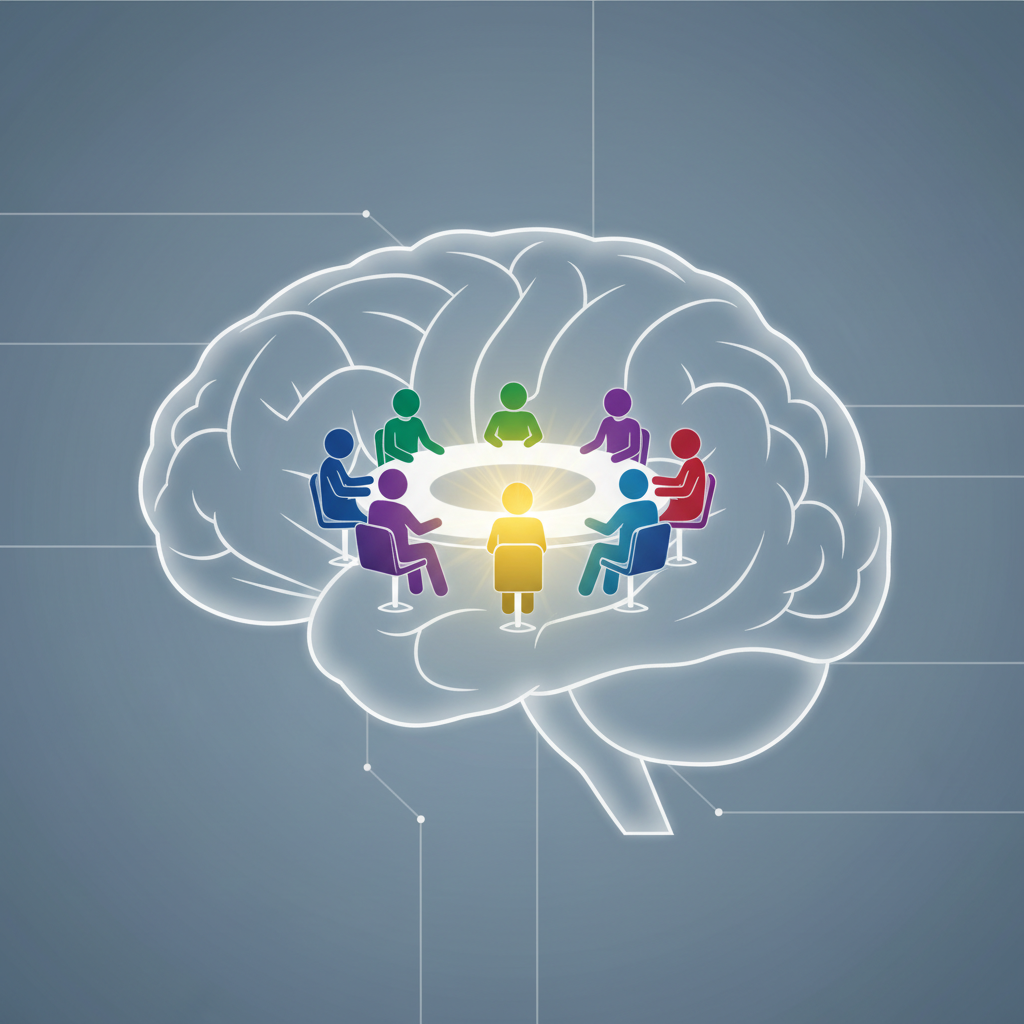
This is where the ‘Mixture of Experts’ comes in, and where our committee meeting analogy begins. Instead of hiring one impossibly brilliant, and impossibly slow, generalist like Anand, what if we hired a committee of specialists?
This committee has a finance expert, Priya. It has a creative director, David. It has a legal counsel, Fatima, and a software engineering lead, Kenji. Now, a committee meeting is called to deal with a new company initiative. The first question is about the quarterly budget forecast. Who do you turn to? Priya, of course. The other experts—David, Fatima, Kenji—they can sit back, listen, maybe sip their coffee. They don’t need to activate their entire brainpower for a finance question.
This is exactly how an MoE model works. It isn’t one giant neural network. It’s a collection of smaller, specialized neural networks—the ‘experts’. One expert might have been trained predominantly on code. Another might be a master of poetry and prose. A third might be a whiz at summarizing scientific papers. A fourth might excel at translating between languages.
But a room full of experts is useless without a good facilitator. In an MoE model, this role is played by a small but crucial component called a ‘gating network’ or a ‘router’. The router is the chairperson of the committee. Its job is not to answer the question itself, but to look at the incoming question—your prompt—and intelligently decide which one or two experts are best suited to handle it.
Let’s walk through an example. You give a prompt: “Write me a short, funny poem about a software bug in Python.” The router looks at this. It doesn’t try to write the poem. It analyzes the request and thinks, “Aha, this needs knowledge of Python and creative writing.” It then activates the ‘Python code’ expert and the ‘creative poetry’ expert. It routes the prompt to them. Those two experts work on the problem, consulting each other through the model's architecture. The other experts—the legal expert, the financial expert, the historical expert—remain dormant. They consume no computational power for this task.
Once the two active experts have formulated their response, their outputs are combined, and a final, coherent answer is presented to you. The result is that you’ve received a high-quality, specialized answer, but you’ve only used a tiny fraction of the model’s total capacity. This is revolutionary.
The most immediate benefit is speed and cost. Inference—the act of generating an answer—becomes dramatically faster and cheaper. Because you're not lighting up a 1-trillion parameter model every time you ask a question, but maybe just a 50-billion parameter slice of it, the computational load plummets. This is why a model like Mixtral 8x7B, which has a total of 47 billion parameters, can perform at the level of a much larger 70-billion parameter dense model like Llama 2 70B, but at a fraction of the inference cost.
This efficiency has huge implications. It democratizes access to high-end AI. For a startup in Bangalore or a medium-sized enterprise in Pune, renting compute time for a massive dense model was often prohibitively expensive. With MoE models, running a powerful, state-of-the-art AI becomes feasible. This fosters innovation far beyond Silicon Valley. We can start to imagine specialized MoE models for Indian law, or models where several experts are trained on different Indian languages, allowing for more nuanced and culturally aware AI.
Another benefit is scalability. With dense models, the only way to get smarter was to get bigger, which we know has diminishing returns. With MoE, you can increase the model's total knowledge by simply adding more experts to the committee. You could add an expert on medical research or one on automotive engineering. This doesn't necessarily make the model slower to run, because the router will still only ever pick a few experts for any given task. We can now build models with trillions of parameters in total, but which remain nimble and fast in practice. It’s the difference between expanding one person’s brain to an impossible size versus simply hiring a new specialist for the team.
Of course, it’s not a perfect system. The biggest challenge is training the router. The gating network has to be trained very carefully. If you do it poorly, the router might get lazy. It might find that one or two of the experts are pretty good at most things, and just keep sending all the work to them. In the corporate world, this is the equivalent of a bad manager who overloads their two star employees while the rest of the team does nothing. This leads to an unbalanced model where most of your expensive experts are sitting idle, defeating the entire purpose of the architecture.
There’s also a memory challenge. While the computation (the active thinking) is sparse, all the experts still need to be loaded into the computer’s VRAM. So, you still need a machine with a massive amount of memory to even host the full model, even if you’re only using a small part of it at any moment. This means the hardware barrier to entry is still high, even if the cost-per-query is low.
Despite these hurdles, the shift to a Mixture of Experts architecture feels like a crucial step forward in the maturation of AI. It’s a move away from brute force and towards a more elegant, efficient, and specialized form of intelligence. It mirrors how human knowledge and expertise work in the real world. No single person knows everything. We build companies, societies, and scientific communities by combining the specialized knowledge of many individuals.
We’re no longer just trying to build one giant, monolithic brain. We're learning how to build a smart, effective, and collaborative team. We're moving from the lone genius to the well-run committee. We're teaching the AI not just to know everything, but to know who to ask. And that, to me, feels like a much more sustainable and truly intelligent path forward.
Why it matters
- 01Mixture of Experts (MoE) models work like a committee, using a 'router' to direct tasks to specialized 'expert' sub-networks instead of using the whole model.
- 02This approach makes AI inference much faster and more cost-effective because only a small fraction of the model's parameters are active for any given query.
- 03While MoE allows for massive scalability in knowledge, the key challenges lie in training the router effectively and the high memory required to host all the experts.