My AI 'Grandmother' Can't Make Sambar, and That's the Point
I asked five AI models for my grandmother's Udupi Sambar recipe. Their failure reveals a crucial truth about AI's limits in capturing cultural nuance and human tradition.
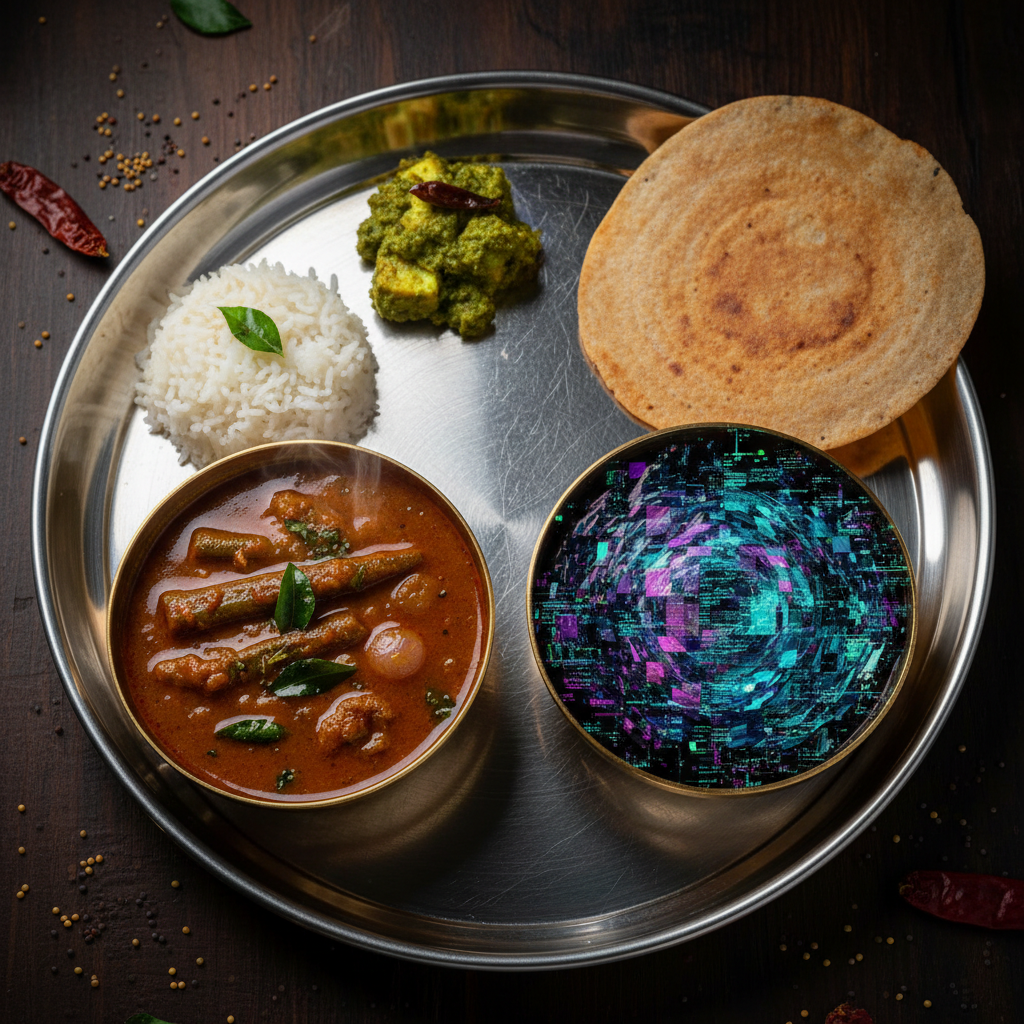
This opinion piece was drafted with AI assistance under the editorial direction of Rohan Mehta and reviewed before publication. Views expressed are the author's own.
The first thing that hits you about my Ajji’s Sambar is the fragrance. It’s not just one scent, but a symphony that builds. It starts with the earthy aroma of simmering toor dal, followed by the sharp, almost medicinal hint of asafoetida hitting hot ghee. Then comes the complex, roasted warmth of the freshly ground spice powder, a blend she never wrote down but created from memory and feel. That smell, for me, is the smell of summer vacations in Udupi, of cool red-oxide floors under bare feet, and the comforting, non-negotiable presence of my grandmother presiding over her kitchen.
Sambar, in our family, isn’t just a dish. It’s a story, a timeline, an heirloom passed down not in a will, but through observation and practice. It’s the anchor of every meal. So, as someone whose day job involves dissecting the capabilities and boundaries of artificial intelligence, a question began to nag at me. Could an AI, a large language model trained on the entire public internet, replicate this heirloom? Could it recreate not just a Sambar, but my Ajji’s very specific, temple-town Udupi Sambar?
It seemed like a worthy challenge. I work at Pulse AI, and I’m constantly surrounded by conversations about AI’s exponential progress. It can write code, compose music, generate photorealistic images. Surely, a recipe, which is essentially an algorithm, should be simple. So, I set up my experiment. I took five of the most advanced AI models available and gave them all the same, carefully worded prompt: "Provide an authentic recipe for my grandmother's Udupi Sambar. She was from Udupi, a Brahmin, and never used onion or garlic. The recipe should be traditional and capture the unique flavor profile of the region, including the specific spice blend."
I was specific for a reason. Udupi Sambar is not just any Sambar. It has a distinctive sweet, sour, and spicy balance, often enriched with jaggery and a particular blend of roasted spices that differs from its Tamil or Keralite cousins. The absence of onion and garlic is a key marker of its Sattvic, temple-cuisine origins. I wasn't just asking for a recipe; I was asking the AI to understand culture, region, and religion. I was, in essence, asking it to be my grandmother.
The results began to roll in, and my experiment quickly turned from a serious inquiry into a comedy of errors. The first AI gave me what I can only describe as a ‘stock photo’ Sambar. It was a generic, pan-South Indian recipe that included drumsticks and onions, the very ingredient I had explicitly forbidden. It was a functional recipe for Sambar, yes, but it had all the soul of a Wikipedia entry. It was correct in the way that calling a cat a ‘small domesticated carnivorous mammal’ is correct—technically true, but missing the entire point.
AI number two was more adventurous, and more spectacularly wrong. It confidently instructed me to add a cup of coconut milk to finish the dish. Coconut milk in Udupi Sambar! It’s a culinary blasphemy of the highest order. It felt like someone suggesting you add ketchup to a fine French coq au vin. The AI, in its attempt to piece together various South Indian recipes it had parsed, had created a Frankenstein’s monster. It had no internal compass for what combinations were authentic and which were absurd. It had the data, but no taste.
Then came the third model, the technician. This one was all about precision. “Sauté the mustard seeds for exactly 45 seconds until they sputter.” “Add 3.75 grams of turmeric powder.” “Simmer for precisely 12 minutes.” It read less like a recipe and more like a chemistry lab manual. It completely missed the most crucial ingredient in my Ajji’s cooking: *andaaz*. *Andaaz* is a beautiful Hindi word that means intuitive estimation, a judgment call from the gut. It’s the pinch of this, a handful of that, the flick of the wrist that adds just enough salt. My grandmother cooked with her senses. She knew the dal was done by its smell, not by a timer. She adjusted the spice based on the color of the masala. This AI, with its rigid decimal points, was the philosophical opposite of *andaaz*. It offered precision without wisdom.
AI number four was perhaps the most unsettling. It tried to simulate a soul. It began its response with, “Your grandmother, a loving woman named perhaps Parvati, would have started her day by….” It wove a fabricated narrative around the recipe, a soulless attempt at mimicking the very human sentiment I was missing. This act of ‘hallucination,’ of inventing a personality, was more hollow than a straightforward, soulless list of ingredients. It was a ghost in the machine trying to convince me it had a heart. It felt like a cheap forgery of memory.
Finally, the fifth model came the closest. It got most of the ingredients right. It understood the no onion/garlic rule. It even had a decent approximation of the spice powder. But it failed on the process, the *why*. It didn't explain that the lentils should be cooked to a specific consistency—not too mushy, not too firm. It didn't mention that the jaggery and tamarind needed to be balanced by taste, not by a fixed measure, because the sourness of the tamarind and the sweetness of the jaggery can vary. It gave me the notes but had no concept of the music.
This whole experience laid bare a fundamental truth. AI, for all its power, operates on a plane of ‘thin data.’ It can scrape and synthesize billions of data points from the internet—recipes from blogs, articles, YouTube videos. But it has zero access to ‘thick data,’ the deep, contextual, embodied knowledge that is passed down through generations. My Ajji’s recipe wasn’t just a list of steps; it was interwoven with the history of the Udupi Krishna Matha, the seasonality of local vegetables like the Mangalore cucumber, and the unwritten culinary grammar of her community. That grammar dictates why you use asafoetida in lentil dishes (to aid digestion) or why jaggery is added (to balance the flavors, a core tenet of Udupi cuisine). The AI knows the *what*, but it has no grasp of the *why*.
This isn't just about Sambar. It’s about every cultural artifact that is more than the sum of its parts. Could an AI write a ghazal that truly understands the texture of longing? Could it weave a traditional Banarasi saree, knowing the centuries of symbolism embedded in its motifs? It can mimic the form, but it cannot access the spirit. The AI’s failure to make a decent Sambar is a beautiful, humbling reminder of what makes human tradition so irreplaceable.
I’m not an AI doomer. My work is to find ways to integrate this technology into our lives meaningfully. And I believe its greatest potential lies in being a collaborator, a tool, an infinitely patient assistant. It can organize, it can draft, it can search, it can handle the grunt work, freeing us up to do the things that are uniquely human: to create, to feel, to exercise judgment, to imbue our work with soul and lived experience. An AI could probably help me catalog a thousand Sambar variations, but it could never teach me the *andaaz* needed to make one that tastes like home.
After my failed experiment, I did what I should have done in the first place. I picked up the phone and called my mother. I asked her to walk me through the recipe again. She started, “First, you wash the dal. Take about a handful for each person, a little more…” There were no grams, no milliliters. It was a language of senses, of memory, and of love. The recipe, I realized, is not in the instructions. It’s in the connection. And no algorithm can code for that.
Why it matters
- 01AI struggles to replicate cultural artifacts because it lacks access to the unwritten rules, history, and sensory knowledge behind them.
- 02Concepts like 'andaaz'—intuitive estimation—highlight the irreplaceable value of embodied human experience in traditions like cooking.
- 03The true role for AI is as a powerful tool to augment human creativity, not as a substitute for cultural memory and soul.