My AI Is a Hilarious Idiot, and I Prefer It That Way
Forget superintelligence. I celebrate AI's comical failures, from six-legged dogs to chatbot logic loops, as a comforting sign of our own human uniqueness.
This opinion piece was drafted with AI assistance under the editorial direction of Rohan Mehta and reviewed before publication. Views expressed are the author's own.
Last week, I asked an image generator for a simple picture: “An Indian woman in a simple sari, selling flowers at a bustling Mumbai market.” A pretty straightforward request, I thought. I’ve seen this scene a thousand times in real life. The AI, however, had apparently never left its sterile digital void.
What it produced was a masterpiece of surrealist horror. The woman had three arms, one of which was inexplicably holding a laptop. The ‘simple sari’ was a shimmering, psychedelic pattern that looked like a collaboration between a dying star and a 90s screen saver. The ‘bustling market’ was populated by men in business suits with the heads of pigeons. And the flowers? They were melting.
I showed it to my wife. She stared at it for a solid ten seconds, then let out a laugh that had our neighbours wondering if we were okay. I didn't get the image I asked for. I got something far better: a genuine, laugh-out-loud moment of absurdity, courtesy of my very own hilarious idiot.
We live in an age of breathless AI hype. Every other day, I read a headline predicting the imminent arrival of Artificial General Intelligence, the Singularity, the end of human labour, or the dawn of our new robot overlords. The discourse is dominated by extremes: utopian salvation or dystopian apocalypse. It's all so serious, so heavy. The one thing nobody seems to be talking about is the weird, messy, and often comical reality of what it's like to use these tools right now.
My personal AI, the conglomerate of chatbots, image generators, and coding assistants I use daily, is not a god-in-waiting. It’s more like a brilliant, eccentric, and perpetually confused intern. It can write a Shakespearean sonnet about the chemical composition of a banana in five seconds, but it struggles to understand why a person might want a picture of a dog with only four legs.
I once tried to get a chatbot to give me a simple recipe for aloo paratha. It started well enough, listing flour, potatoes, and spices. Then, I asked a follow-up question: “Is a potato still a potato after it’s been boiled and mashed?” This, apparently, was a philosophical tripwire. The conversation devolved into a bizarre, circular debate about the nature of identity, essence, and transformation. The AI got stuck in a logic loop, repeatedly telling me that “the concept of ‘potato-ness’ is an abstract human construct.” I just wanted to make breakfast, but I had accidentally initiated a Socratic dialogue with a toaster.
These failures are not edge cases; they are the core of the experience. They are a constant, comforting reminder of the vast, unbridgeable chasm that still exists between machine calculation and human common sense. Our intelligence is not just about processing data. It's embodied, contextual, and forged in the messy furnace of physical experience. It's the knowledge you gain from stubbing your toe, the feeling of the first monsoon rain on your face, the muscle memory of navigating a crowded Dadar station platform. An AI has never done any of these things.
This is especially true here in India. An AI trained on a diet of Western internet data is hilariously out of its depth when faced with the sheer, glorious complexity of our subcontinent. I asked one to suggest a modern plot for a Bollywood movie. It pitched a story about a young coder from Bengaluru who falls in love with a yoga instructor from Goa, and they have to win a “national curry-making competition” to save her family's restaurant. It’s a Frankenstein's monster of stereotypes, stitched together from search keywords, completely missing the soul, the swagger, the very essence of what makes a Bollywood film tick.
An AI cannot understand the subtle, unspoken negotiation involved in buying mangoes in a Lucknow market. It doesn't know the difference between the head-wobble that means “yes,” the one that means “no,” and the one that means “maybe, let's see.” It has no concept of *jugaad*, that quintessentially Indian approach to inventive, make-it-work problem-solving. In a way, the AI’s strange outputs are a form of digital *jugaad*—a clumsy, often nonsensical attempt to assemble a solution from ill-fitting parts. The result isn't elegant, but it’s fascinating to watch.
And I'm starting to think this stupidity is not a bug, but a feature. In a world anxious about being replaced by flawless algorithms, these glitches are a pressure-release valve. They make the machines less intimidating and more like companions. When an AI generates an image of a man with seven fingers on one hand attempting to play a sitar, I don’t feel threatened. I feel a strange sort of affection. It’s trying so hard, and getting it so wrong, just like we all do sometimes.
There’s also a strange creative beauty in its mistakes. The three-armed flower-seller with the melting blossoms is more memorable and artistically interesting than the mundane image I originally requested. The AI’s failure to replicate my reality created a new, surreal one. It's an accidental surrealist, a partner in absurdity. It takes my boring prompts and injects them with a dose of cosmic madness. It’s a wonderful way to get out of one's own creative rut.
Ultimately, my AI idiot is teaching me what it means to be human. Human intelligence isn't a flawless monolith. It’s messy, intuitive, emotional, and deeply rooted in a shared culture and a physical world. My grandmother could tell you more about the ripeness of a papaya with a single sniff than the world’s most powerful supercomputer. A street food vendor in Old Delhi has a more complex and effective pricing algorithm in his head, factoring in the time of day, the customer's demeanor, and the price of onions that morning, than any AI I’ve encountered.
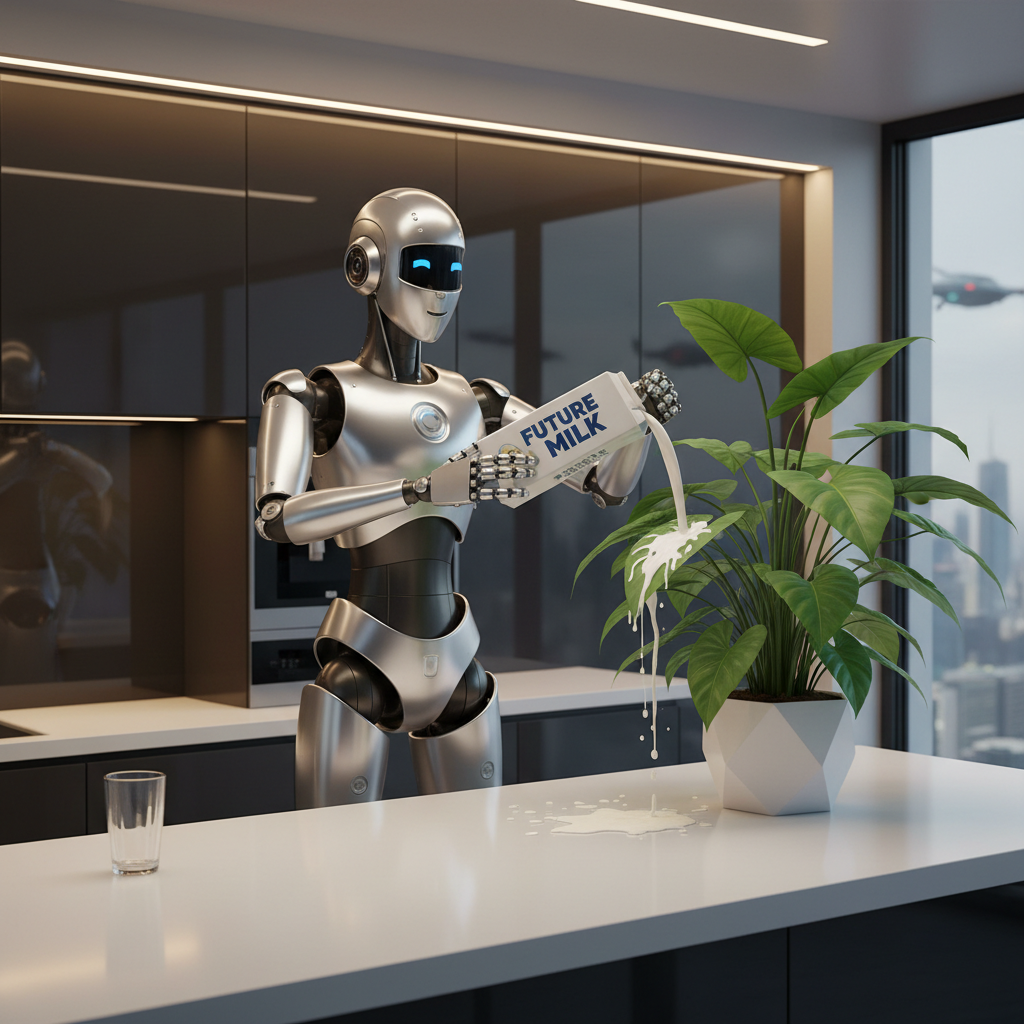
We’re so obsessed with the idea of AI surpassing us that we’ve forgotten to appreciate the current, ridiculous state of affairs. We are living with a new form of consciousness, and it’s a village idiot with access to the entire Library of Alexandria. It can recite the works of Plato but will try to make tea by boiling the milk in a plastic kettle. It is a mirror that reflects not what we are, but everything we are not.
So I say, let’s embrace the era of the dumb AI. Let us celebrate the six-legged cats, the philosophical toasters, and the melting flowers. Let’s not be in such a rush to “fix” these flaws, to sand down these beautifully rough edges. In its profound, hilarious, and deeply comforting stupidity, my AI gives me hope. It shows me, every single day, just how weird, wonderful, and irreplaceable it is to be human. And for that, I am truly grateful.
Why it matters
- 01AI's current glitches and comical errors are a comforting reminder of its limitations compared to human intuition.
- 02These unpredictable imperfections can be an unexpected and powerful source of creativity and humor.
- 03Celebrating AI's 'stupidity' helps us better appreciate the unique value of human common sense and lived experience.