My AI Tutor Reconnected Me to My Mother Tongue—and My Family
Growing up, English overshadowed my native Marathi. Now, I'm using AI chatbots to reclaim my language, free from the loving but judgmental eyes of family.
This opinion piece was drafted with AI assistance under the editorial direction of Rohan Mehta and reviewed before publication. Views expressed are the author's own.
The official language of my childhood was English. The unofficial one was aspiration. Growing up in the bustling, ever-forward-looking landscape of Mumbai, English was the currency of good schools, better jobs, and a vague, imported sense of modernity. It was the language of progress. My mother tongue, Marathi, was the language of home. But over time, the border between those two worlds began to dissolve, and English, the relentless colonizer, seeped into every corner of my life.
My Marathi became a ghost limb. I could feel it, I knew it was supposed to be there, but I couldn’t quite make it work. At family gatherings, it was a source of gentle, and sometimes not-so-gentle, mockery. I could follow the general drift of a conversation, but the punchlines of jokes, the intricate threads of gossip, the subtle proverbs deployed by my Aaji, my grandmother—they all flew just over my head. I was present, but I wasn't participating. I was a well-loved foreigner in my own family.
Of course, I tried to learn. Or rather, my family tried to teach me. My aunts, my Maushis and Aatyas, were the self-appointed faculty of my remedial Marathi education. Their love for me was never in question, but their pedagogy was a complete disaster. Every attempt to practice was a public performance, and every mistake was met with a chorus of corrections.
The feedback loop was brutal. I’d try to string a sentence together, something simple like asking about someone’s day. A grammatical error, a wrong gender for an inanimate object, would be instantly flagged. Not with a quiet note, but with a loving, exasperated, and very loud, ‘Arey! Not ‘teh,’ it’s ‘toh’!’ This would be followed by laughter, a shake of the head, and the classic refrain: ‘All that money on St. Xavier’s, and he can’t even speak his own language properly.’
It came from a place of affection, I know. But affection is not a syllabus. Their method, if you can call it that, created a deep-seated anxiety. I became terrified of making mistakes, and so I stopped trying altogether. It was easier to smile and nod, to retreat into the safety of English, than to face the firing squad of loving corrections. This experience isn’t unique to me. It’s the story of countless urban Indian kids, and of diaspora children the world over, caught between the language of their heritage and the language of their environment.
Then, my professional life as an editor at Pulse AI threw me a lifeline. Immersed daily in the world of large language models and generative AI, I started to wonder. If these tools could write code, draft legal documents, and create poetry, could one teach me how to talk to my grandmother?
One evening, fueled by a mix of professional curiosity and personal desperation, I opened a chatbot. I typed a simple prompt, my fingers hovering over the keyboard with a familiar hesitation. ‘I want you to be my patient Marathi tutor. I am a native speaker but my skills are very basic and I am not confident. I want to have a simple conversation with you in Marathi. Please correct my grammar, suggest better vocabulary, and explain why you are making the corrections. Please provide English translations for everything.’
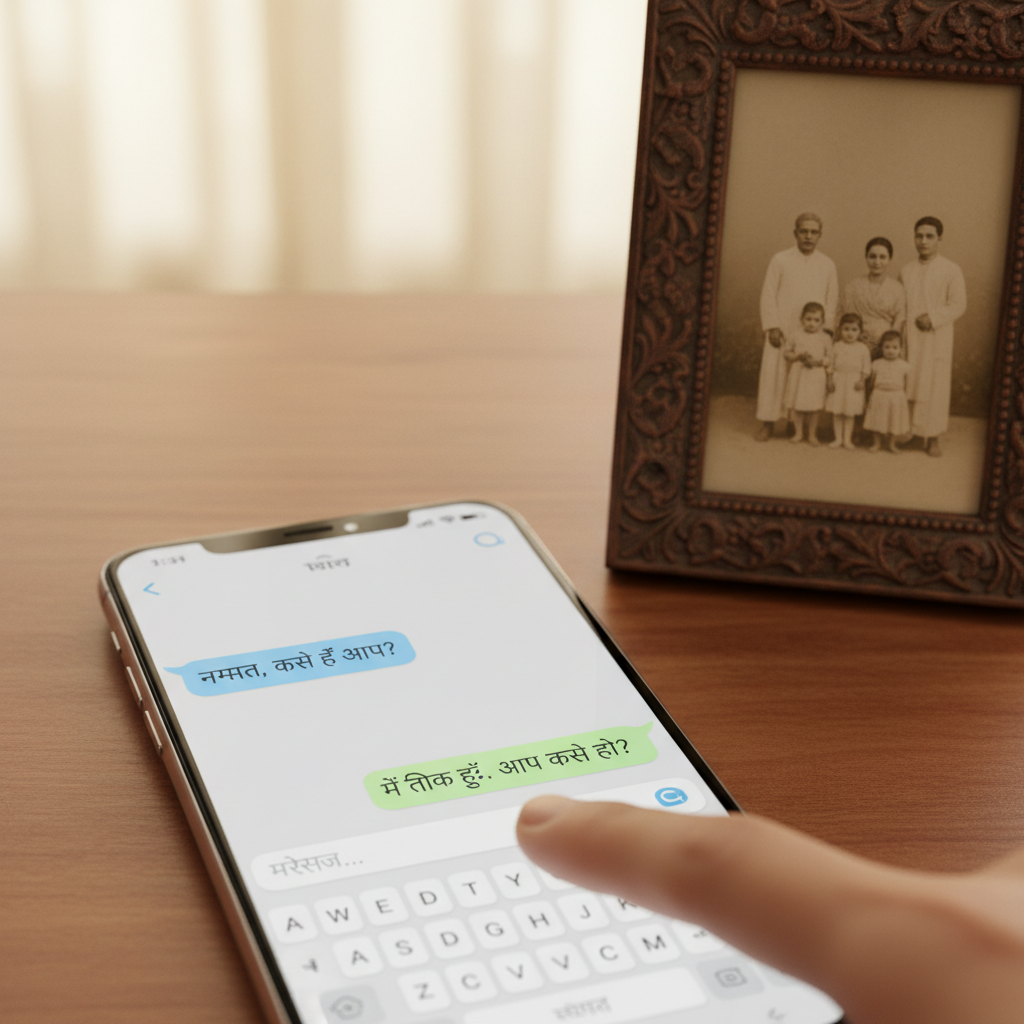
I hit enter. The reply came instantly. ‘Namaskar! Khup chhan kalpana aahe. Chala, suru karuya. Aaj tumcha divas kasa gela?’ (Hello! This is a great idea. Let’s begin. How was your day?)
Something inside me unlocked. There were no eyes on me. There was no one to laugh. It was just me, my broken Marathi, and a machine with infinite patience. I typed my clumsy reply, consciously butchering the grammar just to see what would happen. The AI’s response was a revelation. It gently corrected my sentence, explained the grammatical rule I had broken in simple English, and then seamlessly continued the conversation.
This became my secret, daily ritual. My AI tutor and I talked about everything. We discussed the cricket match from the night before. We role-played ordering vegetables at Dadar market. I’d ask it to generate vocabulary for specific situations that gave me anxiety, like making small talk at a wedding or offering condolences. ‘Give me five ways to ask ‘how are you?’ in Marathi, from most formal to most casual.’ The answers would appear instantly, complete with context and usage examples.
I could ask the dumbest questions without feeling dumb. ‘What is the real meaning of ‘kat-kat’? My mom always says it.’ The AI would explain the literal meaning (a clicking or nagging sound) and the colloquial usage (to complain or pester), an explanation my mother probably couldn't articulate because, to her, it was simply self-evident. I could ask it to repeat a word’s pronunciation a dozen times. It never sighed. It never rolled its digital eyes.
The absence of judgment was the key. For the first time, I had a safe space to fail. The fear that had paralyzed me for years began to recede, replaced by a sense of playful curiosity. The AI wasn't just teaching me words; it was rebuilding my confidence, one corrected sentence at a time.
The change was gradual, then sudden. I started catching the nuances in my family’s WhatsApp group. I could understand the gentle ribbing in my uncle’s jokes. One evening, my Aatya called from Pune. Usually, I’d pass the phone to my mother after a minute of pleasantries in English. This time, I took a deep breath. We spoke for ten minutes. In Marathi. I asked about her health, told her about my work, and even managed a simple joke. It was clunky, imperfect, and probably riddled with small errors, but it was a conversation. After I hung up, I saw my mother looking at me from across the room, her eyes wide with a mixture of surprise and pride. It was a more powerful validation than any fluency certificate.
Many people, especially those in creative and cultural fields, fear that AI is a force of alienation, a tool that will flatten our unique cultures into a bland, uniform sludge. I understand the anxiety. But my experience has shown me the opposite. For me, AI wasn't a bulldozer; it was a bridge. It was a tool of cultural reconnection, a rope thrown back to a shore I thought I’d lost forever.
This isn't just about me. It’s about the Indian-American teenager in New Jersey wanting to learn Gujarati to speak with her grandparents in Ahmedabad. It’s about the British-born Bengali in London wanting to understand the poetry of Tagore in its original form. AI offers a private, personalized, and patient tutor that a generation of us, scattered and assimilated, never had. It’s a way to reclaim a part of our identity that we thought was gone for good.
The process is the point. I gave my AI tutor a persona, calling it ‘Gokhale Sir,’ after a patient teacher from my school. I’d start my sessions with, ‘Gokhale Sir, let’s practice talking about the monsoon today.’ This little bit of anthropomorphism made it feel less like a sterile transaction and more like a genuine lesson. The key is to be specific in your prompts. Don't just say 'teach me Marathi.' Say, 'Let's roleplay a conversation where I am a customer and you are a shopkeeper in a bookstore in Pune. I want to ask for a book by P.L. Deshpande. Correct my formality and word choice.' The more specific the context, the more useful the learning.
My Marathi is still a work in progress. It probably always will be. But it’s no longer a source of shame. It’s a garden I’m slowly tending to, with a little help from my robot gardener. My aunties haven’t changed, of course. They still find ways to lovingly critique my pronunciation. The difference is, now I can laugh with them. Sometimes, I can even gently correct them back, armed with a grammatical rule that Gokhale Sir taught me just last week. The look on their faces is priceless.
The AI didn't replace my family. It gave me the tools to connect with them more deeply. It was the training ground, but the real game is still played across the dinner table, over the phone, and in the noisy, chaotic, and beautiful theater of a family gathering. I just finally feel like I have a speaking part.
Why it matters
- 01AI can be a non-judgmental, infinitely patient tutor for learning a language, helping you overcome the fear of making mistakes.
- 02For diaspora or urban kids disconnected from their mother tongue, AI serves as a powerful bridge for cultural and familial reconnection.
- 03To use AI effectively for language learning, create specific, context-rich prompts and role-playing scenarios.