My Daughter’s AI Homework Helper: A Parent's Confession
As a parent and AI editor, I watch my daughter use an AI tutor with a mix of awe and anxiety. Is it the future of education or a shortcut that bypasses real learning?
This opinion piece was drafted with AI assistance under the editorial direction of Rohan Mehta and reviewed before publication. Views expressed are the author's own.
It was nine o'clock on a Tuesday night, the hour when parental patience wears thin. Across the dining table, my ten-year-old daughter, Anaya, let out a sigh that carried the weight of the world. Her nemesis was a sheet of math problems involving fractions and percentages, concepts that seemed to have been designed by a committee of medieval torturers.
I slid over to her side, full of that can-do paternal spirit that lasts about five minutes. “Let’s see it, kiddo.” We read the problem together. I started explaining it the way my father explained it to me thirty years ago in our flat in Mumbai: drawing uneven pies and talking about cricket scores. Her eyes glazed over. My explanation, which felt so logical in my head, landed like a foreign language.
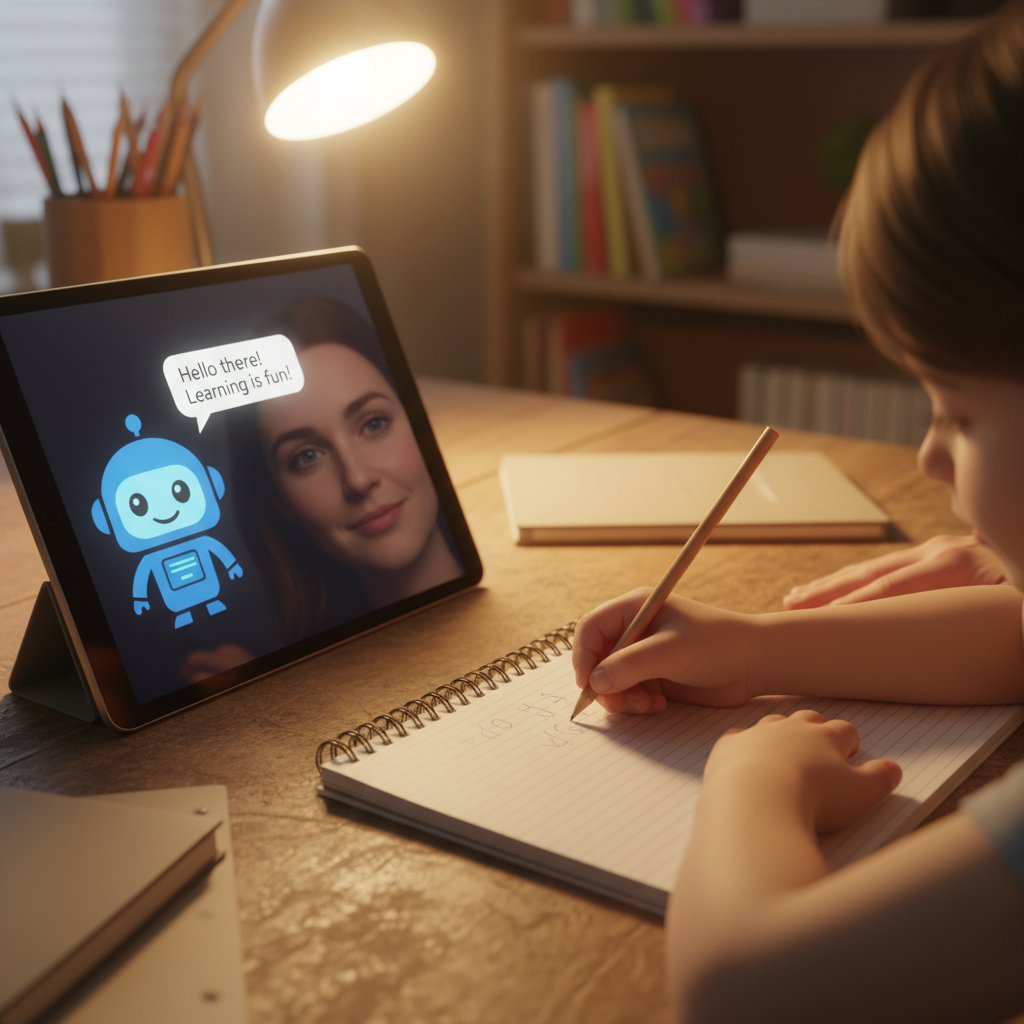
Frustration began to bubble, both hers and mine. Mine was laced with a cocktail of exhaustion from a long day and the quiet shame of not being able to connect with my own child’s mind. Just as the tension peaked, she did something that has become increasingly common in our home. She calmly reached for her tablet, tapped open an app, and aimed its camera at the worksheet.
A moment later, a pleasant, synthesized voice began to speak. “I see you’re working on converting fractions to percentages. Let’s break it down.” On screen, the problem deconstructed itself. Virtual blocks appeared, coloring in to represent the fraction. An animated number line showed the relationship. The app didn’t just give her the answer; it guided her through the logic with a Socratic patience I could never hope to muster at 9 p.m.
Within ten minutes, she had her “aha” moment. The tension in her shoulders released. “Oh, I get it now,” she said, and proceeded to solve the next problem on her own. I felt a wave of profound gratitude wash over me. The fight was over. The tears were averted. My daughter understood the concept, and I didn't have to be the bad guy. This, I thought to myself, is a miracle. A private tutor, on demand, for the price of a subscription.
My day job is being an editor at Pulse AI. I live and breathe this technology. I spend my days writing, editing, and thinking about the ways artificial intelligence is reshaping our world, from medicine to finance. I am, by definition, an optimist and a believer in its potential. Watching that app rescue our evening, I felt like I was living in the very future I write about. I thought of my own childhood, of my thirty classmates crammed into a humid room, trying to absorb a single lecture delivered by an overwhelmed teacher. I thought of how much a tool like this would have meant for the kids in the back row who were too shy or too lost to ask a question.
But then, a few days later, a different feeling began to creep in. Anaya was stuck on another problem. Again, out came the tablet. This time, I didn't participate. I just watched from the corner of my eye as I cleaned the kitchen. The interaction was swift, efficient, and clean. The AI identified the sticking point, provided a scaffolded explanation, and checked for understanding. Anaya got the answer, filled it in, and moved on. The whole process was seamless.
And that’s what started to bother me. It was too seamless.
I was raised on the idea of the “productive struggle.” Learning wasn’t supposed to be easy. It was the intellectual equivalent of scraping your knee—it hurt, but it taught you something about gravity and coordination. I have a vivid memory of being stumped by a geometry proof for two whole days. I filled pages of a notebook with failed attempts. I walked around in a fog, the problem turning over and over in my mind. The eventual moment of breakthrough, when the logic finally clicked into place in the middle of a family dinner, was euphoric. It wasn't just about finding the answer; it was about the resilience I’d built in the process. I had wrestled with the beast and won. I had learned how to think.
I watched my daughter at the table, breezing through her assignment with her digital assistant, and I felt a pang of anxiety. Was she learning to think, or was she learning to follow prompts? Was she building the mental muscle to wrestle with complex, ambiguous problems on her own, or was she simply becoming an expert at using a tool to find the most efficient path to a solution? We laud AI for its ability to eliminate friction, but what if some friction is necessary for growth?
This is the conflict that now rages within me, as both a parent and a technology professional. I see the incredible promise. An AI tutor can personalize education in ways a human teacher with thirty students never can. It can adapt to a child’s pace, offer endless practice, and never get tired or frustrated. It’s a profound force for equity, giving every child access to support that was once the privilege of the wealthy.
At the same time, I fear we are creating a generation that outsources the very process of thinking. When you no longer need to hold a map in your head because GPS will always guide you, do you lose your innate sense of direction? Similarly, when an AI can instantly break down any problem for you, do you lose the ability to sit with uncertainty and forge your own path to a solution?
My role as a parent is changing right before my eyes. I am no longer the keeper of knowledge. My father could answer my questions about algebra because the domain of knowledge was relatively stable. I, on the other hand, am parenting at a moment of exponential change. I can't possibly keep up. So, my job is not to be the encyclopedia, but to be the guide, the ethicist, the coach for metacognition.
I’ve started a new ritual. When Anaya uses her AI helper, I now sit with her. After the app gives its neat explanation, I close the tablet and ask my own questions. “That was a great explanation. Can you explain it back to me, but in your own words?” “Why does that method work?” “Can you make up a new problem that’s similar to this one?” My job is to force the transfer of learning from the screen into her own mind, to ensure the knowledge isn't just rented for the evening but truly owned.
I’m not going to take the AI tutor away. Banning it would be as pointless as my parents’ generation trying to ban calculators. That horse has left the stable, and it’s pulling the carriage of the future behind it. The solution isn't rejection; it’s conscious, critical integration. It’s about teaching our children that these tools are powerful collaborators, not cognitive crutches.
The other night, I saw a glimpse of what this future could look like. Anaya was explaining her math homework to me, using the AI’s visual metaphors combined with her own. She was teaching me. In that moment, it wasn’t me versus the machine for my daughter’s mind. It was the three of us at the dining table, learning together. My feelings are still complicated, a tangled knot of hope and fear. But in that moment, I realized my most important job is not to provide the answers, but to keep teaching her which questions to ask.
Why it matters
- 01AI tutors offer incredible, personalized support but risk making the learning process too frictionless, potentially hindering deep understanding.
- 02The 'productive struggle' of solving difficult problems is fundamental for developing resilience and critical thinking skills.
- 03A parent's role is evolving from a source of knowledge into a guide who teaches their child how to use powerful AI tools wisely and critically.