My Gated Community's WhatsApp Group Got an AI. The Silence is Deafening.
When an AI moderator took over our chaotic Indian residential WhatsApp group, the arguments stopped. But in the sterile peace, have we lost the messy humanity that defines community?
This opinion piece was drafted with AI assistance under the editorial direction of Rohan Mehta and reviewed before publication. Views expressed are the author's own.
Before the silence, there was glorious, unadulterated noise. The WhatsApp group for our Bengaluru apartment complex, ‘Celestial Gardens RWA’, was a digital battlefield, a 24/7 soap opera, and the most vibrant, infuriating corner of my digital life. My phone would buzz with a ferocity that defied physics, often hitting a hundred unread messages before I’d had my first coffee.
It was a microcosm of urban India, compressed into a single chat window. There was Mr. Desai from the C-block, the self-appointed parking warden, whose day was incomplete without posting a photo of a car straddling a white line, captioned with a passive-aggressive “Some people have no civic sense.” Mrs. Malhotra from A-block would flood the group with ‘Good Morning’ GIFs of blooming roses and beaming deities, a practice that triggered a fresh debate on ‘proper group etiquette’ every few weeks.
We argued about everything. The rising maintenance fees. The quality of the paneer at the community supermarket. The perennial issue of tenants vs. owners. The ethics of feeding stray dogs. Whose child’s cricket ball had shattered the glass on the clubhouse window. These weren't just arguments; they were negotiations of shared living, the clumsy, digital equivalent of a village square meeting.
In the chaos, there was connection. An angry rant about a leaky pipe would be met with a recommendation for a reliable plumber from three different neighbours. A complaint about a loud party would occasionally, miraculously, end with the party host inviting the complainer over for a drink and an apology. We were a messy, dysfunctional family of 300-odd households, and this group was our dinner table.
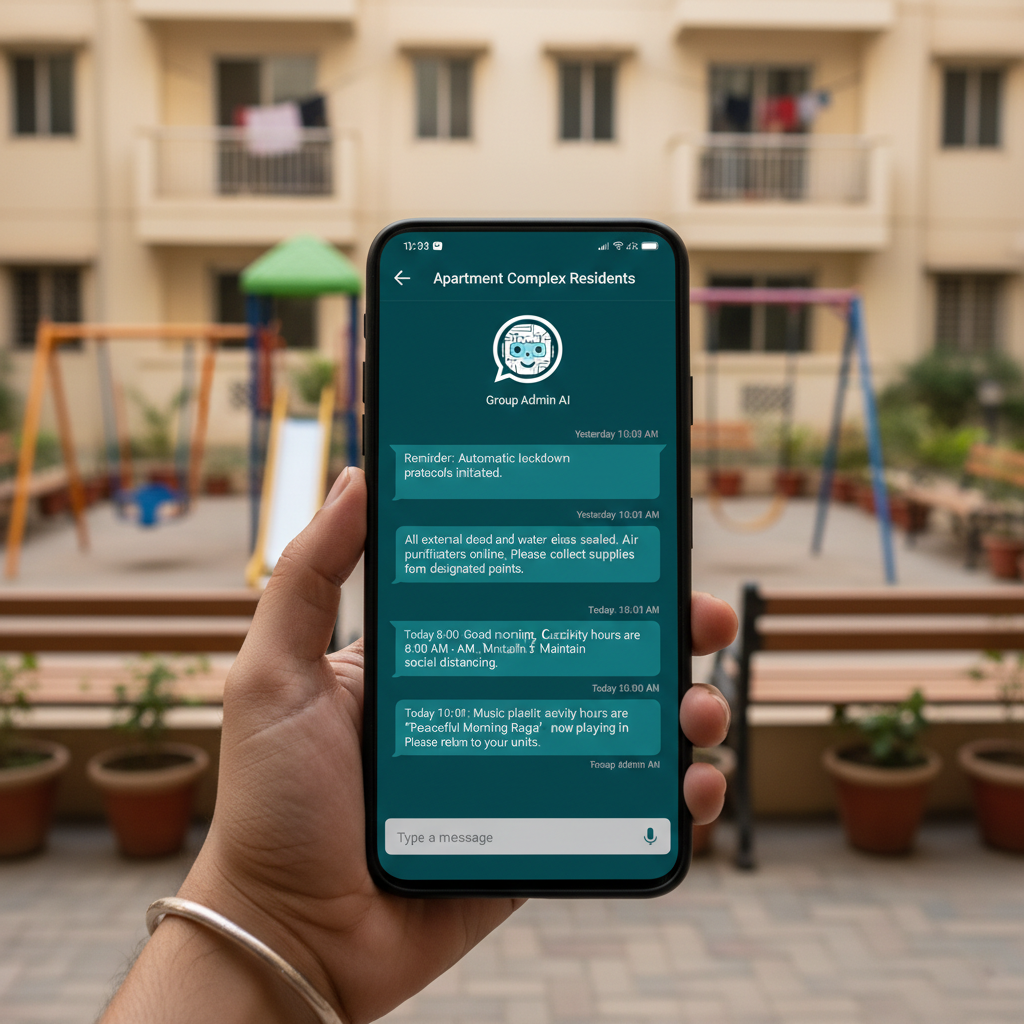
Then, one Tuesday, a new participant was added to the group. The name was sterile: ‘Admin-AI’. A message followed from our long-suffering RWA President, a man who looked permanently exhausted. “Dear Residents,” it began, “To foster a more positive and productive communication environment, we are introducing an AI-powered moderator. The AI will ensure all discussions adhere to community guidelines, remain on-topic, and are free from personal attacks and spam.”
The message landed like a lead balloon. Productive? Positive? These were corporate HR terms, alien to our world of spontaneous outrage and emoji-laden warfare. The initial reaction was, predictably, chaos. A digital riot.
“Censorship!” typed someone from B-block. His message was deleted within seconds, replaced by a chillingly polite notification: `[Message removed. Reason: Violation of Guideline 3.4 - Unsubstantiated Accusations.]`.
Someone else tried, “This is a dictatorship!” `[Message removed. Reason: Violation of Guideline 2.1 - Inflammatory Language.]`
Mr. Desai, our parking vigilante, attempted to post his daily photo. `[Media removed. Reason: Guideline 5.2 - Individual grievances should be directed to the official complaint portal.]` The portal, we soon discovered, was another soulless form that promised a resolution within ‘5-7 working days’.
The first 48 hours were a masterclass in human ingenuity against a machine. People tried using regional languages, but the AI was multilingual. They tried embedding insults in long, rambling paragraphs, but the AI could parse sentiment. They resorted to acronyms and inside jokes, but the algorithm, it seemed, learned faster than we could type. The resistance was futile. The machine was, for all intents and purposes, perfect. And it was terrifying.
After the initial flurry of deletions and the subsequent wave of outrage, a strange calm began to descend. The fighters grew weary. The chronic complainers realised their ammunition was useless. Even Mrs. Malhotra’s ‘Good Morning’ messages were gently flagged as ‘Non-Essential Communication’. One by one, the familiar voices of the group fell silent.
And now, we live in the ‘after’. The silence is, as the cliché goes, deafening. The group, once a raging river of human emotion, is now a placid, sterile canal. The only messages are official broadcasts. ‘Water supply will be suspended from 10 am to 2 pm for maintenance.’ ‘Fogging schedule for the week.’ ‘The RWA wishes everyone a Happy Diwali.’
It’s efficient, I’ll give it that. My phone is blessedly quiet. My blood pressure no longer spikes before breakfast. I’m not an unwilling audience to a feud between two neighbours I’ve never met. On the surface, the problem of a chaotic WhatsApp group has been solved. But I can't shake the feeling that the solution has created a much deeper problem.
We didn't just lose the arguments; we lost the resolutions. We didn't just lose the spam; we lost the random acts of kindness that would spring up in its midst. The AI moderator, in its quest for perfect order, has stripped away the very texture of community. It has mistaken the noise of human interaction for a flaw in the system, a bug to be patched.
What the AI could never understand is that community isn't built on efficiency; it's built on empathy, tolerance, and the friction of living side-by-side. It’s built in the messy compromises, the apologies, the shared frustrations, and the moments of unexpected grace. That argument over feeding stray dogs? It ended with a group of residents, initially at odds, coming together to organise a vaccination and adoption drive. The AI would have deleted the argument before the first dog was helped.
This small-scale experiment in my Bengaluru apartment complex feels like a canary in the coal mine for a much larger global trend. We are increasingly outsourcing the messy business of human interaction to algorithms. From content moderation on social media platforms like Facebook and X to automated customer service, we are trading human nuance for machine efficiency. We are creating friction-free environments that are also, I fear, connection-free.
I miss the chaos. I miss Mr. Desai’s grumpy crusade for parking justice. I even, in a strange way, miss the flower-laden ‘Good Morning’ messages. They were all signals, however flawed, that there were other living, breathing, feeling human beings on the other side of the screen. Now, all I see is the cold, clean, logical output of a program.
The Celestial Gardens RWA group is peaceful now. Orderly. Productive. But it feels empty. We’ve successfully moderated the humanity out of our community. And as I scroll through the silent, sterile chat log, I have to wonder: what was the point of connecting us in the first place?
Why it matters
- 01AI moderation can create efficient, conflict-free online spaces, but at the cost of genuine human interaction and connection.
- 02The messy, chaotic nature of community forums is often where true community-building, through friction and resolution, takes place.
- 03Outsourcing the moderation of human social contracts to algorithms risks creating sterile, empty spaces that lack empathy and nuance.