My Interview Audio Was Unusable. AI Cleaned It Up in 5 Minutes.
I recorded a crucial interview in a noisy Bengaluru cafe. The audio was a disaster. Here's how a free AI tool rescued my recording and my story in minutes.
This opinion piece was drafted with AI assistance under the editorial direction of Rohan Mehta and reviewed before publication. Views expressed are the author's own.
It was a classic Bengaluru Tuesday. The sky was that familiar shade of pre-monsoon grey, and the traffic on the Outer Ring Road was, as always, behaving like a single, malevolent organism. I was late. I was supposed to be meeting the founder of a buzzy new fintech startup, a woman who rarely gave interviews, and my usual quiet corner in a library-themed cafe was, naturally, occupied.
We ended up at a popular spot in HSR Layout, one of those places that’s perpetually buzzing with the nervous energy of a hundred-and-one startup pitches. The coffee was excellent, the conversation even better. For ninety minutes, she was brilliant. She was candid about her early struggles, her vision for digital payments in Tier-3 cities, and the pressure from her venture capital investors. My trusty smartphone, sitting between us, recorded it all. I walked out of there feeling the electric thrill of a story that was going to write itself.
Back at my desk, I plugged in my headphones, ready to start the transcription. I pressed play. And my heart sank.
It was a trainwreck. An audio apocalypse. I could hear my interviewee, but her voice was swimming in a sea of sonic chaos. There was the high-pitched hiss of the industrial espresso machine. The rhythmic clang of ceramic plates being stacked by a busboy. A baby crying two tables over. And, most egregiously, a man with a booming voice right behind me loudly explaining the concept of ‘synergistic disruption’ on a phone call. It was completely, utterly unusable.
My mind raced through the options, each one more horrifying than the last. Spend eight hours manually trying to filter the noise, syllable by painful syllable? Pay an audio engineer a fortune to maybe salvage it? Or the final, most humiliating option: call this incredibly busy founder and ask for a do-over, admitting my own technical incompetence. My big scoop was dead on arrival, drowned out by a cappuccino machine and corporate jargon.
It was in this moment of pure journalistic despair that I remembered a conversation from a few weeks prior. A colleague, who runs our podcast division, had been raving about some new AI tools that ‘magically’ clean up audio. At the time, I’d dismissed it as marketing fluff. Magic? In software? Please. But desperation is a powerful motivator.
A quick search led me to Adobe Podcast Enhance. The landing page made a bold claim: “Remove noise from voice recordings with speech enhancement.” It was free to try. I had nothing to lose but a few megabytes of bandwidth.
The process was almost insultingly simple. There were no confusing dials, no sliders for ‘treble’ or ‘compression’, no intimidating audio engineering lexicon. It was just a box that said, “Drag and drop audio.” I took my monstrous 250MB WAV file, a monument to my poor planning, and dragged it into my browser. A small progress bar appeared, telling me it was ‘Enhancing speech.’ I sat back, my skepticism warring with a sliver of hope. It felt like leaving a terminally ill patient at the door of a faith healer. I wasn't expecting a miracle.
Less than five minutes later, it was done. The site presented me with a simple toggle switch: ‘Original’ and ‘Enhanced.’ I clicked on ‘Original’ first, to remind myself of the horror. Yes, there was the plate-clanging, the baby, the synergy guy. It was just as bad as I remembered. Then, holding my breath, I flicked the switch to ‘Enhanced.’
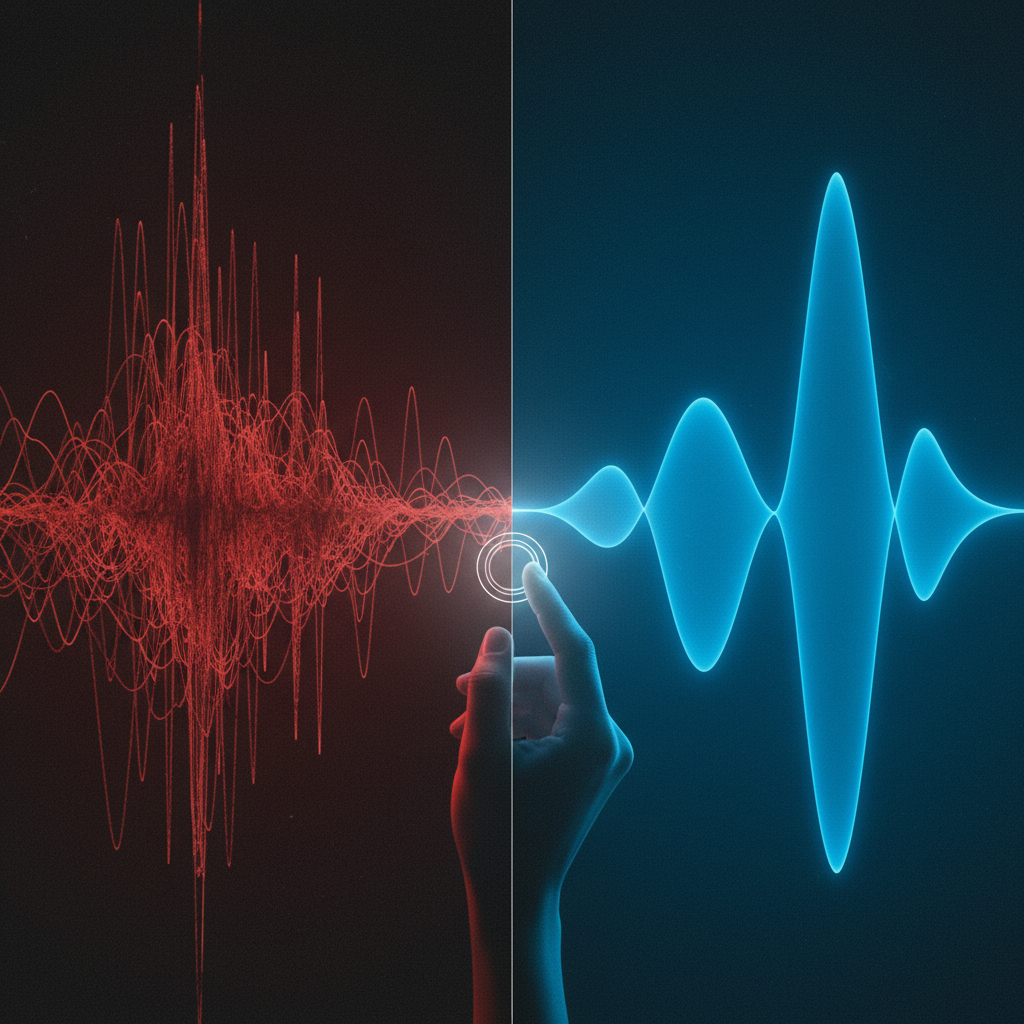
The silence was the first thing I noticed. The entire soundscape of the cafe had simply vanished. The hiss, the clang, the crying, the jargon—gone. All of it. And then her voice came through, followed by my own. It wasn't just audible; it was pristine. It was rich, clear, and centered, as if we had been sitting in a sound-proofed radio studio all along. The AI hadn't just turned down the background noise; it had identified our voices, isolated them, and reconstructed them, removing everything else.
I toggled back and forth, again and again, unable to believe what I was hearing. Original: chaos. Enhanced: clarity. It wasn't just good; it was sorcery. A task that would have taken a trained audio professional hours, if not days, was completed by an algorithm in the time it took me to make a cup of coffee. The quality was so good, it was almost unsettling. My brain couldn't reconcile the memory of that loud, chaotic cafe with the studio-quality audio playing through my headphones.
That one five-minute experience fundamentally changed my perspective on the practical application of AI in my own creative workflow. This isn’t some abstract concept about future job displacement. This is a real, tangible tool that solves a common and frustrating problem for millions of people.
Think about it. Every student trying to listen back to a lecture recorded in a cavernous, echoey hall. Every independent journalist doing an interview on a busy street. Every budding podcaster in a small town in India, recording in their bedroom with a cheap microphone, unable to afford a proper studio. Suddenly, the barrier to producing professional-sounding audio has been obliterated. It’s a radical democratization of quality. Anyone with an internet connection can now make their voice sound like it was recorded in a world-class facility.
Of course, it’s not always absolutely perfect. If you listen very closely, there's a slightly processed quality to the voice, a faint, metallic sheen that an audiophile might notice. But the alternative wasn't a slightly less-perfect version; the alternative was a completely unusable file. This technology takes you from zero to ninety-five percent of the way to perfect, for free, in minutes. The value proposition is staggering.
This isn't about replacing human skill. An AI didn't find the story, convince the founder to talk, or ask the right questions. It didn't have the creative spark or the journalistic curiosity. But it did act as the most incredible assistant I've ever had. It took a tedious, technical task that was blocking me from my real work—telling the story—and simply made it disappear. It allowed me to focus on my strengths, rather than my weaknesses.
In a country like India, where the background noise is a constant feature of life and the ‘jugaad’ spirit of making do with what you have is a national trait, a tool like this feels particularly revolutionary. It’s the ultimate digital jugaad, giving creators everywhere the power to punch far above their weight, to sound as professional as a multi-million dollar media house.
I never did get that coffee. But I got my audio file. And I got my story. That evening, as I finished writing the piece, using quotes I could now hear perfectly, I felt a sense of profound gratitude. Not for some sentient, all-knowing artificial being, but for a piece of clever, practical software. The AI didn't do my job for me. It just cleaned up my mess, and in doing so, allowed me to do my job.
Why it matters
- 01Free AI tools like Adobe Podcast Enhance can turn unusable, noisy audio into studio-quality recordings in minutes.
- 02This technology dramatically lowers the barrier for independent creators, journalists, and students to produce professional-sounding content.
- 03AI is most powerful not as a replacement for human skill, but as an assistant that automates tedious tasks and enables creativity.