My Newest Co-worker is an AI Swarm, and I'm Its Conductor
I've moved beyond single chatbots. I now manage a swarm of specialized AI agents for research, writing, and analysis. This is what it feels like to conduct an AI orchestra.
This opinion piece was drafted with AI assistance under the editorial direction of Rohan Mehta and reviewed before publication. Views expressed are the author's own.
It’s 7 AM in Mumbai. The auto-rickshaws are already creating a familiar cacophony on the street below my window, and the smell of fresh coffee is filling my apartment. A year ago, this is when I’d open my laptop and dive into a sea of emails and Slack messages, a purely reactive start to the day. Now, my ritual is different. Before I even glance at my inbox, I check on my team. The thing is, this team never sleeps, doesn't demand a salary, and is composed entirely of code.
My newest co-workers are a swarm of autonomous AI agents. And my job, increasingly, is to be their conductor.
Like many of you, I spent the last couple of years in a constant state of dialogue with a single AI. I’d use a chatbot to help me brainstorm article ideas, write tricky emails, or summarize a dense report. It was a partnership, a conversation between me and a very capable, if sometimes weirdly over-eager, intern. It felt revolutionary. But eventually, it started to feel like a limitation.
This single-chatbot model is a generalist. It’s a jack-of-all-trades, which is great for ad-hoc tasks. But my work, as an editor and a leader at Pulse AI, isn’t just a series of random, unconnected requests. It’s a workflow. It’s a system. I needed specialists. I needed a team that could handle processes, not just prompts.
That’s when I moved from chatting with an AI to conducting an orchestra of them. I’m no longer just a user; I'm a manager of a digital workforce. Each member of this swarm is a small, focused AI agent I’ve tasked with a very specific role. They work in concert, passing information to each other, building upon each other’s work until a complex task is completed.
Let me give you a concrete example from last week. We needed to produce a deep-dive report on the competitive landscape for a new feature we're considering. The old me would have spent days on this. The new me deployed a swarm.
First, I spun up 'Scout'. This agent's only job was to monitor the digital world. I gave it a list of our top five competitors and a set of keywords. For 24 hours, it scanned everything: tech news sites, financial reports, company blog posts, LinkedIn updates from their key engineers, even Reddit threads where their products were being discussed. Scout doesn't analyze; it just gathers. It's a digital bloodhound, bringing back a mountain of raw, unstructured data.
As Scout was finishing its run, 'Analyst' woke up. This second agent’s task was to take the raw data dump and make sense of it. I'd configured it to look for specific signals: What marketing language are they using? What new features have they announced or hinted at? What are the most common user complaints? What's the overall sentiment? Analyst churns through thousands of pages of text, categorizing and structuring the information into a coherent, but still very long, report.
Then came 'Synthesizer'. This third agent is my personal favorite. It took Analyst's dense, 50-page report and did what I would have painfully done myself: it distilled the absolute key insights. It produced a crisp, two-page executive summary, complete with bullet points on strategic threats and opportunities. It identified a pattern in user complaints about a competitor's product that represented a clear market gap for us.
Finally, I brought in 'Creator'. Armed with the summary from Synthesizer, I tasked this fourth agent with drafting five different angles for an internal presentation to pitch our new feature. It generated slide headlines, talking points, and even suggested visuals.
While all this was happening, what was I doing? I wasn't collecting data or writing summaries. I was conducting. My role was to define the mission with absolute clarity. I had to design the workflow, ensuring Scout's output was in a format Analyst could understand, and that Synthesizer knew exactly what 'key insights' meant to me. I was the one who read the final two-page summary, using my human judgment to verify its conclusions and spot potential AI hallucinations. I made the final decision on which presentation angle was the most compelling.
This is a fundamental shift in cognitive labor. My value is no longer in the 'doing' of the work, but in the 'directing' of it. It requires a different set of skills. It’s less about prompt engineering and more about systems design. It's less about writing a paragraph and more about architecting the machine that writes a thousand of them.
From my vantage point here in India, I see this as a particularly powerful paradigm. We’re a nation known for our ingenuity and our ability to 'leapfrog' legacy technologies. For startups and even established companies here, building out a swarm of AI agents is infinitely faster and more scalable than traditional hiring for certain roles. It allows a small, lean team in Bengaluru to have the research and analytical power of a massive corporation in Silicon Valley. It democratizes capability.
This new management style feels like a superpower, but it’s not without its perils. The job of the conductor is incredibly demanding. An orchestra with a lazy conductor produces noise, not music. If my initial instructions are vague, the entire chain of agents produces garbage. If Scout misses a critical piece of news, the final summary is flawed. The risk of error is cascaded and amplified.
There's also the danger of becoming too detached. I have to constantly dip back into the raw data myself to make sure my agents aren’t developing a skewed view of reality. I am the final backstop for bias, for error, for the subtle contextual understanding that, for now, remains stubbornly human. I need to know how the instruments sound individually to know if the symphony is working.
I’m not managing people, but I am managing process, output, and quality at a scale I never could before. It's a new kind of cognitive load. It’s exhilarating and, at times, a bit terrifying. I’m building the plane while flying it, figuring out the rules of this new game as I play.
The single chatbot was a bicycle, a tool that helped me get from A to B faster. This swarm of agents is a high-speed train network that I have to design, build, and operate. The destination is the same—valuable insights, great content, smart strategy—but the scale and speed of the journey are on another planet.
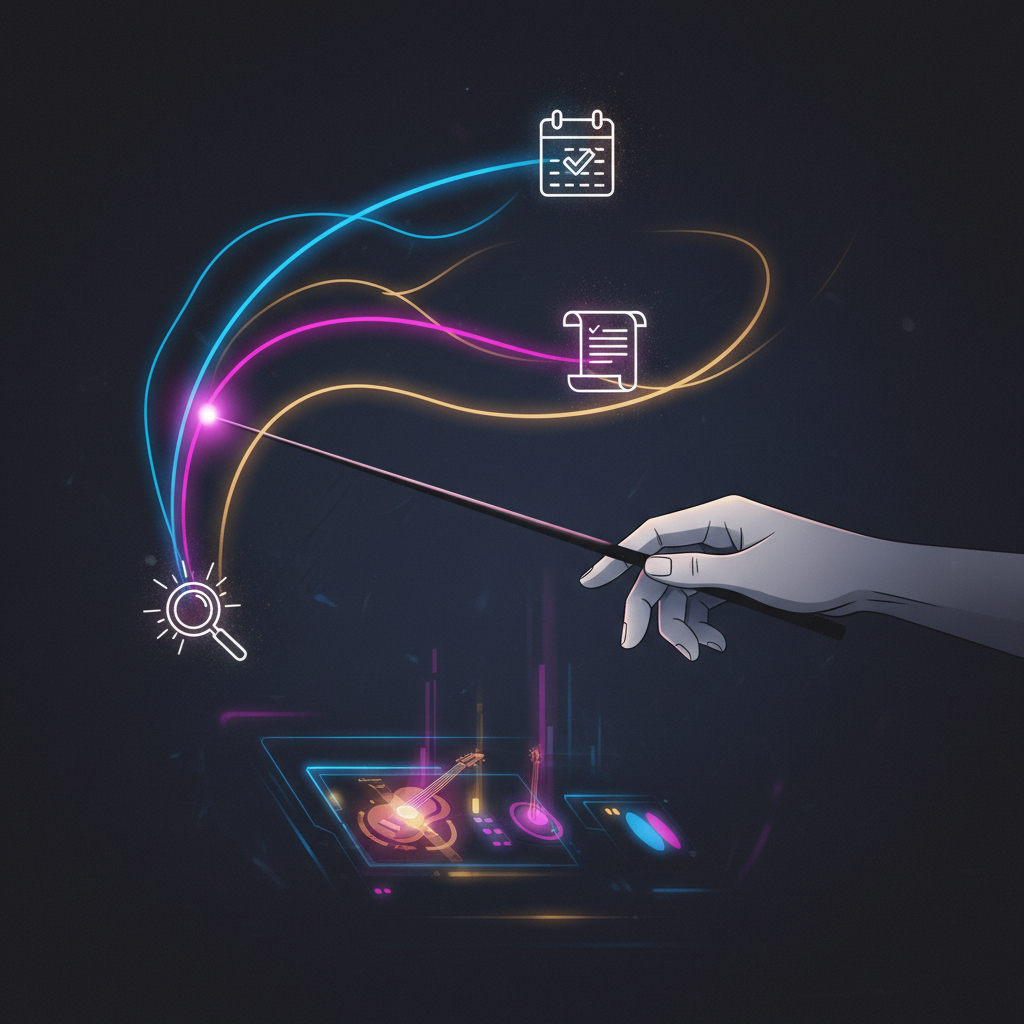
My job title still says 'Editor', but on most days, I feel like a conductor standing before a powerful, invisible orchestra, baton in hand, ready to bring an idea to life. The music has already started, and I’m just trying to keep up with the tempo.
Why it matters
- 01The future of knowledge work is shifting from using a single AI tool to orchestrating multiple, specialized AI agents.
- 02This new role requires skills in systems thinking, clear direction, and quality control, rather than just task execution.
- 03Managing an AI swarm augments human capability at an unprecedented scale, but demands vigilant oversight to prevent cascaded errors.