The AI Relay Race: A Guide to Handing Off AI Work to Humans
AI-generated work is easy to create but hard for colleagues to edit. Rohan Mehta offers a practical guide to the last mile of AI collaboration.
This opinion piece was drafted with AI assistance under the editorial direction of Rohan Mehta and reviewed before publication. Views expressed are the author's own.
A few weeks ago, I felt like a magician. I had a deadline for a comprehensive market analysis on the rise of neo-banks in Southeast Asia. I spent an hour crafting a series of intricate prompts for a large language model. The AI spun up a ten-page report, complete with market sizing, competitive landscape, and growth projections. I felt a surge of pure, unadulterated productivity. I had done a week’s work in an afternoon. I tidied up the document, attached it to an email, and sent it to my colleague, Anjali, in our Mumbai office for review and a final polish.
The silence that followed was deafening. The next morning, a tentative calendar invite appeared: “Quick sync on the neo-banking report?” The ‘quick sync’ turned into a painful hour-long call. Anjali was lost. The report was coherent, but it was also a ghost. It had no lineage, no discernible sources. Where did that 15% growth figure for Indonesia come from? Was the analysis of the Philippines' regulatory environment based on pre- or post-2023 legislation? The document I had sent her was a finished-looking product with no visible process, a beautifully decorated house with no foundation.
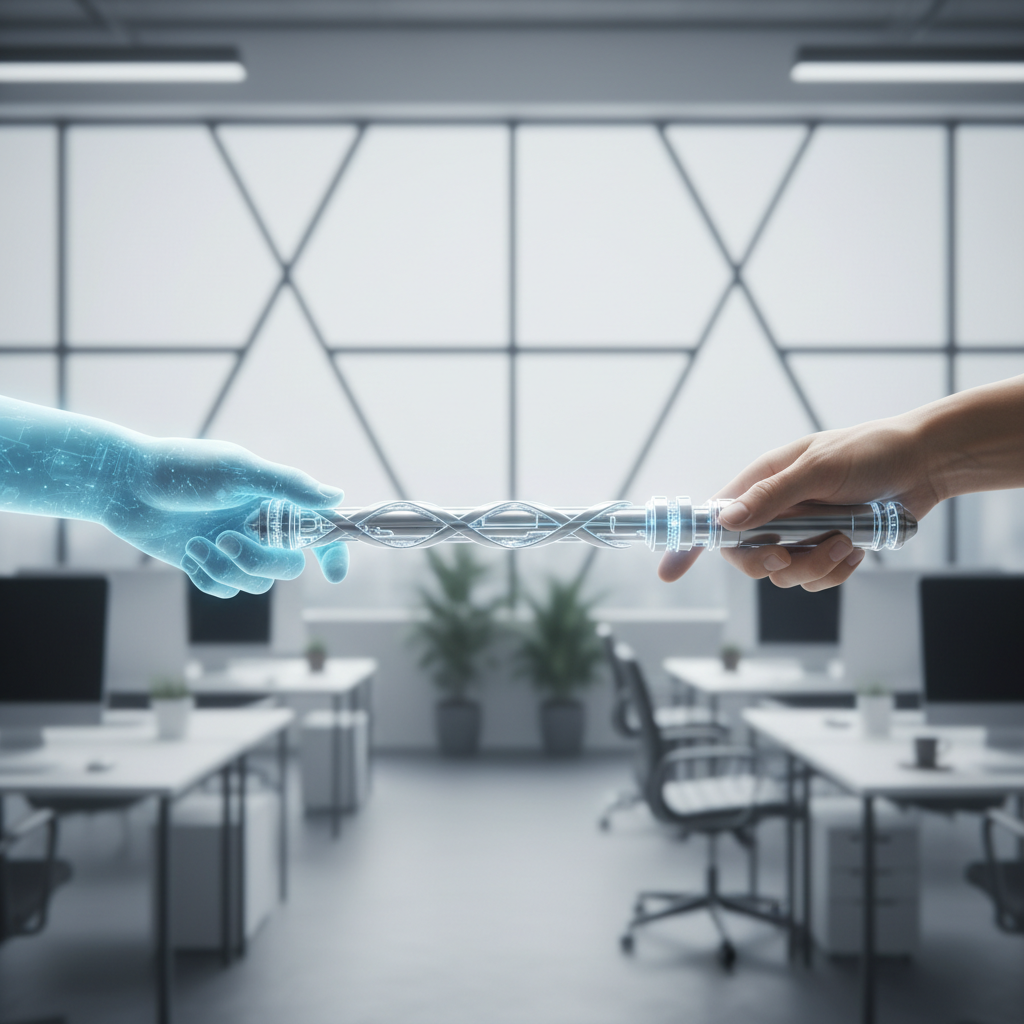
I hadn't handed her a finished draft; I had handed her a black box. My productivity hack had become her collaborative nightmare. This experience taught me a fundamental lesson about working with AI in a team setting. It’s not a solo sprint; it’s a relay race. And in a relay, the most critical part isn't how fast you run your leg, but how cleanly you hand off the baton.
The problem is that AI-generated work, in its raw form, is the antithesis of collaborative. It’s an artifact, not a process. When a human colleague writes a first draft, their knowledge, biases, and research trail are implicitly embedded. You can ask them, “Hey, where did you get this stat?” or “What was your thinking behind this paragraph?” With an AI, you can’t. The work appears fully formed, severed from the creative and analytical journey that produced it. This makes it incredibly difficult for a teammate to pick up, question, edit, or build upon.
This isn't just about catching AI ‘hallucinations’ or factual errors, though that’s part of it. It’s about understanding intent. When I prompted the AI, I had a dozen micro-assumptions in my head. I was leaning towards a certain narrative about customer acquisition costs, a theory I’d been nurturing for weeks. The AI, picking up on my cues, wove that narrative into the report. Anjali, coming in cold, couldn't see my fingerprints. She was just reading a confident, but ultimately opaque, piece of text. For all she knew, it was objective truth, when in reality, it was a co-creation between my own biases and a machine’s predictive power.
So, I changed my entire workflow. I realized I needed to make my process visible. I needed to create a trail of breadcrumbs for my teammates to follow. This has now become my three-step guide to the ‘last mile’ of AI-assisted work, ensuring the baton is passed, not dropped.
First, I maintain a ‘Prompt Log’ for every significant project. This is non-negotiable. It’s a simple document—a shared Google Doc or a page in Notion works perfectly. For every major piece of content I generate, I log the date, the specific AI model I used (e.g., GPT-4, Claude 3 Opus), the full prompt I wrote, and most importantly, a short paragraph titled ‘My Intent.’
Under ‘My Intent,’ I explain *why* I framed the prompt that way. Was I trying to get a devil’s advocate position? Was I looking for data to support a pre-existing hypothesis? Was I just fishing for creative angles? This context is everything. The prompt itself is the ‘what,’ but the intent is the ‘why.’ When Anjali now looks at the Prompt Log, she can see my thought process. She understands that the AI’s output on, say, the UPI revolution's impact on Indian kirana stores, was generated from a prompt specifically asking for a “highly optimistic and disruptive” perspective. She immediately knows the output is skewed by design and can adjust her edit accordingly.
Second, I meticulously annotate the AI-generated output before it ever touches our main working document. Think of this as preparing the raw material for the kitchen. I never, ever just copy and paste a pristine block of AI text and pass it off as a draft. Instead, I bring it into a document and use comments and highlights as a form of meta-commentary.
My annotation system is straightforward. I’ll bracket entire AI-generated sections with a clear note: `[AI-Gen: Initial Draft from Prompt #3 in Log]`. This is the basic flag. Then, I go deeper. If the AI produces a specific statistic, I’ll add a comment: `[Fact-Check Needed: AI claims 300M new digital payment users in India by 2025. Need primary source.]` If a paragraph feels a bit too generic or uses corporate jargon, I’ll flag it: `[Rohan's Note: Rephrase for a more human tone. The AI sounds like a press release here.]` If I suspect the AI's knowledge is outdated, I’ll add a warning: `[Source Check: This analysis of GDPR feels very 2020. We need to verify against recent rulings.]`
This act of annotation transforms the document. It’s no longer a sterile, intimidating block of text. It’s a conversation starter. It’s a map that shows my colleague exactly where her expertise is needed most. I’m not asking her to blindly edit a mystery document; I’m inviting her to apply her critical thinking to specific, flagged areas. I’m respecting her role as a collaborator, not treating her like a proofreading service for my robot assistant.
Third, and this ties it all together, is the creation of a single ‘Source of Truth’ file for the project. In the old days, this was just the draft. Now, it’s a comprehensive package. This central file, again, usually a Google Doc for its powerful collaboration features, becomes our shared workbench.
At the top of this document is the project brief and our key objectives. Below that, I include a direct link to our running Prompt Log. Then, I’ll paste the annotated AI output, with all my comments and flags visible. This is our raw clay. Below that is the clean, work-in-progress version where we collaboratively build the final piece. As we verify facts and find primary sources, we add them to a dedicated ‘Verified Sources’ section at the bottom. The baton is no longer just the text; it's this entire, self-contained ecosystem of context.
This might sound like a lot of extra work. In a way, it is. It adds maybe 30-60 minutes to my initial process. But it saves us hours, sometimes days, of confusion, rework, and painful ‘quick syncs.’ It’s the difference between a shallow productivity gain for me and a deep, systemic efficiency gain for my entire team.
This isn't just a process tweak; it's a cultural shift. The narrative of AI is so often focused on individual empowerment, the ‘10x developer’ or the ‘solo creator’ who can now do the work of a team. But most of us don't work in a vacuum. We work in organizations, in teams spread across cities like Delhi, London, and Singapore. Our work is interconnected. In this global, distributed context, clarity and documentation aren’t nice-to-haves; they are the bedrock of effective teamwork.
My process of logging, annotating, and centralizing the source of truth is my way of domesticating the AI, of bringing it into our team’s culture of transparency. It’s about shifting the focus from the magic of generation to the craft of collaboration. The real power of AI in the workplace won't be unlocked by individuals moving faster on their own, but by teams learning how to integrate these powerful tools into their shared workflows with trust and clarity.
The AI relay race is a team sport. My job as the first runner is not just to get a head start, but to ensure that when I pass the baton, my teammate has everything they need to run their leg with confidence, knowing exactly what’s in their hand and where the finish line is. The output is better, the process is healthier, and my colleagues, well, they actually look forward to my emails now.
Why it matters
- 01Document your AI prompts with context, not just the text, to create a transparent starting point for collaboration.
- 02Annotate AI-generated content to flag areas that need fact-checking, editing, or further development by a human colleague.
- 03Create a central 'source of truth' file for each project that includes prompts, raw output, and the work-in-progress draft.