The Secret Physical Journey of a Single AI Prompt
We think of AI as living in the cloud, but it's deeply physical. This is the story of how one AI prompt travels the globe and the real energy and water it consumes.
This opinion piece was drafted with AI assistance under the editorial direction of Rohan Mehta and reviewed before publication. Views expressed are the author's own.
It’s two in the morning in my Delhi flat. The city outside is finally quiet, and the only light comes from my laptop screen. Like millions of others, I’ve fallen down the rabbit hole of generative AI. Tonight, I’m creating images, trying to stump the machine with prompts born from a mix of late-night absurdity and a distinctly Indian context.
I type: “A Royal Bengal tiger wearing a Nehru jacket, sipping chai on a balcony overlooking a neon-lit Chandni Chowk in the year 2077.” I hit Enter. For a few seconds, there’s a swirl of digital ether on the screen. Then, four images crystallise. They’re not perfect, but they’re mesmerising. The machine understood the cultural cues—the jacket, the chai, the chaotic density of Old Delhi. It feels like magic, like I’ve whispered an incantation into the void and the void has answered with a picture.
But I’m an editor at an AI publication. Part of my job is to look behind the curtain. And as I stare at the picture of the futuristic tiger, I can’t help but ask myself a different question. What just happened? Not in the abstract, digital sense, but in the real, physical world. Where did my little string of text go, and what machinery did it command to bring this image to life?
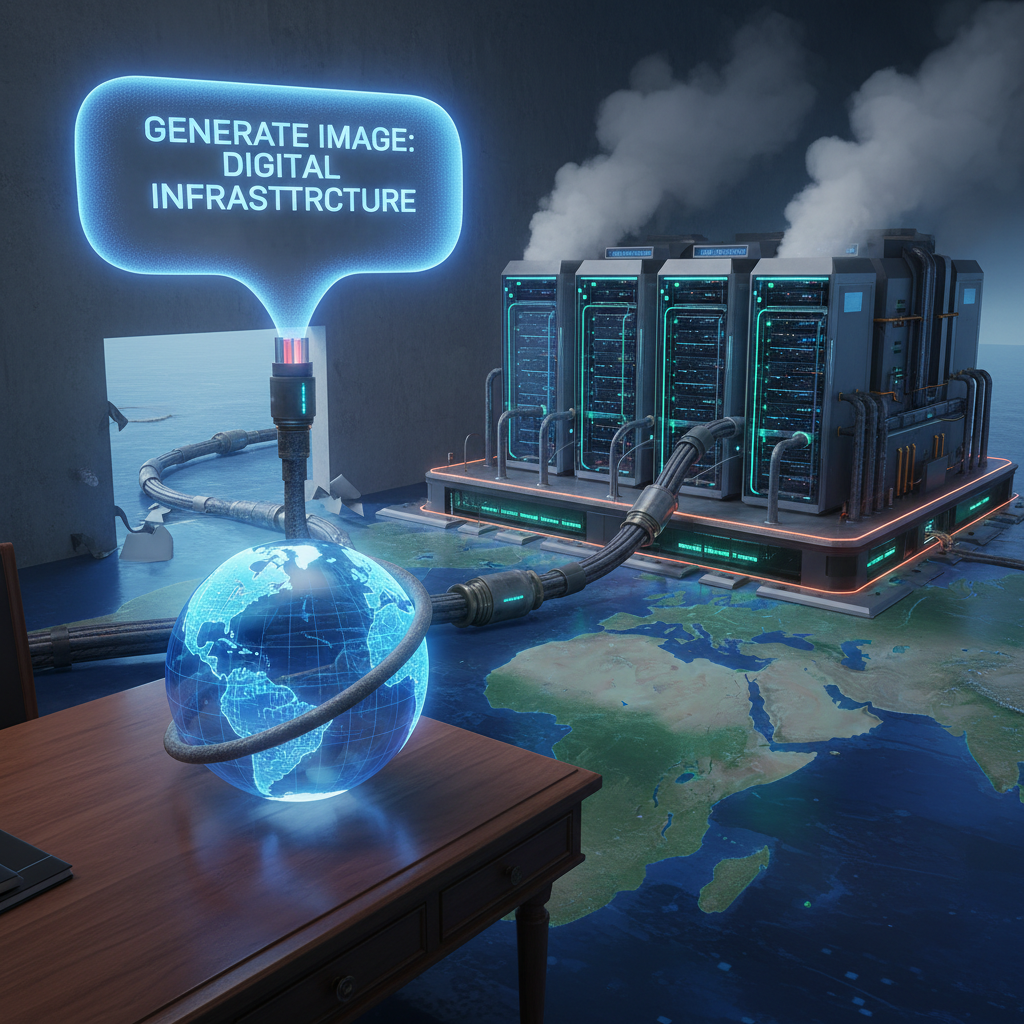
The answer, I’ve come to learn, is far from magical. It’s a story of heavy industry, global logistics, and a surprising thirst for natural resources. My prompt didn’t just vanish into ‘the cloud.’ It took a journey, a physical round trip across the planet that consumed real energy and water.
Let’s trace it. The journey begins on my keyboard in Jor Bagh. My keystrokes become electrical signals, converted into data packets by my laptop. These packets leap wirelessly to my router, which shoots them through a cable into the local network. They join a river of data flowing through fiber optic lines buried beneath the streets of Delhi, heading towards one of India's major data gateways.
Most likely, my prompt is routed west, towards Mumbai. It travels in pulses of light through cables strung alongside railway tracks and national highways, sharing bandwidth with countless WhatsApp messages, banking transactions, and Netflix streams. In Mumbai, it arrives at a drab, highly secure building known as a cable landing station. This is where the internet takes a swim.
My prompt, now just a flicker of light, is multiplexed with millions of other data streams and injected into an undersea fiber optic cable. Maybe it's the IMEWE (India-Middle East-Western Europe) cable or one of the newer systems connecting Asia to the rest of the world. These cables, no thicker than a garden hose, are marvels of engineering. Armoured against sharks and ship anchors, they snake along the ocean floor for thousands of kilometers.
Imagine that. My whimsical idea about a tiger in a jacket is now a beam of light at the bottom of the Arabian Sea, hurtling past the coast of Oman, through the Red Sea, past Egypt via the Suez Canal, and into the Mediterranean. It’s an impossibly fast and silent leg of the journey, covering in milliseconds what once took months by sea.
The prompt might surface in Marseille, France, or continue on to land on the East Coast of the United States. From there, it’s another overland sprint. This time, across continents. The destination is a data center, one of the anonymous, windowless warehouses that form the physical backbone of the cloud. Let’s say my request is handled by one of Google's facilities. It could be in The Dalles, Oregon, on the banks of the Columbia River, or perhaps in Hamina, Finland, a small town on the frigid coast of the Gulf of Finland.
Let’s go with Hamina. My prompt has travelled roughly 15,000 kilometers to arrive at a gigantic former paper mill, repurposed to house racks upon racks of computers. This is where the magic trick is actually performed, and it is anything but delicate. This is a factory.
Inside, my data packet is routed to a specific server. The server’s main processor, its CPU, acts as a traffic cop. It sees the request is for image generation and sends it to the real workhorses: a bank of specialised chips called Graphics Processing Units, or GPUs. These are the power-hungry beasts at the heart of the AI boom.
The GPUs get to work. First, they load a colossal piece of software—the generative model itself—into their memory. This model, which has been trained on billions of images, contains a statistical understanding of our visual world. The GPUs then perform an astonishing number of calculations, a process called inference. They mathematically deconstruct my prompt—”tiger,” “Nehru jacket,” “chai,” “Chandni Chowk”—and synthesise a new image pixel by pixel based on the patterns it has learned.
This is the moment of peak consumption. A single high-end GPU can draw as much power as a small microwave oven running at full tilt. Answering my prompt requires a cluster of these GPUs working in concert. The energy required for this single act of creation is not trivial. Some studies suggest that generating a single AI image consumes as much electricity as charging your smartphone. If I sit there for an hour, generating dozens of variations, my creative session has the energy footprint of leaving an LED bulb on for a full day, or more.
All that computation, all those trillions of calculations per second, produces one major byproduct: heat. The GPUs in Hamina are now blazing hot. If that heat isn't removed, they will cook themselves into oblivion. This is where the second, and arguably more critical, resource comes into play: water.
Every major data center is, in essence, a sophisticated cooling plant. In many facilities, especially in warmer climates like Arizona or Texas, this involves pumping millions of liters of fresh water into cooling towers. The water absorbs the heat from the servers and is then evaporated into the atmosphere. This is ‘consumptive’ water use; the water is gone from the local ecosystem forever.
Researchers estimate that a simple conversation with a model like ChatGPT, involving 10-50 short prompts and responses, can ‘drink’ a 500ml bottle of water. Image generation is even more intensive. My single image of a chai-sipping tiger effectively cost a glass of water to cool the hardware that made it.
Google’s Hamina data center is cleverer than most. It uses a pioneering system that pulls in frigid seawater from the Gulf of Finland to cool the facility. This is far more energy-efficient and doesn't consume precious freshwater. But it underscores the fundamental point: these digital factories have an umbilical connection to a physical place and its resources. Whether it’s seawater from the Gulf of Finland or fresh water from the drought-stricken Colorado River, the cloud is anchored to the earth.
Once the image is rendered—a process that took a few seconds but an immense amount of energy—the journey reverses. The image file, a packet of data representing my tiger, is sent from the server in Finland back onto the global fiber network. It retraces its path, under the sea, across the land, back to the exchange in Mumbai, through the terrestrial cables to Delhi, to my router, and finally, onto my screen.
The entire round trip, a journey of 30,000 kilometers through some of the most complex infrastructure ever built, is completed in the time it takes to blink. The sheer speed masks the physicality of it all.
I look at the image again. It is no longer an ethereal creation conjured from nothing. I see the silicon in the GPUs, forged in a foundry in Taiwan. I see the copper wiring. I see the ghost of the electricity, perhaps generated by a hydroelectric dam or a natural gas plant. I see the cool water of the Finnish sea. My prompt didn't just create an image; it set a global industrial process in motion.
This realisation isn't meant to be a condemnation of AI. I remain an optimist. This technology holds incredible promise. But we do ourselves a disservice by mythologising it. Calling it ‘the cloud’ was a brilliant marketing move, suggesting something weightless, clean, and infinite. The reality is a network of colossal, power-hungry, water-guzzling factories. Factories that are, for now, essential for this new industrial revolution.
Thinking this way changes our relationship with the technology. It encourages us to ask important questions. How can we make the models more efficient? How can we power these data centers with truly renewable energy? How can we reduce their thirst for water in a world facing increasing scarcity? It makes us conscious consumers, not just passive users.
Every time you ask an AI to write a poem, summarise a document, or generate a picture, you are kicking off a physical process. You are placing an order with a factory thousands of miles away. It’s an amazing thing to be able to do. But it's not magic. And it's not free. It has a footprint, written not in code, but in kilowatts and liters.
Why it matters
- 01AI is not an abstract cloud service but a physical industrial process that happens in massive data centers.
- 02Every AI query consumes significant energy for computation and vast amounts of water for cooling server hardware.
- 03Understanding the material cost of AI is crucial for developing and using this technology sustainably.