Your Smartwatch Is Judging You: What Its AI Really Sees
A low readiness score from my fitness tracker changed my entire day. This is a look inside the physiological AI that interprets your every move and breath.
This opinion piece was drafted with AI assistance under the editorial direction of Rohan Mehta and reviewed before publication. Views expressed are the author's own.
It was a Tuesday morning in Mumbai. I woke up feeling… well, normal. The usual mix of grogginess and the distant hum of the city coming to life. I felt ready to tackle the day, which in my line of work involves a dizzying mix of data, deadlines, and far too much coffee. As I reached for my phone, my wrist buzzed. It was my smartwatch, presenting its morning report. And there it was, in stark, unforgiving numbers: ‘Readiness Score: 42. Low. Prioritise recovery.’
I stared at the screen. Forty-two? That’s not a score; it’s an indictment. My own body, I felt, was perfectly fine. But this little puck of glass and silicon, this constant companion on my wrist, was telling me otherwise. It was judging me. And I have to admit, it completely derailed me. The confident stride I was about to take into my day faltered. Should I cancel my evening gym session? Should I skip that high-stakes meeting? Is that slight tickle in my throat the beginning of a cold the watch detected before I did? That single number, generated by an invisible intelligence, had planted a seed of doubt that coloured my entire day.
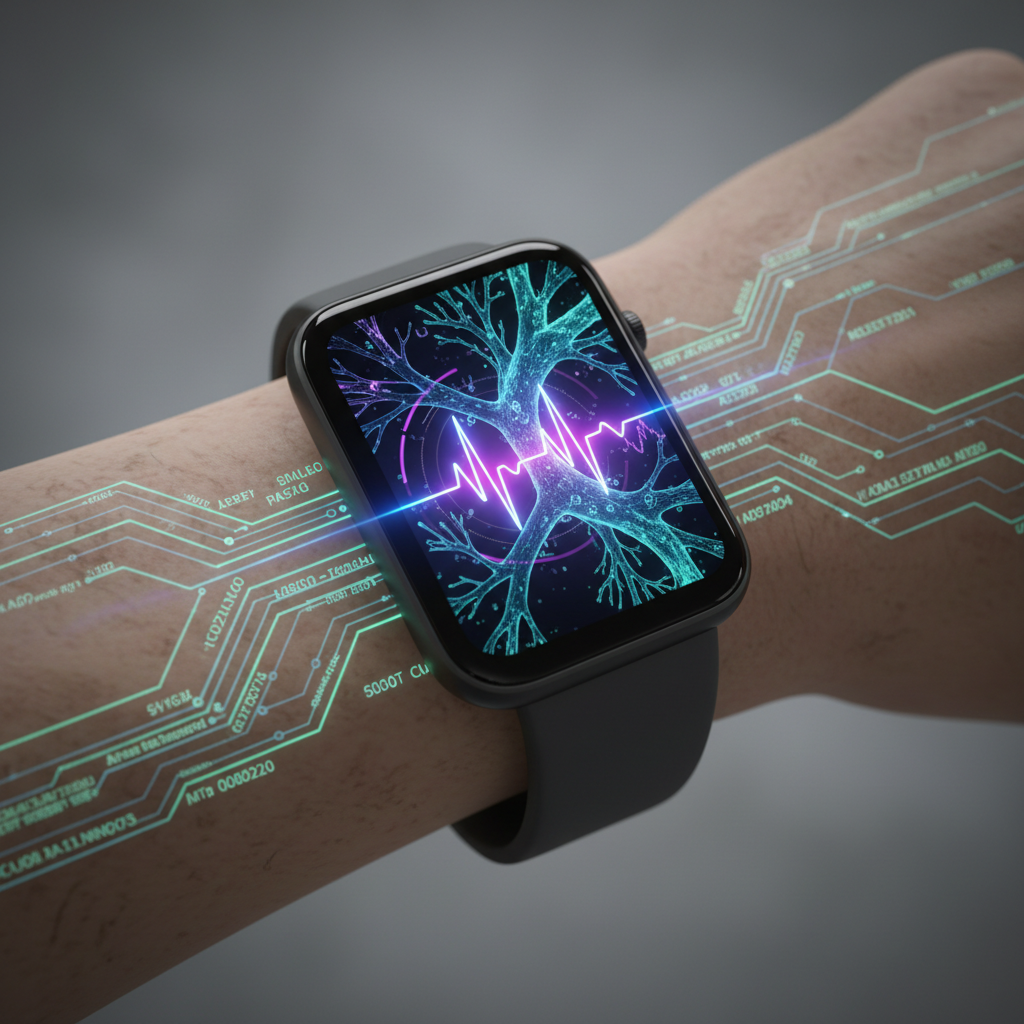
This experience isn’t unique to me. Millions of us in India and across the world are now wearing these devices. We glance at them for the time, for notifications, but increasingly, we look to them for something much deeper: a verdict on our own well-being. We’ve become accustomed to seeing our steps counted and our heart rate displayed. But the new generation of wearables goes much further. They don’t just present data; they offer judgment. Scores for ‘Sleep Quality,’ ‘Stress,’ and ‘Readiness’ are the new frontiers of personal data, and they are powered by a form of artificial intelligence you might not even know you're wearing: physiological AI.
So what is this invisible engine, and how does it arrive at a number like 42? It’s not magic, but it is incredibly complex. It starts with the sensors, the silent observers constantly collecting data from your body.
The most visible one is the array of green lights that periodically flashes on the underside of your watch. This is a technology called photoplethysmography, or PPG. It sounds complicated, but the principle is simple. It shines light into your skin and measures how much of it is absorbed or reflected back. Since blood absorbs green light, the sensor can detect the volumetric changes in your blood vessels with each heartbeat. This is how it measures your heart rate. But it’s what the AI does with this information that is truly transformative.
It isn’t just looking at the number of beats per minute. It’s looking at the time *between* the beats. This is called Heart Rate Variability, or HRV. You might think a healthy heart beats like a metronome, but the opposite is true. A healthy, well-rested nervous system allows for subtle, constant variations in the timing between heartbeats. A higher HRV is a sign of resilience, of your body’s readiness to adapt to stress. A consistently low HRV can signal physical or psychological stress, fatigue, or impending illness. Your watch tracks this all night while you sleep, and a lower-than-usual HRV is a major red flag for its readiness algorithm.
Then there’s the accelerometer and gyroscope, the same technology that lets your phone know whether you’re holding it in portrait or landscape. On your wrist, these sensors are master motion detectors. They track the subtlest of movements. When you’re asleep, they’re logging every toss and turn. The AI combines this movement data with your heart rate data to make an educated guess about your sleep stages. Less movement and a lower heart rate might indicate deep sleep, while the presence of rapid eye movement (also inferred from sensor patterns) and a more active heart rate could signal REM sleep. It's an estimation, of course—the gold standard is a lab-based polysomnography with electrodes glued to your head—but it’s getting scarily accurate.
More recent devices also include skin temperature sensors. The AI isn't interested in the absolute temperature of your bedroom; it's interested in the *change* in your skin temperature relative to your own personal baseline, which it learns over several weeks. A sudden spike in your overnight temperature trend can be a powerful, early indicator that your body is fighting off an infection, days before you ever feel a symptom. For women, it can also map these temperature shifts to menstrual cycles, offering another layer of physiological insight.
Finally, some watches have what’s called an Electrodermal Activity (EDA) sensor. This measures microscopic changes in the sweat levels on your skin, a direct line to your sympathetic nervous system—the one responsible for your 'fight or flight' response. When you're stressed, you sweat more, even if it's imperceptible. The AI uses this to give you a ‘Stress Score,’ quantifying your physiological response to a demanding meeting or a traffic jam in Bangalore.
This is the crux of it. The AI takes these disparate streams of raw, noisy data—HRV, resting heart rate, respiratory rate, movement, skin temperature—and fuses them together. It’s a powerful act of synthesis. The AI models are trained on colossal datasets, learning the complex correlations between these sensor readings and clinically validated states of health, stress, and sleep quality.
Crucially, the AI builds a personalised baseline *for you*. My normal is not your normal. A resting heart rate of 55 might be excellent for me but a sign of a problem for someone else. The algorithm spends weeks learning the unique rhythm of your life, your personal ‘normal.’ The scores it gives you are not just based on a generic model, but on how your current state compares to your own history. That ‘Readiness Score: 42’ was the AI telling me, ‘Rohan, compared to your usual self, something is off today. Your HRV is lower, your resting heart rate is higher, and your skin temperature is elevated.’
This brings us back to my Tuesday morning. Did the watch predict my subpar day, or did it, in fact, cause it? This is the double-edged sword of physiological AI. On one hand, this technology is a revolutionary tool for preventative health. It gives us a language for sensations we’ve always felt but could never quantify. That feeling of being ‘off’ can now be correlated with hard data. In a country like India, with a growing burden of lifestyle diseases, democratising access to this kind of continuous health monitoring could be transformative. It’s an early warning system on your wrist.
But there is a danger. The danger is that we begin to trust the number more than we trust ourselves. We outsource our own bodily intuition to an algorithm. This can create a feedback loop of anxiety. You see a low score, you feel anxious about it, that anxiety raises your stress levels, which the watch then dutifully logs, potentially leading to another low score tomorrow. We risk becoming passive consumers of our own health data rather than active participants in our well-being.
The global context also matters. These algorithms are designed in Silicon Valley, trained predominantly on Western datasets. How well do they generalise to the incredible diversity of a population in India? Does the model account for the physiological effects of a different diet, a humid climate in Kerala, or the high altitude of Ladakh? These are questions the industry is still grappling with.
So what did I do? I didn't cancel my meeting, but I did approach it with a little more mindfulness, managing my energy more carefully. I swapped my intense evening workout for a long walk. I made a point to hydrate more and went to bed thirty minutes earlier. Essentially, I didn’t treat the score of 42 as a final verdict. I treated it as the start of a conversation.
The watch said: ‘Hey, something’s up.’
I asked myself: ‘Okay, why might that be? Did I eat late last night? Was that extra glass of wine a bad idea? Am I worried about that upcoming project?’
This, I believe, is the wisest way to interact with the judgments of our new AI companions. They aren't oracles, and they aren't sentient beings passing moral judgment. They are sophisticated pattern-matching machines. They provide an extraordinary new lens through which to view ourselves, but it is still just one lens. The data is a reflection, not the reality. The ultimate power still resides with us—to listen to our bodies, to use this data as a clue rather than a conclusion, and to weave these new digital signals into the ancient, complex tapestry of human intuition.
Why it matters
- 01Wearable AI uses sensors to translate raw data like heart rate variability and skin temperature into scores for stress and readiness.
- 02These AI-driven scores are not facts but statistical interpretations based on your personal baseline and large population datasets.
- 03The key is to use this data as a tool to prompt self-reflection, not as an absolute judgment that replaces your own intuition.